New Interactive Map Shows How a Shrinking Great Salt Lake Is Increasing Dust Exposure Across Northern Utah
The Great Salt Lake has been shrinking for years, and most people living along Utah’s Wasatch Front already understand the basic concern: as the lake recedes, more dry lakebed is exposed, and that exposed surface can turn into unhealthy dust that gets blown into nearby communities. What has been missing until now is a clear, data-driven way to see exactly how changes in lake levels translate into real-world dust exposure.
That gap is what a newly released interactive mapping tool from the University of Utah aims to fill.
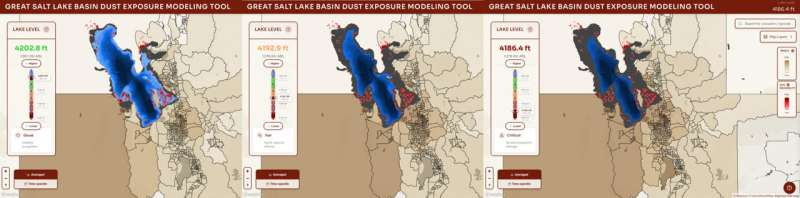
Developed by researchers and hosted by the Wilkes Center for Climate Science & Policy, the Great Salt Lake Basin Dust Exposure Tool allows users to visualize how different lake water levels affect dust emissions and where that dust is most likely to travel during storm events. The result is a practical, science-based way to understand why lake elevation matters so much for air quality, public health, and policy decisions in northern Utah.
What the Great Salt Lake Dust Exposure Tool Does
At its core, the tool lets users adjust the water level of the Great Salt Lake and instantly see how much lakebed becomes exposed under those conditions. As the lake level drops, more playa—dry, fine-grained sediment left behind by the retreating water—appears on the map. These newly exposed areas are major contributors to airborne dust during high-wind events.
The tool goes a step further by modeling how dust from those exposed areas is transported to nearby communities, especially along the Wasatch Front. Users can see which neighborhoods, cities, and census tracts are most affected when dust storms occur under different lake-level scenarios.
This isn’t a simple visualization. It is a data-based model built from real atmospheric measurements and geographic data, designed to show how environmental change translates into human exposure.
Who Built It and How It Was Supported
The dust exposure tool was developed by University of Utah atmospheric scientists Derek Mallia and Kevin Perry. Their work was supported through a project funded by Utah’s Department of Natural Resources, reflecting the state’s growing concern over the lake’s decline and its broader impacts.
The Wilkes Center for Climate Science & Policy hosts the tool and its accompanying story map, which explains the science behind the model and the reasons dust from the Great Salt Lake is such a pressing issue.
The project also aligns with broader state planning efforts, including the Great Salt Lake Basin Integrated Plan, which aims to guide long-term decisions about water use, conservation, and lake restoration.
What Data the Model Is Based On
The current version of the tool relies primarily on PM2.5 data from spring 2022. PM2.5 refers to fine particulate matter that is small enough to be inhaled deep into the lungs and is associated with respiratory and cardiovascular health risks.
According to the researchers, spring 2022 was not an outlier. Additional dust event data from 2018 through 2023 is being prepared for inclusion in future updates, and early analysis suggests that the patterns observed in 2022 are consistent across multiple years.
This expanded dataset will strengthen confidence in the model’s conclusions and allow users to explore dust exposure across a wider range of historical conditions.
Why Lake Level Matters So Much for Dust
One of the clearest takeaways from the model is how closely dust emissions are tied to lake elevation.
When the Great Salt Lake is at lower levels, large areas of lakebed are exposed. Many of these areas are highly erodible, meaning wind can easily lift dust into the atmosphere. As lake levels rise, those same dust “hotspots” become submerged, dramatically reducing their ability to generate airborne particles.
The tool visually demonstrates this relationship by showing how dust production changes as users raise or lower the lake’s elevation. The effect is not subtle. Even modest changes in water level can significantly alter how much dust reaches nearby communities.
Dust Does Not Come Only From the Great Salt Lake
An important feature of the tool is that it does not treat the Great Salt Lake as the only dust source affecting northern Utah.
The model also includes dust contributions from other parts of the Great Basin, such as Sevier Lake, Tule Dry Lake, and areas of the West Desert. This broader perspective shows that even when the Great Salt Lake reaches what might be considered “good” or healthier levels, PM2.5 concentrations can still remain elevated due to dust transported from elsewhere.
This matters because it underscores the complexity of regional air quality. Restoring the Great Salt Lake can significantly reduce dust exposure, but it will not eliminate the problem entirely without addressing other dust-producing landscapes.
Why This Matters for Public Health
Dust from dry lakebeds is not just a nuisance. Fine particles like PM2.5 are linked to asthma, lung disease, heart problems, and other serious health issues. Communities downwind of major dust sources often face higher risks, especially during prolonged dry and windy periods.
By showing which areas are most affected under different conditions, the tool helps policymakers, planners, and public health officials better understand who is exposed, when, and why. It also highlights gaps in existing dust monitoring networks by revealing exposure patterns in areas without permanent sensors.
A Tool for Policymakers, Not Just Scientists
While the tool is rooted in academic research, its intended audience goes far beyond scientists. The Wilkes Center and its partners emphasize that the goal is to put cutting-edge scientific information into the hands of the public and decision-makers.
The Wilkes Center is also a lead organization behind the Great Salt Lake Strike Team, which recently released its 2026 Data and Insights Summary. That report concluded that delivering more water to the Great Salt Lake is more cost-effective than trying to manage the long-term impacts of a permanently low lake, including dust, ecosystem loss, and economic damage.
The dust exposure tool directly supports that conclusion by showing the tangible consequences of inaction.
A Work in Progress With More Updates Ahead
The researchers behind the tool are clear that it is not finished. As more data becomes available and modeling techniques improve, the tool will continue to evolve. Future updates are expected to refine dust transport estimates, incorporate additional years of observations, and improve how different sources interact during complex weather events.
This openness about uncertainty is part of what makes the project valuable. Rather than presenting a static answer, the tool encourages users to explore scenarios, ask questions, and better understand the trade-offs involved in managing water and land in a drying region.
Why the Great Salt Lake’s Decline Is a Bigger Picture Issue
The shrinking of the Great Salt Lake is driven by a combination of long-term drought, climate change, and human water diversions. Similar situations elsewhere, such as California’s Owens Lake, have shown how quickly exposed lakebeds can become massive dust sources if not managed carefully.
What makes the Great Salt Lake especially important is its proximity to major population centers. Millions of people live downwind of the lake, making dust exposure not just an environmental issue but a public health and economic concern.
Research Reference
Great Salt Lake Basin Dust Exposure Modeling Tool and associated research
https://wilkescenter.utah.edu/great-salt-lake/