New Predictive Tool Maps Future Road Expansion, Deforestation and Disease Hotspots in Tropical Forests
Researchers have developed a new scientific tool that can reliably predict where new roads are likely to expand into tropical forests, long before those roads appear on official maps. This matters because roads are one of the strongest drivers of deforestation, ecological disruption, and emerging disease risks, especially in biodiversity-rich regions of the world.
The research was co-authored by Distinguished Research Professor Bill Laurance from James Cook University, along with an international team of scientists. Their findings were published in the prestigious journal Proceedings of the National Academy of Sciences (PNAS) in 2025.
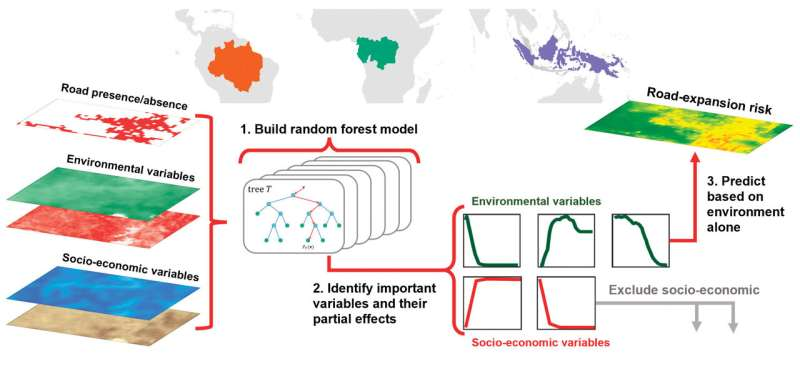
At its core, the study introduces a road expansion risk index, a predictive model designed to identify areas most vulnerable to future road building. By flagging these high-risk zones early, the tool offers environmental groups, governments, and public health officials a valuable head-start in protecting forests and preparing for potential disease outbreaks.
Why Roads Matter More Than We Often Realize
Roads do far more than simply connect places. In tropical regions, they often act as gateways for deforestation, opening previously inaccessible forests to logging, mining, agriculture, and settlement. Once a road appears, forest loss tends to accelerate rapidly around it.
According to the researchers, Earth is currently experiencing an unprecedented surge in road construction. Around 25 million kilometers of new paved roads are expected globally by the middle of this century, and nearly 90% of that construction is happening in developing countries. Many of these areas are located in tropical and subtropical regions that host exceptional biodiversity and play a critical role in regulating the global climate.
A major challenge is that many roads — both legal and illegal — never appear in government databases. Mapping studies in places like the Brazilian Amazon and the Asia-Pacific region have repeatedly found that the actual length of roads can be up to 13 times greater than what official records report. This gap makes it extremely difficult to anticipate where deforestation and related impacts will occur next.
How the New Tool Works
Instead of relying on incomplete road maps, the new tool takes a different approach. It uses a large, global dataset to identify the environmental factors that consistently influence where roads tend to be built.
The study found that road construction is most strongly shaped by:
- Rainfall patterns
- Soil characteristics
- Topography
- Proximity to rivers
These natural factors were analyzed while also accounting for local socioeconomic and administrative conditions, ensuring that the predictions were not overly simplistic or detached from real-world governance and development pressures.
By combining all of these elements, the model produces a risk index that highlights areas where road expansion is most likely to occur in the future — even in regions with little or no existing road data.
This makes the tool especially valuable for remote tropical forests, where on-the-ground monitoring is difficult and official infrastructure records are often outdated or nonexistent.
Predicting Deforestation Before It Happens
One of the most important applications of the tool is its ability to predict future deforestation frontiers. Because roads are such strong and consistent predictors of forest loss, identifying where roads are likely to appear provides a powerful way to anticipate where deforestation pressure will intensify next.
This proactive capability represents a major shift from traditional conservation strategies, which often respond after forest destruction has already begun. With this index, governments and conservation organizations can focus resources on high-risk areas early, potentially preventing irreversible damage.
The researchers emphasize that this approach could significantly improve land-use planning, environmental impact assessments, and enforcement efforts in tropical regions facing rapid infrastructure expansion.
Links Between Roads and Disease Risk
Beyond deforestation, the study highlights another critical — and often overlooked — consequence of road expansion: public health risk.
Roads frequently act as vectors for human pathogens. By increasing access to remote ecosystems, they bring people into closer contact with wildlife, raising the likelihood of zoonotic spillover events, where diseases jump from animals to humans.
The researchers suggest that the road expansion risk index could help identify zones vulnerable to emerging infectious diseases, offering public health officials an additional tool for surveillance and prevention.
In a world still grappling with the consequences of recent pandemics, the ability to anticipate where environmental disruption might trigger new disease outbreaks is increasingly important.
Invasive Species and Ecological Side Effects
Roads also create ideal conditions for invasive weeds and feral animals, which often thrive along disturbed corridors. Once established, these species can spread rapidly into surrounding ecosystems, outcompeting native plants and animals.
By mapping likely road expansion routes, the new tool may also help predict future invasion pathways, allowing land managers to intervene before invasive species gain a foothold.
Why This Matters for Global Conservation Efforts
The researchers believe this predictive index could transform conservation strategies at multiple levels. Governments, non-governmental organizations, and international agencies could use it to:
- Prioritize conservation funding
- Strengthen land-use regulations
- Design protected areas more strategically
- Balance infrastructure development with environmental protection
As global demand for roads continues to grow, such tools are becoming essential for ensuring that development does not come at the cost of irreversible forest loss and ecological collapse.
A Broader Look at Road Expansion and Tropical Forests
Road-driven deforestation has long been recognized as one of the most significant threats to tropical forests. Roads fragment habitats, increase forest edge effects, and make forests more vulnerable to fire and illegal exploitation.
What makes this new research stand out is its forward-looking nature. Instead of documenting damage after it occurs, the study provides a scientifically grounded way to anticipate risk, giving decision-makers the opportunity to act early.
As infrastructure development accelerates worldwide, especially in the Global South, predictive tools like this one are likely to play an increasingly central role in shaping sustainable development policies.
Research Reference
Road expansion risk predicts future hotspots of tropical deforestation
Proceedings of the National Academy of Sciences (2025)
https://doi.org/10.1073/pnas.2502426122