Record 2023 Wildfire Smoke Signals a Long-Term Shift in North American Air Quality
North America is entering an era of smokier summers, and the record-breaking wildfire season of 2023 may be a preview of what lies ahead. A new scientific analysis drawing on 70 years of air quality data shows that the unprecedented smoke from Canadian wildfires in 2023 was not a one-off disaster. Instead, it reflects a long-term, continent-wide shift in how and why air quality is worsening across both Canada and the United States.
The study finds that while air pollution from factories and vehicles has declined in many regions, especially in eastern North America, wildfire smoke is now emerging as the dominant threat to summer air quality, particularly in the west and north. This marks a major change in the forces shaping the air people breathe.
A continent-wide change decades in the making
For much of the late 20th century, air quality trends across North America followed a relatively clear pattern. Industrial emissions from power plants, factories, and vehicles drove pollution levels, especially in the east. Over time, environmental regulations such as the Clean Air Act and its amendments starting in 1970 led to significant reductions in sulfur dioxide and nitrogen oxide emissions. As a result, summer air quality steadily improved in eastern Canada and the eastern United States from the 1970s through the early 2000s.
But the new analysis shows that this improvement came with an unexpected counterpart. Beginning in the 2000s, western and northern Canada began to experience worsening summer air quality, not because of industry, but because of more frequent and more intense wildfires. The study describes this as a clear east-to-west shift in air quality concerns across the continent.
In simple terms, the problem has moved. Pollution controls cleaned up the air in the east, but a warming climate has made the west increasingly vulnerable to large fires and persistent smoke.
Why 2023 stands out so sharply
The wildfire season of 2023 was historic by nearly every measure. According to the study, nearly 15 million hectares burned across Canada, an area roughly the size of New York State and more than twice the previous national record. Twelve out of Canada’s thirteen provinces and territories experienced their worst wildfire smoke levels ever recorded.
To understand how unusual this was, researchers combined multiple long-term data sources:
- Satellite observations from five different instruments, some dating back to 2001
- Weather station reports of “smoke” and “haze” reaching back to 1953
- National burned-area records beginning in 1959
Together, these datasets paint a consistent picture. In 2023, Canada recorded the highest smoke levels in over 20 years of satellite monitoring and the most widespread smoke and haze reports in seven decades of surface observations.
On average, smoke or haze was reported during about 4.3% of summer days in 2023, equivalent to roughly seven days. That may sound small, but it is more than double the previous record and over seven times higher than the long-term average.
Smoke didn’t stop at the border
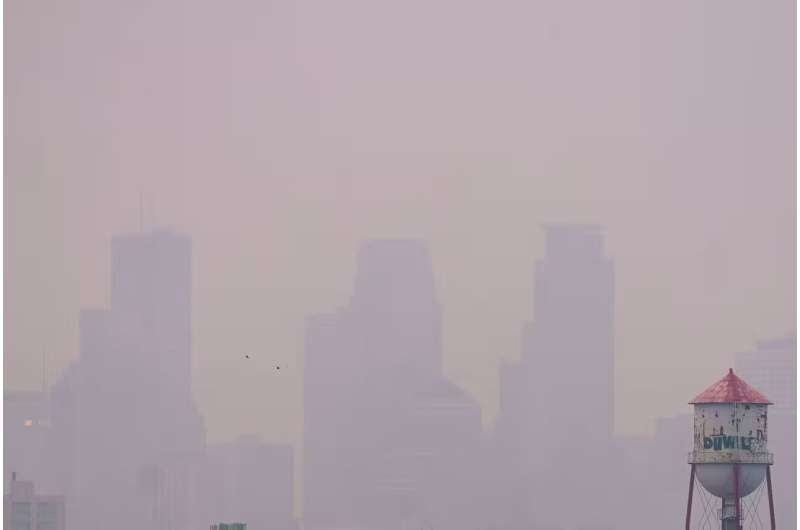
One of the most visible impacts of the 2023 fires was how far the smoke traveled. Thick smoke blanketed major U.S. cities, triggering air quality warnings in places such as Minneapolis, Chicago, New York, and Washington, D.C. The study highlights that wildfire smoke does not respect national borders, making it a shared North American problem rather than a strictly Canadian one.
This cross-border spread reinforces a key conclusion of the research: fire-driven air pollution is now a dominant factor in summer air quality across much of the continent, including regions that historically did not face severe wildfire smoke.
Climate change and fire-friendly conditions
The analysis places the 2023 wildfire season within the broader context of climate change. While the researchers did not perform a new climate attribution study themselves, they draw on earlier work showing that hotter, drier conditions made the 2023 fires more likely, especially in eastern Canada during May and June.
Climate projection studies reviewed in the paper suggest that warming is likely to continue producing drier, more fire-prone summers across many parts of Canada. Although the exact regional impacts may vary, these projections align closely with the sharp increase in burned area observed over the past decade.
Notably, the trend did not stop in 2023. Preliminary data show that wildfires burned nearly 5 million hectares in 2024 and around 8 million hectares in 2025, reinforcing concerns that extreme fire seasons are becoming more frequent rather than exceptional.
A public health challenge unlike traditional pollution
One of the study’s most important points is that wildfire smoke cannot be controlled in the same way as industrial pollution. Factories and vehicles can be regulated at the source. Wildfires, driven by weather and climate, cannot.
This makes smoke a particularly difficult public health challenge. Previous research cited by the study shows that wildfire smoke has caused significant health problems in Canada and other countries. One recent analysis estimates that smoke exposure contributes to around 40,000 deaths each year in the United States alone.
Fine particulate matter from wildfire smoke can worsen asthma, trigger heart attacks, and increase the risk of stroke, especially among children, older adults, and people with existing health conditions.
Preparing for smokier summers
The findings suggest that communities across North America must adapt to a future where wildfire smoke is a recurring feature of summer life. Better smoke monitoring and forecasting can provide early warnings, helping people reduce exposure during severe events.
However, the study emphasizes that long-term resilience will require broader measures. These include access to clean indoor air, such as home air filtration systems, public clean-air shelters, and improved building standards that reduce smoke infiltration.
The wildfire season of 2023 demonstrated that even regions far from traditional fire zones are vulnerable, making coordinated policies and public health strategies increasingly urgent.
Understanding wildfire smoke and air quality
Wildfire smoke is a complex mixture of gases and tiny particles. The most harmful component for human health is PM2.5, fine particles small enough to penetrate deep into the lungs and even enter the bloodstream. Unlike typical urban smog, wildfire smoke can persist for days or weeks and spread thousands of kilometers from the source.
Climate change influences wildfire smoke in several ways. Higher temperatures dry out vegetation, creating more fuel. Earlier snowmelt and longer summers extend the fire season. Together, these factors increase the likelihood of large, long-lasting fires that generate massive smoke plumes.
The research makes one thing clear: the air quality story of North America is no longer just about tailpipes and smokestacks. Wildfire smoke has become a defining environmental and public health issue of our time, and the record-breaking events of 2023 may be a sign of what future summers will increasingly bring.
Research paper:
https://doi.org/10.1029/2025EF007041