Scaling Up Actionable Climate Knowledge Gets a Clear Framework From University of Michigan Researchers
Climate change is no longer a distant or abstract issue. Communities everywhere are already dealing with flooding, heat waves, water shortages, and infrastructure risks. While climate science has produced an enormous amount of data, a persistent challenge remains: how to turn that knowledge into something people can actually use at scale. A new study led by researchers at the University of Michigan takes a direct look at this problem and offers a structured way forward.
Published in the Proceedings of the National Academy of Sciences (PNAS), the research identifies three key pathways for scaling up actionable climate knowledge. The study does not claim there is a single solution that works everywhere. Instead, it provides a flexible framework that helps researchers, policymakers, and communities understand how climate information can move beyond reports and models and into real-world decision-making.
What the Study Is Really About
At its core, this research focuses on actionable climate knowledge. This refers to climate information that is not only scientifically sound, but also usable, trusted, and applied by people making decisions. That includes city planners, local governments, emergency managers, community organizations, and others who need climate insights to guide planning and investments.
The researchers analyzed existing academic literature and combined it with their own extensive experience working on climate adaptation projects across the United States. Their goal was to identify patterns in what actually helps climate knowledge spread and have impact, rather than staying limited to small pilot projects or academic circles.
One of the main takeaways is simple but powerful: scaling up climate knowledge almost always requires involving more people, and doing so in deliberate ways.
The Three Pathways to Scaling Climate Knowledge
The study outlines three distinct but complementary pathways. These pathways often overlap, and projects may use more than one at the same time.
1. Broadening Participation in Climate Knowledge Creation
The first pathway focuses on who is involved in creating climate information. When more people, especially those from diverse backgrounds and roles, participate in the process, the resulting knowledge is more likely to be relevant and useful.
Broad participation can include community members, local officials, scientists from different disciplines, planners, and practitioners. Their input helps ensure that climate tools and data reflect real needs rather than theoretical assumptions.
The researchers emphasize that this approach often leads to stronger trust. People are more likely to use climate information when they feel it reflects their lived experience and local realities. Broad participation also helps surface challenges and priorities that scientists alone might overlook.
2. Diffusing Climate Knowledge Through Decision-Support Tools
The second pathway centers on making climate knowledge easier to access and apply. Even well-designed climate information can remain underused if it is difficult to interpret or disconnected from everyday decisions.
To address this, the study highlights the role of online decision-support tools, interactive platforms, and other practical resources that translate climate data into clear insights. These tools allow people who were not involved in the original research process to still benefit from the knowledge.
Diffusion does not mean simply publishing information online. It involves thoughtful design, clarity, and usability, so that decision-makers can quickly understand risks, trade-offs, and options without needing specialized training.
3. Aggregating Impact Through Influential Decision-Makers
The third pathway looks at scale through influence. Instead of reaching everyone directly, climate knowledge can spread by engaging individuals or institutions whose decisions affect many others.
Examples include policymakers, government agencies, utility providers, and large organizations. When these actors adopt climate-informed approaches, the impact cascades outward to communities, businesses, and individuals who are affected by their decisions.
This pathway recognizes that influence and authority matter. Securing buy-in from key decision-makers can dramatically increase the reach of climate knowledge, even if the initial group of participants is relatively small.
A Simple Example That Makes the Framework Click
To explain these ideas in a relatable way, the researchers use a workplace potluck organized around a federal holiday.
The designation of a federal holiday represents aggregated impact, since government decisions influence employers nationwide. A planning committee that includes people from different departments demonstrates broadened participation, ensuring the event appeals to many. Using email invitations or digital tools to notify employees reflects diffusion of information.
While the example is intentionally simple, it shows how these pathways naturally appear in everyday situations, making the framework easier to understand and apply to climate challenges.
FloodWise Communities as a Real-World Case Study
The study draws heavily on a real project known as FloodWise Communities, developed with the involvement of Great Lakes Integrated Sciences and Assessments (GLISA).
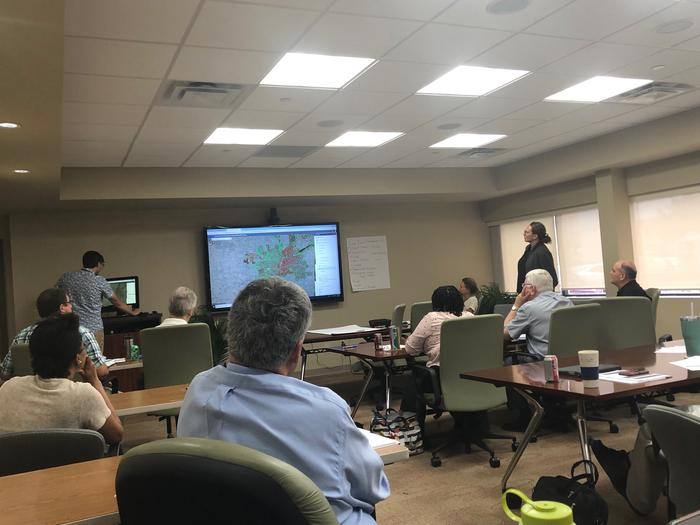
FloodWise Communities is a tool designed to help cities and local leaders assess their vulnerability to flooding and stormwater risks. It was created through extensive collaboration with community members from five Great Lakes cities, ensuring that the tool addressed local concerns and decision-making needs.
The researchers later explored whether this tool could be adapted for the Gulf Coast, a region with different climate conditions, governance structures, and community priorities. Scaling the tool was not simply a technical task. It required building trust, engaging local planners and residents, and acknowledging that solutions would look different than they did in the Great Lakes.
This process involved persistence, experimentation, and adjustment. Ultimately, following the three pathways helped the team navigate these challenges, even though the final outcome differed from earlier implementations.
Why There Is No Universal Recipe
One of the most important messages of the study is that there is no one-size-fits-all approach to scaling climate knowledge. Context matters deeply. What works in one region, sector, or community may not work in another.
The pathways are not meant to be followed in a strict order, nor are they guaranteed to produce success. Instead, they offer a way to think systematically about scaling impact, while leaving room for adaptation and creativity.
The researchers describe the framework as providing ingredients rather than a fixed recipe. Users must decide how to combine them based on local needs, constraints, and opportunities.
Why This Framework Matters Right Now
As climate impacts accelerate, the demand for usable climate information continues to grow. Governments and organizations are under pressure to make faster, better-informed decisions, often with limited resources.
This research helps shift the focus from simply producing more climate data to thinking carefully about how knowledge moves, who it reaches, and how it shapes decisions. By emphasizing participation, usability, and influence, the framework encourages approaches that are both practical and scalable.
For researchers, it offers guidance on designing projects with broader impact in mind. For policymakers and practitioners, it highlights ways to engage with climate knowledge that go beyond reports and static datasets.
Research Reference
Scaling up actionable climate knowledge – Proceedings of the National Academy of Sciences
https://doi.org/10.1073/pnas.2515771122