Urban Sprawl Could Leave 220 Million People Without Clean Water by 2050, New Global Study Warns
Urban growth is often seen as a sign of progress, but new research shows that how cities expand may matter far more than how fast they grow. A major international study has found that urban sprawl could significantly reduce access to clean water and sanitation for hundreds of millions of people by 2050, especially in rapidly growing cities across Asia, Africa, and Latin America.
The research, conducted by scientists at the Complexity Science Hub (CSH) in collaboration with the World Bank, examines the relationship between city shape and access to essential infrastructure. By analyzing data from more than 100 cities in 55 countries, the study highlights how outward, low-density expansion makes it harder and more expensive to deliver basic services like piped water and sewage systems.
What the study analyzed and why it matters
To understand the real-world impact of urban form, the researchers worked with an unusually large and detailed dataset. Their analysis covered information related to 183 million individual buildings and 125,000 household surveys, combined with infrastructure data and economic indicators. This allowed them to examine not just where people live, but how city layouts affect service delivery and costs.
The core question behind the research was simple: does the way a city grows affect people’s access to water and sanitation? The answer, according to the data, is a clear yes.
The findings suggest that urban form alone can determine whether hundreds of millions of people receive basic services, even without changes in total infrastructure investment.
Three possible futures for growing cities
The researchers modeled three scenarios for how cities might expand as their populations grow and, in many cases, double by mid-century.
The first scenario is compact growth, where cities become denser, fill in unused land, and concentrate new development close to existing infrastructure. The second is persistent growth, which assumes cities continue expanding as they do today. The third, and most concerning, scenario is horizontal growth, where cities spread outward into distant, low-density areas.
Under the horizontal growth scenario, the results are striking. By 2050, 220 million fewer people would have access to piped drinking water, and 190 million fewer people would be connected to sewage systems, compared to a compact growth pattern. Persistent growth would largely maintain current access levels, but sprawling expansion would actively reduce them.
The study’s lead author, Rafael Prieto-Curiel of CSH, emphasizes that in this modeling approach, the only thing that changes is where development happens, not how much money is invested or how much infrastructure is built.
Why distance from the city center makes such a difference
A key concept used in the study is something called sparseness. Sparseness measures how widely a city’s population is distributed, taking into account how far people live from the city center. In simple terms, it asks whether most residents live close to downtown or are scattered across distant suburbs.
Cities with low sparseness are compact, with a large share of the population living near central areas. Jakarta, for example, has more than half of its 33 million residents living close to the city core. Cities with high sparseness, such as Kigali, have most residents living far from the center. In Kigali, only 15% of the population lives centrally.
The study found that as sparseness increases, access to infrastructure drops sharply. In more sprawling cities, access to piped water falls by about 50% compared to compact cities. Water bills are also significantly higher — around 75% more expensive in sprawling urban areas. Residents living in outer neighborhoods have 40% less access to critical infrastructure than those closer to the city center.
These patterns help explain everyday experiences in cities like New Delhi, Cairo, Lagos, and Bogotá, where people on the urban fringe often struggle with unreliable or unaffordable water services.
The role of interactive data and visualization
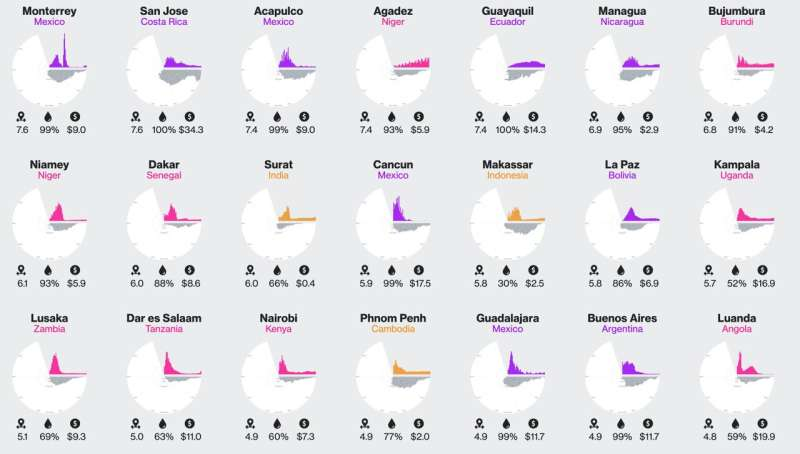
To help communicate these findings, CSH researcher Liuhuaying Yang developed an interactive visualization called Urban Thirst. This tool allows users to explore how city shape affects water access and service costs across more than 100 cities worldwide.
The visualization brings together data on population distribution, water tariffs, and infrastructure access, making it easier to see how dispersed urban development directly correlates with poorer outcomes for residents.
Africa and Asia face the greatest challenges
The implications of the study are particularly serious for Africa and Asia, regions expected to experience the largest urban population growth over the coming decades.
African cities are projected to grow from 550 million residents in 2018 to nearly 1.5 billion by 2050. Asian urban populations are expected to increase by about 50% over the same period. This growth will demand enormous planning efforts.
The study highlights that African cities are already nearly twice as sprawling as Asian cities. Only 12% of African urban residents live in central areas, compared to 23% in Asian cities. This existing pattern of dispersion means African cities may face even greater challenges in delivering water and sanitation services as populations rise.
Urban planning as a powerful policy tool
One of the most important takeaways from the research is that urban planning is something cities can control. While water scarcity often dominates headlines, city shape is a policy choice.
The findings show that compact, walkable neighborhoods with adequate density are not just environmentally friendly but also crucial for ensuring universal access to basic services. By building cities more efficiently, governments could improve water and sanitation access without necessarily increasing spending or building entirely new systems.
However, the researchers are careful to note that densification alone is not a cure-all. Some densely populated informal settlements, such as Kibera in Nairobi, Rocinha in Rio de Janeiro, and parts of Iztapalapa in Mexico City, remain underserved despite high density. Governance, service provision, and infrastructure management still matter.
Even so, the study makes it clear that sprawling growth makes service delivery far more difficult, multiplying costs and reducing coverage.
Why city shape affects infrastructure so strongly
Water and sewage systems rely on networks of pipes, pumps, and treatment facilities. When cities expand outward, these networks must stretch farther to serve fewer people per kilometer. This increases maintenance costs, energy use, and the likelihood of service disruptions.
Compact cities, by contrast, allow infrastructure to serve more people over shorter distances, making systems more reliable and affordable. Over time, these structural differences can shape inequality within cities, leaving peripheral neighborhoods behind.
Looking ahead to 2050
As global urbanization continues, this research offers a clear warning: if cities keep spreading outward, millions could lose access to clean water and sanitation, even as technology and infrastructure improve elsewhere.
The study underscores that decisions made today about zoning, land use, and transportation will shape access to basic services for decades to come. In that sense, urban form is not just about city aesthetics or traffic patterns — it is about public health, equity, and human dignity.
For policymakers, planners, and residents alike, the message is straightforward: building cities better may be one of the most effective ways to secure clean water for the future.
Research paper:
https://doi.org/10.1038/s44284-025-00338-3