With Smart Planning, Birds and Floating Solar Can Share Water Bodies Without Conflict
Floating solar panels — solar installations placed directly on lakes, ponds, and reservoirs — are gaining attention as a promising way to expand renewable energy without using valuable land. In the northeastern United States, where water bodies are abundant and energy demand is high, floating solar could play a meaningful role in the clean energy transition. But as with any large-scale infrastructure placed in natural environments, questions arise about how it might affect wildlife. A new scientific study takes a close look at one group in particular: birds, especially waterbirds, and offers a data-driven way to balance energy production with conservation.
The study, published in the journal Environmental Science & Technology, shows that floating solar and birds do not have to be at odds. With careful, ecologically informed planning, it may be possible to reduce risks to birds without sacrificing solar energy potential.
Why Floating Solar Raises Ecological Questions
Floating solar, also known as floating photovoltaic (FPV) systems, involves mounting solar panels on buoyant structures that sit on the surface of water. These systems can reduce evaporation, limit algae growth, and avoid the land-use conflicts sometimes associated with ground-mounted solar farms. However, water bodies are also critical habitats for many bird species.
Waterbirds use lakes and ponds for feeding, resting, nesting, and migration stopovers. Any large structure placed on the water surface could potentially alter these behaviors. Concerns include collision risk, habitat displacement, and changes in how birds perceive or use a water body. At the same time, birds themselves can affect solar installations, for example through droppings that reduce panel efficiency.
The new research set out to understand these interactions systematically, rather than relying on assumptions or isolated observations.
How the Researchers Studied Bird–Solar Overlap
The research team combined two major datasets covering the northeastern U.S., a region stretching from New England and New York down to Virginia and Washington, D.C. This area includes a large portion of the Atlantic Flyway, one of North America’s most important bird migration routes.
First, the researchers used results from a previous Cornell-led assessment that identified more than 16,000 lakes and ponds suitable for floating solar. Suitability was based on factors such as water body size and proximity to existing energy infrastructure, both essential for feasible solar development.
Next, they overlaid this map with bird abundance data from the Cornell Lab of Ornithology’s eBird Status and Trends tool, one of the most comprehensive bird monitoring resources in the world. This allowed them to estimate where birds and potential floating solar installations were most likely to overlap.
One of the most striking findings was that high solar energy potential rarely coincided with areas of high bird interaction risk. In other words, many of the best places for floating solar are not the same places where birds are most concentrated.
Identifying Which Bird Species Are Most Vulnerable
Beyond mapping overlap, the researchers took a deeper dive into bird biology. They analyzed 291 bird species, examining traits such as body size, maneuverability, vision, habitat preferences, and conservation status. This helped them identify which species might be especially vulnerable if floating solar were installed in certain locations.
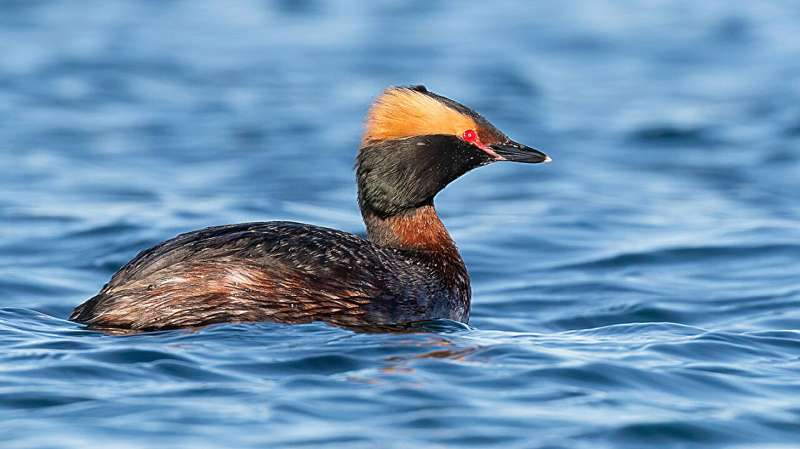
A clear example is the horned grebe, a waterbird that is already experiencing population declines. This species has relatively low maneuverability and limited vision, traits that could make navigating around floating solar panels more challenging and potentially dangerous. Identifying species like this in advance gives wildlife managers a valuable tool for targeted conservation.
This trait-based approach is especially useful because it moves beyond simply counting birds. It helps explain why certain species may be at higher risk and where extra caution or monitoring may be needed.
When Birds Become a Risk for Solar Panels
The study also considered the issue from the industry’s perspective. Birds do not just face risks from floating solar — they can also create problems for the technology itself.
Large congregations of birds, such as Canada geese, can leave significant amounts of droppings on solar panels. Over time, this can reduce energy output and increase maintenance costs. From a developer’s standpoint, avoiding water bodies with extremely high bird abundance can be financially sensible as well as environmentally responsible.
Interestingly, the researchers found that lakes and ponds with high bird diversity often overlap with areas of high recreational value, including boating, fishing, and birdwatching. Avoiding these sites could help prevent conflicts with local communities and reduce opposition to floating solar projects.
Small Water Bodies Carry Higher Interaction Risks
One important caution emerged from the analysis. In the United States, floating solar has mostly been installed on smaller ponds and lakes, rather than large reservoirs. The study found that smaller water bodies, particularly in coastal regions and around the Great Lakes, tend to have a higher likelihood of bird interactions.
This does not mean floating solar should never be placed on small lakes, but it does suggest that extra care is needed when considering these sites. The findings offer an opportunity to address potential conflicts early, before floating solar becomes widespread across the region.
A Broader Goal: Making Sustainability Practical
The researchers emphasize that their goal is not to stop floating solar development, but to guide it wisely. By looking at energy production, biodiversity, and social values together, the study provides a framework for what they describe as an ecologically informed energy transition.
Floating solar is still a relatively new technology in the U.S., especially compared to land-based solar. That makes this an ideal moment to integrate ecological data into planning decisions, rather than trying to fix problems later.
The same approach used in this study can also be applied beyond floating solar. The research team plans to use similar methods to map potential bird interactions with land-based solar in New York State, helping inform future renewable energy projects across different landscapes.
Additional Context: Floating Solar and Wildlife Worldwide
Globally, floating solar is expanding rapidly, particularly in parts of Asia and Europe. Studies from other regions show that birds may respond to floating solar in diverse ways. Some species may avoid installations entirely, while others may use the structures for perching or resting.
What makes the northeastern U.S. study stand out is its large-scale, data-driven perspective. Instead of focusing on a single site, it looks across an entire region, identifying patterns that can guide policy, conservation, and industry decisions before conflicts arise.
What This Research Means Going Forward
The key takeaway from this work is encouraging: renewable energy expansion and bird conservation do not have to be mutually exclusive. By using existing data, understanding species-specific vulnerabilities, and considering human use of water bodies, floating solar projects can be planned in ways that minimize ecological and social impacts.
As floating solar continues to grow, studies like this provide a roadmap for doing it better — smarter siting, fewer conflicts, and a more balanced approach to sustainability.
Research paper:
https://doi.org/10.1021/acs.est.5c09819