Texas A&M Researchers Identify Long-Lost WW2 B-17 Bomber in the Baltic Sea
The story of a World War II B-17 Flying Fortress lost off the coast of Denmark has taken a major turn after researchers from Texas A&M University finally located and documented the wreck eight decades after it vanished. Their discovery, made in partnership with the U.S. Defense POW/MIA Accounting Agency (DPAA), is part of a larger effort to recover and identify more than 81,000 American service members still unaccounted for from past wars. This latest find doesn’t just illuminate a single wartime tragedy—it represents how modern science and collaboration continue to push the boundaries of what we can recover from history.
Confirming the Wreck Beneath Decades of Sediment
The investigative expedition took place in July, launching from Kiel Bay, Germany, and focusing on a one-square-kilometer search zone in the Baltic Sea. Even though the aircraft had been originally spotted by a local diver back in 2001, a detailed, scientifically driven search had never been completed—until now.
The Texas A&M team used side-scan sonar imaging to create sweeping images of the seafloor and magnetometry for detecting buried metallic objects. These techniques helped identify multiple anomalies in the sediment, which, on initial review, could have been geological oddities or debris from wartime naval activity common in the Baltic.
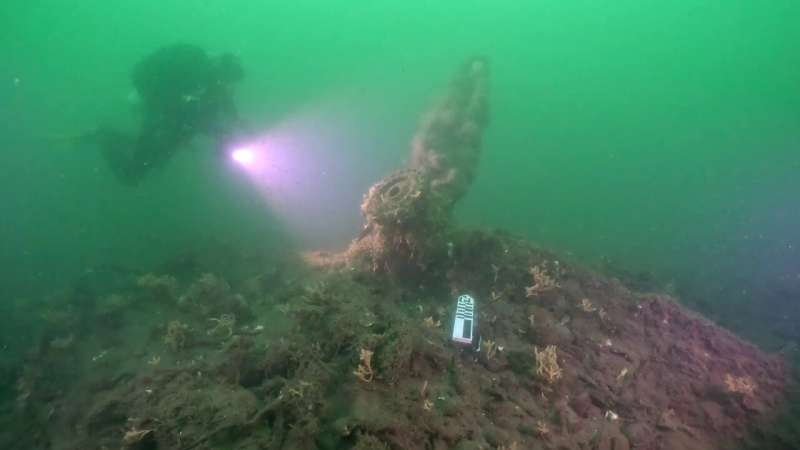
To narrow it down, a remotely operated vehicle (ROV) was deployed, providing the first visual clues. One image in particular resembled an airfoil, and that was enough to persuade the team to dive. With visibility less than 10 feet, divers slowly uncovered pieces of the wreck that confirmed this was indeed a B-17 heavy bomber: fragments of wings, an engine, fuel tanks, and other structural components scattered across the seabed.
The condition of the wreck was expectedly poor—the bomber hit the water hard when it crashed in 1943, and decades of sediment buildup and marine growth had further obscured its shape. Even so, the team was able to visualize key components and begin piecing together a clearer picture of what the aircraft looked like before impact.
Machine Guns Become Key to Identification
One of the most important discoveries was the recovery of two .50-caliber machine guns. These had been knocked loose during the crash and were located near the main debris field. After raising them to the surface and carefully removing layers of hardened sea concretion, the team revealed clearly legible serial numbers.
This matters because WWII aircraft inventories were tightly controlled. Machine guns were not only serialized—they were also tracked by exact installation position on each aircraft. That means the serial numbers alone could allow researchers to identify the specific bomber and the crew members who were on board when it went down.
This is the critical bridge between the wreckage and the families of those who never returned home. Once archival researchers cross-reference these numbers with wartime maintenance and flight records, they will be able to verify the bomber’s identity with extremely high confidence.
What Happened to the B-17 in 1943?
The B-17 Flying Fortress was a dominant heavy bomber used extensively by the U.S. in the European Theater. Hundreds were lost over the Baltic and North Sea. Although the team has not yet announced a final identification of this particular aircraft, historical records suggest likely possibilities.
One probable match is a bomber returning from a mission over Anklam, Germany, in the fall of 1943. Many returning aircraft routed over the Baltic Sea to avoid German defenses. Some were hit by flak, attacked by fighters, or suffered mechanical failure in the cold, turbulent air over the water. The exact circumstances of this crash remain unclear, and the ongoing research aims to resolve those mysteries.
The Role of DPAA and Collaborative Research
The DPAA’s mission is massive—locating and identifying tens of thousands of missing Americans from World War II, the Korean War, Vietnam, and other conflicts. Underwater crash sites are often among the hardest cases, requiring advanced technology, archaeological expertise, and partnerships with universities.
Dr. Piotr Bojakowski, who led this mission, emphasized that these recoveries are never the work of one person or one agency. The operation involved nautical archaeologists, anthropologists, volunteers from the Nordic Maritime Group, and the logistical support of both German and Danish maritime authorities.
Each person involved contributes specialized knowledge: sonar technicians, divers, artifact preservation specialists, and archival researchers. It’s the combination of all these efforts that allows an aircraft lost 80 years ago to finally be brought into modern understanding.
A Closer Look at the B-17 Flying Fortress
Since this story revolves around the B-17, it’s worth looking at why this aircraft remains such an iconic symbol of WWII aviation.
Design and Capabilities
The B-17 was known for:
- Four powerful engines, allowing long-range missions deep into enemy territory
- Heavy defensive armament, including up to 13 .50-caliber machine guns
- A reputation for surviving extreme damage, often returning home with large sections missing
- Its role in daylight precision bombing missions, primarily flown by the U.S. Eighth Air Force
Despite its durability, many did not survive the intense flak and fighter attacks common over Europe. Thousands of crew members never made it home.
Why Recovering a B-17 Matters Today
The discovery of a lost bomber does more than fill a historical gap. It helps:
- Restore missing chapters of wartime events
- Bring closure to families with relatives still listed as Missing In Action (MIA)
- Provide archaeologists with insight into crash dynamics and aircraft construction
- Preserve historical memory at a time when direct accounts from WWII are becoming increasingly rare
Each discovery ensures future generations understand not just the numbers, but the human stories behind the war.
The Work Still Ahead
Now that the machine guns have been recovered, cleaned, and documented, the archival research phase begins. This phase is meticulous and time-consuming—records must be checked, RAF and Luftwaffe engagement logs reviewed, and mission reports examined.
Only after cross-referencing every detail will the team be able to confirm:
- The bomber’s official serial number
- The names of the crew on board
- The mission they flew
- The circumstances of their final moments
It may take months, possibly longer, but this is a crucial part of the process. The ultimate goal is to determine whether any human remains are recoverable and, if so, return them to their families.
Why This Discovery Is a Global Effort
Wartime wreckage is scattered across oceans worldwide. Many countries, including Germany, Denmark, the UK, and the U.S., cooperate on such recoveries because every site is part of shared global history. This B-17 was not just an American aircraft—it was a participant in events that reshaped the world.
Modern underwater archaeology blends technology, research, and human empathy. Each discovery like this one reminds us that wars don’t fully end until every possible story is told and every lost person is accounted for.