How Brain Stimulation During Sleep Helps Mice Remember Experiences They Would Normally Forget
Scientists have long known that sleep plays a critical role in memory, but a new study takes this idea much further. Researchers have now shown that carefully timed brain stimulation during sleep can strengthen weak memories, allowing mice to remember experiences that would normally fade away. The findings, published in the journal Neuron in 2025, offer valuable insight into how memories are formed and stored—and why this process often fails in conditions like Alzheimer’s disease and dementia.
This research does not rely on speculation or abstract theories. Instead, it dives deep into the precise brain signals that govern memory consolidation, identifies which ones matter most, and demonstrates how enhancing those signals can directly improve memory performance.
Why Memory Consolidation During Sleep Matters
When an animal—or a human—has a new experience, that information is first encoded in the hippocampus, a brain region essential for learning and memory. However, for a memory to last, it must eventually be transferred to the neocortex, where long-term memories are stored more permanently.
This transfer process, known as memory consolidation, happens primarily during sleep, especially non-REM sleep. If consolidation is weak or disrupted, memories can quickly disappear. This is one reason people with neurodegenerative diseases often struggle to retain new information.
The new study focuses on understanding exactly which brain activities during sleep make the difference between remembering and forgetting.
The Role of Sharp-Wave Ripples in Memory
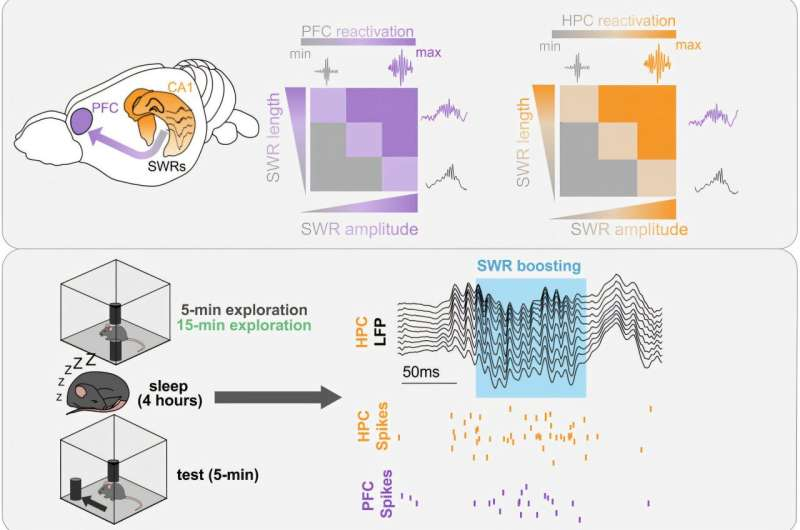
The researchers identified a specific type of brain activity called sharp-wave ripples, which are brief bursts of synchronized neural firing lasting about 100 milliseconds. These ripples originate in the hippocampus and are known to play a role in memory consolidation.
What makes this study stand out is that the scientists did not treat all ripples as equal. They discovered that a subset known as large sharp-wave ripples is especially important. These larger ripples are strongly associated with the reactivation of recent experiences and their transfer from the hippocampus to the neocortex.
By recording neural activity in both the hippocampus and the neocortex, the team observed a clear pattern:
- When mice successfully remembered an experience, large sharp-wave ripples were frequent and strong during sleep.
- When mice failed to remember, those ripple events were weaker and less frequent.
This finding allowed researchers to pinpoint when the brain is actively converting new experiences into long-term memories.
Using Optogenetics to Strengthen Weak Memories
After identifying the importance of large sharp-wave ripples, the scientists tested whether they could artificially enhance these signals. To do this, they used optogenetics, a highly precise technique that allows researchers to control neuron activity using light delivered through an optical fiber.
With optogenetics, the team could stimulate specific neurons at exactly the right moment during sleep, boosting the large sharp-wave ripples without disrupting other brain activity.
The experiment followed a clear and controlled design:
- Mice were exposed to a new object for five minutes, a duration normally too short to form a lasting memory.
- When tested four hours later, the mice did not recognize the object, confirming that the experience had not been consolidated.
- During the mice’s sleep, researchers selectively boosted large sharp-wave ripples associated with that experience.
- After this intervention, the mice successfully remembered the object.
This showed that timing mattered just as much as stimulation. The brain was not forced to remember everything—only memories linked to the enhanced ripple activity were strengthened.
Memory Improvement Even in Cognitively Impaired Mice
One of the most important aspects of the study is that the technique also worked in mice engineered to have cognitive deficits. These animals normally struggle with memory formation, even under optimal conditions.
By boosting large sharp-wave ripples during sleep, researchers were able to extend memory consolidation in animals that would otherwise fail to remember at all. This suggests that the underlying memory machinery remains present but underactive in cognitive impairment—and that targeted stimulation may help restore function.
What This Means for Alzheimer’s Disease Research
Alzheimer’s disease and other forms of dementia are known to disrupt sleep patterns and memory consolidation mechanisms. The same hippocampal-to-neocortical transfer process identified in mice is also present in humans.
This research provides strong evidence that:
- Memory problems in Alzheimer’s may stem partly from impaired sharp-wave ripple activity during sleep
- Enhancing the right brain signals at the right time could help improve memory retention, even when disease is present
While optogenetics itself is not currently used in humans, the study lays the groundwork for future non-invasive approaches, such as electrical or magnetic stimulation synchronized with sleep rhythms.
Next Steps in the Research
The researchers are not stopping here. Their next phase involves applying the same sleep-based brain stimulation techniques to mouse models specifically designed to mimic Alzheimer’s-like conditions.
This work is being conducted in collaboration with experts in biomedical engineering and neurovascular research. The goal is to determine whether boosting large sharp-wave ripples can counteract disease-related memory loss, not just enhance weak memories in healthy brains.
Extra Context: Why Sleep Is So Critical for Memory
Decades of neuroscience research have shown that sleep is not a passive state. During sleep:
- The brain replays recent experiences
- Neural connections are strengthened or weakened
- Unimportant information is filtered out while valuable memories are preserved
Sharp-wave ripples act like high-speed data transfers, rapidly sending information from short-term storage in the hippocampus to long-term cortical networks. Disruptions to this process—whether from aging, stress, or disease—can have serious consequences for learning and memory.
This study adds an important layer of understanding by showing that not all ripples are equal, and that selectively enhancing the most meaningful ones can dramatically change memory outcomes.
Why This Study Matters
What makes this research especially compelling is its precision. Instead of broadly stimulating the brain, the scientists:
- Identified the exact neural events linked to successful memory
- Manipulated those events only during sleep
- Demonstrated clear behavioral improvements in memory
This combination of detailed brain monitoring and targeted intervention represents a significant step forward in memory research.
Research paper reference:
https://doi.org/10.1016/j.neuron.2025.10.003