Methamphetamine Disrupts Dopamine Balance by Reducing a Key Protein Modification
A new preclinical study has uncovered an important mechanism behind how methamphetamine spikes dopamine levels in the brain. Researchers found that the drug temporarily reduces a chemical modification on the dopamine transporter (DAT)—a molecular machine responsible for clearing excess dopamine from the spaces between neurons. This seemingly small disruption leads to an impaired ability to remove dopamine from synapses, allowing the neurotransmitter to build up quickly and intensely. Because dopamine is central to movement, reward, motivation, learning, and mood, this finding helps explain both the euphoric high associated with methamphetamine and the long-term neurological risks linked to chronic use.
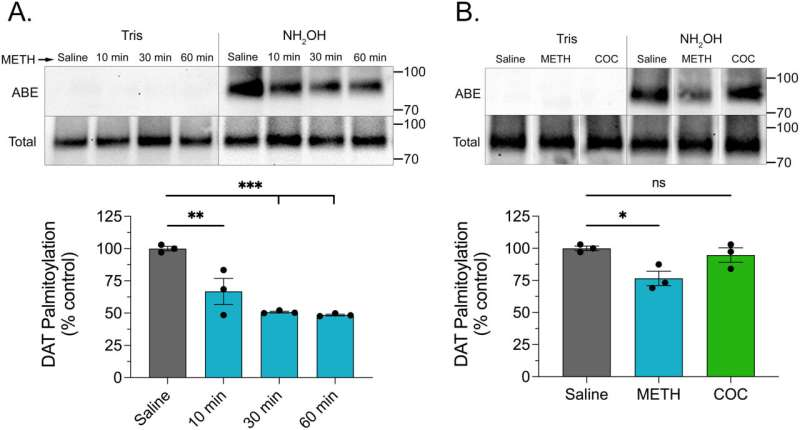
The study, led by scientists at the University of North Dakota, revealed that methamphetamine rapidly lowers a biochemical process called palmitoylation on DAT. Palmitoylation normally supports the transporter’s function by helping it efficiently pull dopamine back into neurons. When palmitoylation drops, DAT loses some of its ability to do its job. What’s especially interesting is that this reduction in palmitoylation happens very quickly—within minutes—and occurs alongside a measurable decrease in dopamine uptake.
To understand this effect, researchers used male Sprague–Dawley rats, giving them injections of either saline, methamphetamine at 15 mg/kg, or (−)-cocaine at the same dose. The rats were then examined at various time intervals to track changes in palmitoylation and transporter function. The team also performed in vitro experiments to closely examine how methamphetamine interferes with DAT biology. Across both approaches, the results were consistent: methamphetamine reliably reduced DAT palmitoylation and decreased dopamine transport activity.
One detail that stands out is how reversible this effect is. After methamphetamine administration, palmitoylation levels eventually returned to normal. But the transporter’s activity did not bounce back as quickly. This gap suggests that methamphetamine triggers additional downstream processes that continue to suppress DAT function even after palmitoylation has recovered. Identifying those processes could be a major goal for future research.
Another important finding is that the effect is specific to methamphetamine. Cocaine—another stimulant known to increase dopamine levels—did not alter palmitoylation in the same experiments. That means methamphetamine has a unique molecular influence on DAT that other stimulants do not share. The study further showed that protein kinase C (PKC), an enzyme already known to reduce dopamine uptake by phosphorylating DAT, is also required for methamphetamine’s suppression of palmitoylation. This creates a multilayered picture: methamphetamine activates PKC, which then modifies DAT in more than one way to weaken dopamine reuptake.
The researchers also tested a mutant version of DAT in which one of the main palmitoylation sites was altered. As expected, this mutant displayed about half the normal palmitoylation levels. But what’s notable is that cells expressing this mutant transporter took up even less dopamine when treated with methamphetamine compared to cells with the normal transporter. This detail strengthens the idea that palmitoylation plays a protective role in maintaining stable dopamine regulation and that its disruption amplifies methamphetamine’s impact on the dopamine system.
Together, these discoveries highlight a previously unknown mechanism by which methamphetamine destabilizes dopamine signaling. Understanding this mechanism offers new pathways for developing treatments that could help stabilize the dopamine system in individuals struggling with methamphetamine addiction. It may also have potential applications in neurological and psychiatric conditions linked to dopamine imbalance, such as depression, schizophrenia, and various movement disorders.
Understanding Dopamine Transporters and Why This Matters
Dopamine transporters act like cleanup crews in the brain. After dopamine is released into a synapse, DAT clears the neurotransmitter by pulling it back into the neuron. This process ensures that dopamine signals remain brief and controlled. When DAT is disrupted—as happens with methamphetamine use—dopamine lingers longer in the synapse, amplifying its effects.
DAT activity is regulated by several types of protein modifications. Two of the most studied ones are:
- Palmitoylation, which enhances dopamine reuptake
- Phosphorylation, particularly via PKC, which reduces reuptake
Methamphetamine has long been known to influence DAT by stimulating PKC-related phosphorylation. This new research adds another layer: methamphetamine also reduces palmitoylation, compounding its ability to suppress transporter function. With both modifications pushing DAT toward inactivity, dopamine levels in the synapse rapidly rise.
Excess dopamine may feel pleasurable in the short term, but chronically elevated dopamine disrupts neural circuits. Over time, this contributes to addiction, mood instability, impaired cognitive function, and structural changes in the brain.
Why Cocaine and Methamphetamine Behave Differently
Both cocaine and methamphetamine are stimulants that increase dopamine levels, but they do so through distinct mechanisms. Cocaine acts mainly by blocking DAT, preventing it from clearing dopamine. Methamphetamine takes a more complex approach:
- It enters neurons through DAT.
- It disrupts the vesicles that store dopamine.
- It reverses DAT’s direction, causing dopamine to flood outward.
- And as this new study shows, it reduces palmitoylation, weakening the transporter even further.
The fact that cocaine did not affect palmitoylation demonstrates that methamphetamine interacts with DAT in a more invasive, multi-step way. This helps explain why methamphetamine tends to have stronger and longer-lasting effects on dopamine systems than cocaine.
What Palmitoylation Actually Is
Palmitoylation involves attaching a fatty acid (palmitate) to a protein. This attachment helps stabilize proteins in cell membranes and can alter their function. When DAT is palmitoylated, it becomes better at transporting dopamine. So when methamphetamine reduces palmitoylation, DAT’s efficiency drops, and dopamine clearance slows down.
Interestingly, the study observed that palmitoylation recovers sooner than dopamine transport activity. This suggests that even after DAT appears chemically restored, other methamphetamine-induced processes keep it from functioning normally. These lingering effects are likely tied to why methamphetamine use has such long-term consequences.
Broader Implications for Treating Addiction and Mental Health Disorders
By revealing a new way methamphetamine interferes with dopamine regulation, this research opens up promising therapeutic opportunities. If scientists can figure out how to maintain or restore healthy DAT palmitoylation, it may be possible to buffer the dopamine system against methamphetamine’s damaging effects.
Because dopamine plays a role in many mental health conditions, understanding palmitoylation could contribute to research on:
- Major depressive disorder
- Schizophrenia
- Parkinson’s disease
- Attention disorders
Any condition involving abnormal dopamine signaling might benefit from insights into how DAT is regulated. While this research is still in its early stages and conducted in animals and cell models, it provides a strong foundation for future exploration.