Neutron Scattering Research Reveals How Vitamin E Acetate From Vaping Damages Lung Membranes
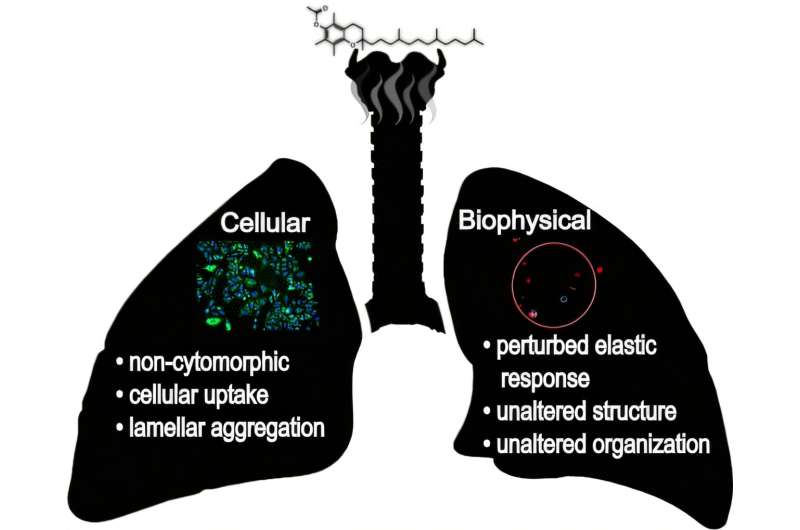
Scientists are gaining a much clearer picture of how vaping can damage the lungs, thanks to a new study that uses neutron scattering to examine what happens deep inside lung membranes. Researchers from the University of Windsor, working at the U.S. Department of Energy’s Oak Ridge National Laboratory (ORNL), have uncovered detailed molecular evidence explaining how vitamin E acetate (VEA)—a substance commonly found in illegal vaping products—can interfere with breathing and contribute to e-cigarette or vaping-associated lung injury (EVALI).
The study, published in the peer-reviewed journal Chemical Research in Toxicology, provides one of the most precise explanations yet for how VEA physically alters lung structures. Rather than focusing only on clinical symptoms, the research looks directly at the biophysical changes occurring in the membranes that line the lungs, offering a strong mechanistic link between vaping additives and respiratory injury.
Why Vitamin E Acetate Became a Major Concern
Vitamin E acetate is a synthetic form of vitamin E that is safe when consumed orally or applied to the skin. However, problems arise when it is inhaled. During the peak of EVALI cases, particularly among young people using unregulated THC vaping products, vitamin E acetate repeatedly showed up in lung fluid samples taken from patients.
This raised a key question for scientists and physicians: what exactly does vitamin E acetate do once it enters the lungs? The lungs are not designed to process oily, lipid-based substances, and early clinical evidence suggested that VEA had nowhere to go after inhalation. The University of Windsor team set out to explore this problem at a microscopic level.
Using Neutrons to Study Lung Damage
To investigate how vitamin E acetate behaves inside the lungs, the researchers turned to neutron scattering, an advanced technique capable of revealing structural and mechanical changes in biological materials without damaging them.
The experiments were conducted at ORNL using two world-class facilities:
- The Spallation Neutron Source (SNS)
- The High Flux Isotope Reactor (HFIR)
Within these facilities, the team relied on two specialized instruments:
- Bio-SANS (Biological Small-Angle Neutron Scattering Instrument) at HFIR
- Neutron Spin Echo (NSE) Spectrometer at SNS
These tools allowed scientists to examine lung membrane models with exceptional precision, focusing on how VEA interacts with pulmonary surfactant, a crucial mixture of lipids and proteins that coats the inner surface of the lungs.
What Pulmonary Surfactant Does in the Lungs
Pulmonary surfactant plays a vital role in breathing. It:
- Reduces surface tension inside the lungs
- Prevents alveoli (tiny air sacs) from collapsing
- Allows the lungs to expand and contract smoothly with each breath
Any disruption to this delicate system can make breathing difficult or even dangerous. The research team created three different pulmonary surfactant models, each with increasing complexity, to replicate the conditions inside human lungs as accurately as possible.
The Key Discovery: Membrane Softening
The experiments revealed a critical finding: vitamin E acetate accumulates in lung membranes over time and causes them to soften.
This softening effect is significant because lung membranes need a precise balance between stiffness and flexibility. When membranes become too soft, they lose their ability to maintain proper structure during breathing. According to the study, this mechanical weakening can help explain the labored breathing, chest pain, and respiratory distress seen in patients with EVALI.
Using Neutron Spin Echo spectroscopy, the team was able to measure membrane stiffness at extremely small energy scales—something that is not possible with most other techniques. This allowed them to directly observe how VEA changes the physical behavior of lung membranes rather than just inferring damage indirectly.
Why Neutrons Were Essential for This Research
Neutrons offered several unique advantages:
- They carry no electrical charge, allowing them to pass through delicate biological samples without destroying them.
- They provide contrast variation, meaning researchers can selectively highlight different components of a sample.
- They eliminate the need for artificial additives or dyes that could interfere with results.
Because of these properties, the researchers could study vitamin E acetate in a setting that closely resembles real lung conditions, without introducing substances that would not normally be present in the body.
Connecting the Dots to EVALI
Earlier clinical investigations had already established a strong association between vitamin E acetate and EVALI. However, many questions remained about how the substance caused injury at a molecular level. This study provides one of the clearest answers so far.
By showing that VEA physically softens lung membranes, the research offers a direct mechanical explanation for breathing impairment. It also helps explain why vitamin E acetate tends to build up rather than being cleared from the lungs, increasing damage over time.
Ongoing Research and What Comes Next
While this study focuses on membrane softening, the researchers emphasize that EVALI is likely caused by multiple interacting mechanisms. Breathing involves complex processes such as gas exchange, immune response, and surfactant recycling, many of which are still not fully understood.
The team plans to return to ORNL to continue using neutron-based techniques to explore these additional pathways. Their long-term goal is to build a more complete picture of how vaping-related chemicals interfere with lung function at every level.
Broader Context: Vaping, Additives, and Lung Health
The findings reinforce public health warnings about unregulated vaping products, particularly those containing THC and unknown additives. Vitamin E acetate is often used as a thickening agent in illicit vape oils to mimic high-quality products, but its presence has been strongly linked to lung injury outbreaks.
Health authorities have consistently advised users to avoid vaping products from informal sources and to be cautious about additives that may be safe in other contexts but dangerous when inhaled.
Why This Study Matters
What makes this research especially valuable is its precision. Instead of relying solely on patient symptoms or animal models, it directly measures how a known vaping additive alters lung structures at the molecular level. This approach strengthens the scientific foundation behind vaping-related health warnings and provides critical data for future regulation and medical research.
As vaping products continue to evolve, studies like this help ensure that health risks are understood not just broadly, but mechanistically, where prevention and treatment strategies can be most effective.
Research Paper Reference:
https://doi.org/10.1021/acs.chemrestox.4c00425