New Research Suggests America’s Most Popular Cooking Oil May Play a Role in Obesity
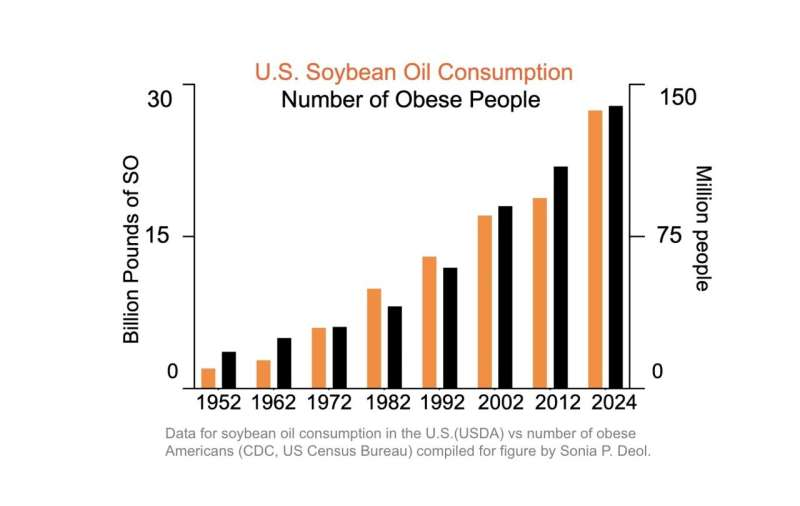
Soybean oil is everywhere in the American diet. It is the most widely consumed cooking oil in the United States and a key ingredient in countless processed and packaged foods. From restaurant fryers to salad dressings, snacks, and baked goods, soybean oil has quietly become a dominant source of dietary fat. Now, a new study from researchers at the University of California, Riverside is raising important questions about how this oil may affect body weight and metabolism.
The study links high soybean oil consumption to obesity, at least in mice, and goes a step further by uncovering biological mechanisms that may explain why some individuals are more susceptible to weight gain than others when consuming diets rich in this oil.
Why Soybean Oil Caught Researchers’ Attention
Over the past century, soybean oil consumption in the U.S. has increased dramatically. In the early 1900s, it accounted for about 2% of total calories in the American diet. Today, that number is close to 10%, largely due to the rise of ultra-processed foods. Despite being cholesterol-free and plant-based, soybean oil is especially high in linoleic acid, an omega-6 fatty acid that has drawn increasing scientific scrutiny.
Previous studies from the same research group had already suggested that soybean oil is more likely to promote weight gain than other fats, such as coconut oil. This new work builds on that foundation and digs deeper into what actually happens inside the body after soybean oil is consumed.
Inside the UC Riverside Mouse Study
In the experiment, researchers fed mice a high-fat diet rich in soybean oil. As expected, most of these mice gained significant weight and developed fatty liver changes commonly associated with obesity. However, not all mice responded the same way.
A group of genetically engineered mice showed a surprising resistance to weight gain, even though they were eating the same high-fat soybean oil diet. These mice had been modified to produce a slightly different version of a liver protein called HNF4α (hepatocyte nuclear factor 4 alpha), which plays a major role in regulating hundreds of genes involved in fat metabolism.
This altered form of the protein changed how the mice processed fats, leading to better metabolic outcomes and healthier livers.
The Role of Linoleic Acid and Oxylipins
One of the most important discoveries in the study involves what happens to linoleic acid after it enters the body. Linoleic acid itself was not found to be directly responsible for weight gain. Instead, the issue appears to be what linoleic acid is converted into.
Inside the body, linoleic acid is metabolized into molecules known as oxylipins. These compounds are biologically active and can influence inflammation, fat storage, and energy use. When linoleic acid intake is high, oxylipin production increases.
The researchers found that mice consuming high levels of soybean oil had elevated oxylipin levels in the liver, and these levels were strongly linked to obesity and fat accumulation. Importantly, the genetically engineered mice produced significantly fewer oxylipins, even on the same diet.
This reduction in oxylipins was associated with healthier liver tissue, smaller fat droplets in liver cells, and improved mitochondrial function, which helps cells generate energy more efficiently.
Why Some Mice Gained Weight and Others Didn’t
The study narrowed down the obesity-related effects to specific oxylipins derived from linoleic acid and alpha-linolenic acid, another fatty acid found in soybean oil. These oxylipins were necessary for weight gain in regular mice.
However, the story is not that simple. When the genetically engineered mice were fed a low-fat diet, they still showed elevated oxylipin levels but did not become obese. This suggests that oxylipins alone are not enough to cause weight gain. Instead, multiple metabolic factors must interact, including diet composition, liver function, and genetic regulation.
Further analysis revealed that the modified mice had much lower levels of two key enzyme families responsible for converting linoleic acid into oxylipins. These enzymes are highly conserved across mammals, including humans, and their activity varies widely depending on genetics, diet, age, medications, and overall metabolic health.
Liver Health Matters More Than Blood Tests
One particularly interesting finding is that oxylipin levels in the liver, not in the blood, were linked to body weight. This means that standard blood tests may not accurately reflect early metabolic changes caused by diet.
In other words, someone could appear metabolically “normal” based on blood work while their liver is already undergoing changes that promote fat accumulation and weight gain.
Cholesterol, Inflammation, and Soybean Oil
Although soybean oil contains no cholesterol, the study found that mice consuming it had higher cholesterol levels. This highlights how dietary fats can influence cholesterol metabolism indirectly, rather than simply through cholesterol content.
The researchers also emphasized the connection between oxylipins and inflammation, which plays a central role in obesity-related diseases such as type 2 diabetes, fatty liver disease, and cardiovascular problems.
What This Could Mean for Humans
Humans naturally produce both versions of the HNF4α protein, but the alternative form seen in the protected mice usually appears only under certain conditions. These include chronic illness, metabolic stress, prolonged fasting, or alcoholic fatty liver disease.
This variation, combined with factors such as age, sex, genetics, and medication use, may help explain why some people gain weight more easily than others when consuming diets high in soybean oil and other omega-6-rich fats.
It is important to note that no human trials are currently planned, and the findings are based on animal models. Still, because the enzymes and metabolic pathways involved are conserved in humans, the researchers believe the results are highly relevant.
Are Other Vegetable Oils Similar?
Soybean oil is not the only oil high in linoleic acid. Oils such as corn, sunflower, and safflower oil also contain large amounts of this fatty acid. The research team plans to investigate whether these oils trigger similar metabolic pathways and oxylipin production.
This raises broader questions about modern diets, which often rely heavily on a narrow range of vegetable oils that were rarely consumed in large quantities throughout human history.
Putting Soybean Oil in Perspective
The researchers are careful not to demonize soybean oil outright. The oil itself is not inherently harmful, and soybeans remain an important source of plant-based protein. The concern lies in the sheer quantity of soybean oil consumed today, particularly through ultra-processed foods.
Modern diets may be activating biological pathways that human metabolism did not evolve to handle, especially when combined with sedentary lifestyles and chronic overnutrition.
Final Thoughts
This study offers one of the clearest explanations yet for how soybean oil may contribute to obesity, moving beyond simple calorie counts and focusing on molecular metabolism inside the liver. It also highlights why dietary advice may need to be more personalized, taking into account genetics and metabolic differences rather than assuming all fats affect everyone the same way.
While more research is needed, especially in humans, these findings add to a growing body of evidence suggesting that the type of fat we consume matters just as much as the amount.
Research Paper:
Poonamjot Deol et al., P2-HNF4α Alters Linoleic Acid Metabolism and Mitigates Soybean Oil-Induced Obesity: Role for Oxylipins, Journal of Lipid Research (2025).
https://doi.org/10.1016/j.jlr.2025.100932