Scientists Develop a Wireless Light-Based Brain Device That Can Send Information Directly to the Mind
Researchers at Northwestern University have unveiled a groundbreaking wireless brain device that can transmit information directly to the brain using patterns of light, bypassing the body’s natural sensory systems such as vision, hearing, and touch. This development marks a major step forward in neurobiology, optogenetics, and bioelectronics, opening the door to new ways of communicating with the brain and potentially restoring lost sensory functions in the future.
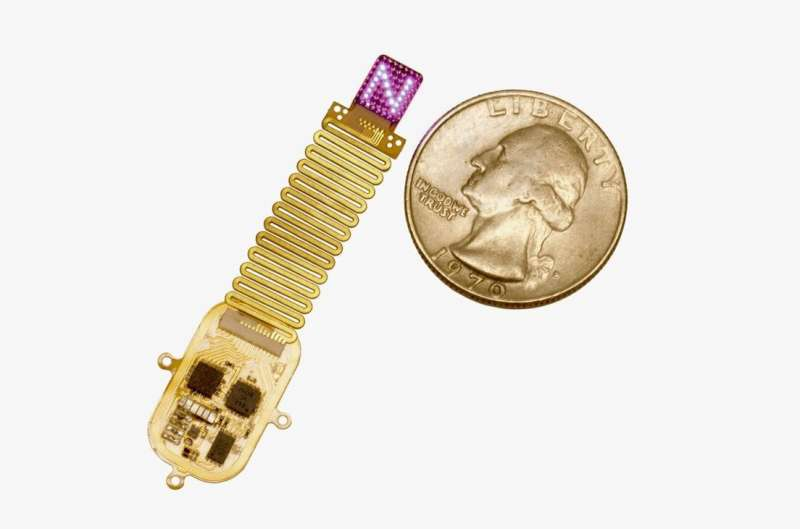
At the center of this research is a soft, flexible, fully implantable wireless device designed to sit just beneath the scalp, resting on top of the skull. Rather than penetrating brain tissue, the device delivers carefully programmed bursts of light through the skull itself, activating specific populations of neurons in the cortex. The study, titled Patterned wireless transcranial optogenetics generates artificial perception, was published in Nature Neuroscience in December 2025.
How the Device Works
The device is roughly the size of a postage stamp and thinner than a credit card. It is made from soft, conformable materials that allow it to fit naturally along the curved surface of the skull. Embedded within it is a programmable array of up to 64 micro-LEDs, each one approximately as thin as a single strand of human hair.
These micro-LEDs emit red light, which is known to penetrate biological tissue more effectively than other wavelengths. This allows the light to travel through bone and reach neurons located deep within the cortex. The device is powered wirelessly, meaning it contains no batteries and requires no physical connections to external hardware.
What makes this system especially powerful is its ability to control each LED independently. Researchers can adjust frequency, intensity, timing, and spatial arrangement of light across the array, creating nearly limitless combinations of stimulation patterns. These patterns are then interpreted by the brain as meaningful signals.
Optogenetics and the Role of Light
This technology builds on a technique known as optogenetics, where neurons are genetically modified to respond to light. When illuminated at specific wavelengths, these neurons either activate or deactivate, allowing scientists to control neural circuits with exceptional precision.
Traditional optogenetics relies on fiber-optic cables implanted directly into the brain, which can restrict movement and interfere with natural behavior. In contrast, the new device is completely wireless and minimally invasive, enabling animals to move freely and behave normally during experiments.
This approach represents a shift away from stimulating small, isolated regions of the brain and toward activating distributed cortical networks, which more closely resemble how natural sensations are processed.
What the Experiments Showed
To test the system, the research team conducted experiments using mouse models whose cortical neurons were engineered to be light-responsive. The mice were trained to associate specific light patterns delivered by the implant with rewards.
During the trials, the device delivered unique stimulation patterns across four distinct cortical regions, effectively “writing” a signal directly onto the brain’s neural circuits. The mice quickly learned to distinguish one target pattern from dozens of alternatives. When they recognized the correct pattern, they consistently chose the correct port in a behavioral task to receive a reward.
Importantly, the mice were not using vision, hearing, or touch to make these decisions. The information was delivered entirely through artificial neural signals, and the animals demonstrated that they could reliably interpret and act on those signals.
This ability to learn and respond to entirely new forms of brain input provides strong evidence that the brain is remarkably adaptable when it comes to interpreting information, even when that information does not originate from natural sensory pathways.
Why Patterned Stimulation Matters
Natural sensory experiences do not activate the brain in a single spot. Instead, they involve complex, distributed patterns of neural activity across multiple regions. Earlier optogenetic devices were limited to switching neurons on or off in a single location, which did not reflect how real perception works.
The new multi-LED array overcomes this limitation. By stimulating several cortical areas simultaneously and in sequence, researchers can create rich, dynamic patterns that more closely resemble natural brain activity. According to the research team, the number of possible stimulation patterns is nearly infinite, offering a powerful tool for studying perception and learning.
Building on Earlier Research
This study builds directly on earlier work from the same team. In 2021, they introduced the first fully implantable, wireless, battery-free optogenetic device capable of controlling neurons with light. That earlier system used a single micro-LED probe and demonstrated that wireless stimulation could influence social behavior in mice without restricting movement.
The new device represents a major evolution of that concept, expanding from a single light source to a high-density array capable of delivering structured information rather than simple activation.
Potential Medical and Technological Applications
Although the current research is limited to animal models, the potential applications are wide-ranging.
One promising area is sensory prosthetics. In the future, similar systems could provide artificial sensory feedback for prosthetic limbs, helping users feel pressure, movement, or texture. The technology could also contribute to vision or hearing prostheses, delivering information directly to the brain when eyes or ears can no longer function.
Another major area of interest is pain management. By modulating specific neural circuits involved in pain perception, this approach could offer alternatives to opioid-based treatments, potentially reducing reliance on systemic drugs.
The device could also support rehabilitation after stroke or brain injury, using patterned stimulation to encourage neuroplasticity and recovery. Beyond medicine, the technology may enhance brain–machine interfaces, allowing more precise control of robotic limbs or external devices using direct brain communication.
Why This Research Matters
This work demonstrates that the brain can learn to interpret entirely artificial patterns of neural activity as meaningful information. It also shows that brain–computer interfaces do not necessarily require electrodes penetrating the brain or bulky external hardware.
By combining wireless power delivery, soft bioelectronics, and optogenetics, the Northwestern team has created a platform that is both powerful and adaptable. It provides researchers with a new way to study how perception works at a fundamental level, while also laying groundwork for future clinical applications.
What Comes Next
The research team plans to explore even more complex stimulation patterns and investigate how many distinct signals the brain can learn and remember. Future versions of the device may include larger LED arrays, tighter spacing between LEDs, coverage of more cortical regions, and different light wavelengths to reach deeper brain structures.
While human applications are still a long way off, this study offers a clear glimpse into a future where information can be written directly into the brain, expanding both scientific understanding and medical possibilities.
Research paper:
https://www.nature.com/articles/s41593-025-02127-6