Visual Training After Concussion Shows Remarkable Gains in Memory, Attention, and Cognitive Function
A growing body of research is reshaping how scientists and clinicians think about concussion recovery, and a new study from researchers at the Perception Dynamics Institute and the University of California San Diego (UC San Diego) adds compelling evidence to that shift. The study shows that a targeted form of visual training can significantly improve cognitive abilities such as attention, memory, reading, and executive function in people who have experienced a mild traumatic brain injury, commonly known as a concussion.
The research, published in Frontiers in Human Neuroscience, focuses on a method called Perceptual Attention Therapy (PATH). According to the findings, this approach delivers faster and more meaningful cognitive improvements than conventional rehabilitation programs typically offered to concussion patients.
Why Concussions Often Leave Lasting Cognitive Problems
Mild traumatic brain injury affects millions of people each year, particularly through sports injuries, falls, and accidents. While the term “mild” might sound reassuring, the long-term effects can be anything but. Many individuals continue to struggle for months or even years with poor concentration, reduced working memory, slower information processing, reading difficulties, and mental fatigue.
Traditional rehabilitation strategies often rely on generalized cognitive exercises or working memory training. While these approaches can help to some extent, their results are often limited and inconsistent. Many patients are left frustrated, unable to fully return to work, school, or everyday life.
This is where the new research offers a different perspective.
The Core Idea Behind Perceptual Attention Therapy (PATH)
PATH is built on the idea that many cognitive problems following a concussion stem from disruptions in early-stage visual processing, particularly in the brain’s dorsal visual pathways. These pathways are responsible for processing motion, spatial awareness, and visual timing. Importantly, they are also especially vulnerable to concussion-related damage.
Rather than starting with high-level cognitive tasks, PATH takes a two-stage approach:
- First, it uses specialized eye–brain exercises to retrain motion discrimination and visual timing at a very basic level of processing.
- Once these foundational visual functions improve, the program introduces targeted working memory exercises to strengthen higher-order cognitive skills.
The logic is straightforward: if the brain is struggling to accurately process visual information in the first place, demanding cognitive tasks built on top of that system are unlikely to work well.
How the Study Compared Different Treatments
The research team compared three distinct intervention strategies for people experiencing concussion-related cognitive difficulties:
- PATH Neurotraining, which targets dorsal visual pathways and visual timing before addressing memory
- A visual training program focused on ventral visual pathways, which are more involved in object recognition rather than motion
- A working memory–only training program, similar to what many standard therapies use
Across multiple measures, PATH consistently outperformed the other two approaches. Participants showed greater improvements in reading speed and accuracy, attention control, working memory capacity, and executive functioning.
Brain Imaging Confirms Real Recovery
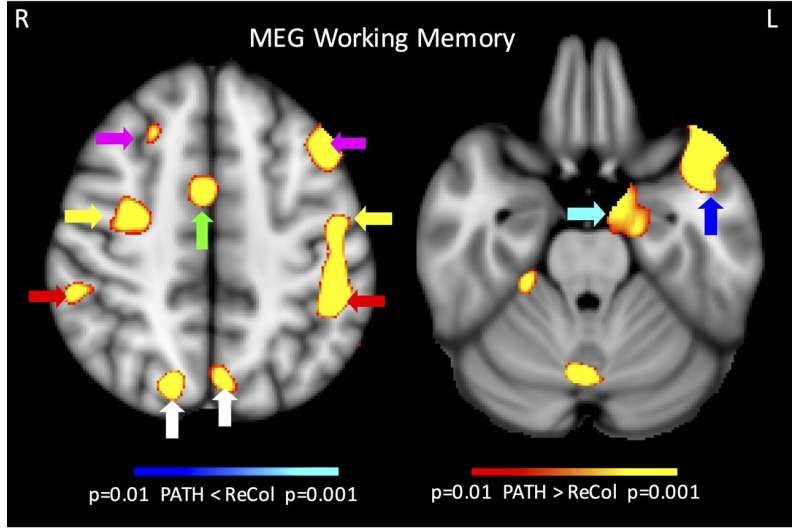
One of the most important aspects of the study is that the improvements were not based solely on behavioral tests. Researchers used magnetoencephalography (MEG) at the UC San Diego Qualcomm Institute to directly observe changes in brain activity.
MEG is a highly advanced brain imaging technique that measures neural activity with exceptional precision in both space and time. Using this technology, scientists were able to see how working memory and attention networks reorganized after PATH training.
The imaging data revealed strengthened neural responses across multiple brain regions, providing strong evidence that the observed cognitive improvements reflected genuine functional recovery rather than temporary compensation or test familiarity.
Improvements Beyond Cognition
While the primary focus of the study was cognitive performance, researchers also noted early signs of broader benefits. Participants undergoing PATH training showed preliminary improvements in emotional functioning and reported reductions in common post-concussive symptoms such as mental fatigue and difficulty focusing.
These changes suggest that restoring foundational visual processing may have ripple effects across the brain, improving not only cognition but also overall quality of life.
Why Visual Timing Matters So Much
Visual timing refers to how accurately the brain processes rapidly changing visual information, especially motion. Even small disruptions in this system can make reading harder, slow down reaction times, and overload attention networks.
In everyday life, this affects tasks such as following lines of text, tracking moving objects, or filtering out visual distractions. When visual timing is impaired, higher-level cognitive systems are forced to work harder, often leading to mental exhaustion and poor performance.
By directly addressing these timing deficits, PATH appears to reduce the cognitive “noise” that makes thinking feel so effortful after a concussion.
How This Research Could Change Concussion Rehabilitation
The findings point toward a paradigm shift in how concussion recovery is approached. Instead of treating attention, memory, and executive function as isolated skills, the research highlights the importance of repairing underlying sensory processing systems first.
This approach may help explain why some patients fail to respond to traditional therapies and why others experience only partial recovery.
The research team is now planning a larger, multi-site Phase II clinical trial, funded by the National Institutes of Health (NIH), scheduled for fall 2026. This trial aims to confirm the results in a broader population and further refine how PATH can be integrated into clinical practice.
The Bigger Picture for Brain Rehabilitation
Beyond concussion recovery, this study adds to a growing understanding of how sensory processing and cognition are deeply interconnected. Similar principles may apply to other conditions involving attention and learning difficulties, including developmental disorders and age-related cognitive decline.
By combining behavioral training with objective brain imaging, the study sets a strong example of how neuroscience can guide more effective, evidence-based rehabilitation strategies.
What This Means for Patients and Clinicians
For individuals living with lingering cognitive symptoms after a concussion, the findings offer real hope backed by measurable brain changes. For clinicians, the study provides a clearer roadmap for designing rehabilitation programs that target the root of the problem rather than just the symptoms.
As research continues, approaches like PATH may become a standard part of concussion care, helping patients regain not only cognitive skills but also confidence in their daily lives.
Research paper:
https://doi.org/10.3389/fnhum.2025.1698605