A Tiny Optical Chip Could Remove One of the Biggest Barriers to Building Massive Quantum Computers
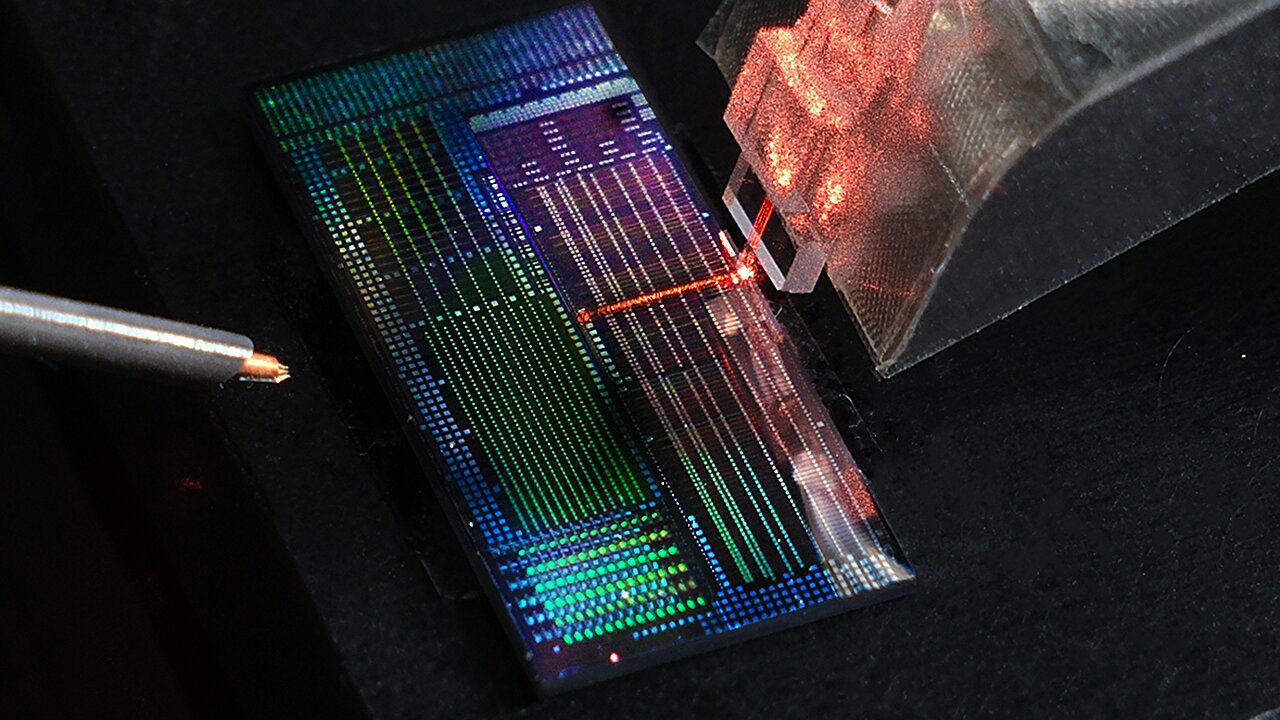
Researchers have taken a major step toward making large-scale quantum computers a reality by developing an ultra-small optical device that can precisely control laser light while consuming far less power than existing technology. The new device, an advanced optical phase modulator, is nearly 100 times smaller than the diameter of a human hair and could fundamentally change how future quantum computers are built.
This breakthrough comes from a collaboration led by scientists at the University of Colorado Boulder, working alongside researchers from Sandia National Laboratories. Their findings were published in the journal Nature Communications and focus on solving one of the most stubborn problems in quantum computing: how to efficiently control enormous numbers of lasers needed to operate very large quantum systems.
Why Laser Control Is a Big Deal in Quantum Computing
Many of today’s most promising quantum computing platforms rely on individual atoms or ions to store and process information. These include trapped-ion and neutral-atom quantum computers, which use carefully tuned laser beams to manipulate the quantum states of atoms.
Each atom acts as a qubit, the quantum equivalent of a classical bit. To perform calculations, scientists must “talk” to each qubit using laser light whose frequency, phase, and timing are controlled with extraordinary precision. In many cases, the laser frequency must be accurate to within billionths of a percent.
That precision doesn’t come easily. At present, researchers use bulky tabletop electro-optic modulators to shift and control laser frequencies. These devices work well in laboratory experiments with small numbers of qubits, but they come with serious drawbacks. They are large, power-hungry, and generate significant heat.
Scaling such systems up to the tens or hundreds of thousands of qubits needed for practical quantum computers would require an absurd number of these bulky devices. Simply put, today’s hardware cannot scale.
A Tiny Modulator With Outsized Capabilities
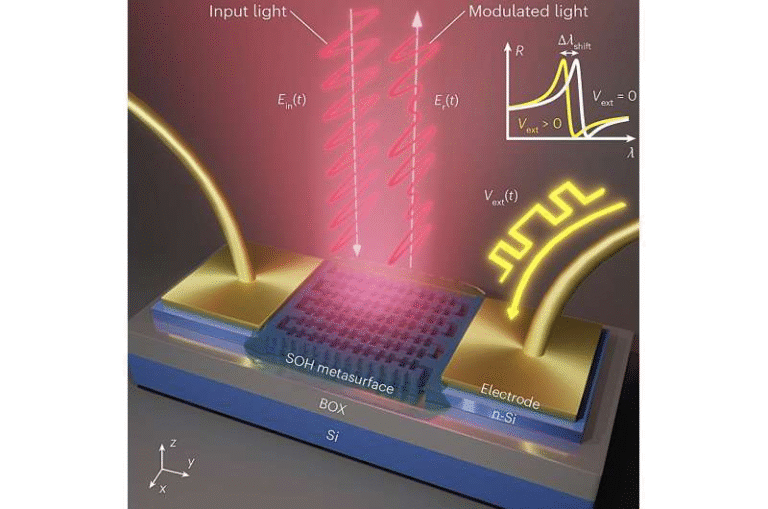
The newly developed optical phase modulator tackles this problem head-on. Despite its incredibly small size, the device can manipulate laser light with extreme accuracy using microwave-frequency vibrations that oscillate billions of times per second.
At the heart of the chip is an acousto-optic system. Electrical microwave signals drive a piezoelectric actuator, which converts those signals into mechanical vibrations. These vibrations then interact with an optical waveguide, subtly changing how light travels through it. The result is precise phase modulation of visible-wavelength laser light.
This allows the chip to generate new laser frequencies with high stability and efficiency, a critical requirement for quantum computing, quantum sensing, and quantum networking applications.
One of the most impressive achievements is efficiency. The new device consumes roughly 80 times less microwave power than many commercially available modulators. Lower power consumption means less heat, which in turn allows many more optical channels to be placed close together, even on a single chip.
Built With the Same Technology as Everyday Electronics
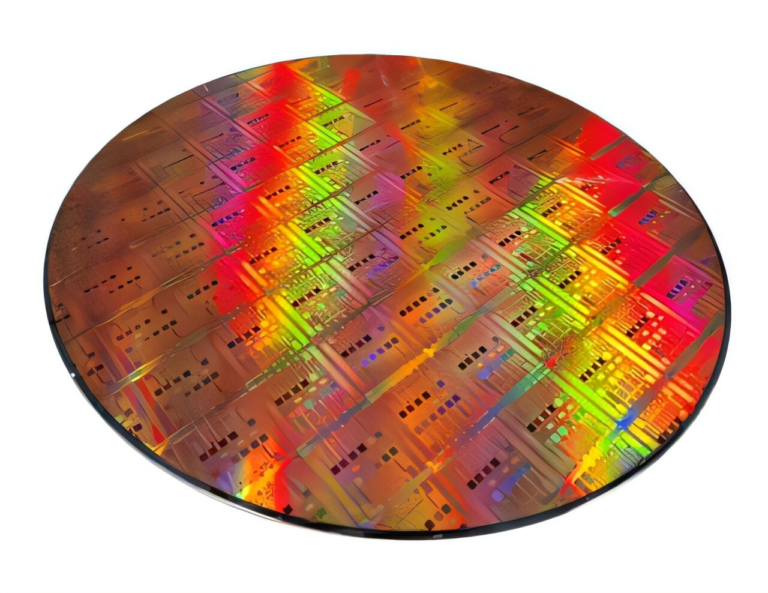
What truly sets this development apart is how the device is manufactured. Instead of relying on custom, hand-assembled components, the team used CMOS fabrication, the same industrial process used to manufacture processors found in phones, computers, cars, appliances, and countless other electronic devices.
CMOS manufacturing is widely regarded as the most scalable technology ever developed. Modern chips contain billions of nearly identical transistors, all produced with astonishing consistency. By designing the optical modulator to be compatible with this process, the researchers have made it possible to mass-produce thousands or even millions of identical photonic devices.
This approach marks a shift away from what some researchers describe as the optical equivalent of vacuum tubes and toward a future where photonics experiences its own transistor-style revolution. Integrated photonic devices could become smaller, cheaper, and far more efficient, just like electronic components did decades ago.
Designed for Real-World Quantum Machines
The optical modulator is not just a laboratory curiosity. It was engineered to handle high optical power, exceeding 500 milliwatts at visible wavelengths commonly used in atom-based quantum systems. This makes it suitable for the intense laser beams required to manipulate atoms reliably.
Because the device is so compact and energy-efficient, it opens the door to dense integration. Instead of sprawling optical tables filled with discrete components, future quantum computers could rely on a handful of photonic chips to manage thousands of laser channels.
This is a critical step toward building quantum machines that are not only powerful but also practical, reliable, and manufacturable at scale.
What Comes Next for This Technology
The research team is already working on the next phase of development. Their goal is to create fully integrated photonic circuits that combine multiple functions on a single chip. These would include frequency generation, filtering, and pulse shaping, all essential operations for quantum control.
Such integration would further reduce size, power consumption, and system complexity. It would also bring quantum hardware closer to the kind of plug-and-play scalability seen in classical computing.
The team also plans to collaborate with quantum computing companies to test these chips in state-of-the-art trapped-atom and trapped-ion quantum computers. Real-world testing will be crucial to understanding how the devices perform under operational conditions.
Why This Matters Beyond Quantum Computing
While quantum computing is the most obvious beneficiary, this technology has implications well beyond that field. Precise, low-power optical modulation is also essential for quantum sensors, which can detect extremely small changes in time, gravity, or magnetic fields.
It also plays a role in quantum networking, where information is transmitted securely using quantum states of light. Scalable, integrated photonic devices could help make quantum communication systems more robust and widespread.
More broadly, this work demonstrates how integrated photonics is becoming a cornerstone technology for the next generation of advanced systems, much as integrated electronics transformed computing in the 20th century.
A Key Piece of the Quantum Scaling Puzzle
Building a truly large-scale quantum computer requires solving many interconnected challenges, from error correction to cryogenic engineering. Precise and scalable laser control has long been one of the most stubborn bottlenecks.
This tiny optical modulator may not solve every problem, but it addresses a critical missing piece. By combining extreme precision, low power consumption, and mass-manufacturable design, it brings the idea of controlling very large numbers of qubits much closer to reality.
As quantum hardware continues to evolve, innovations like this one suggest that the future of quantum computing may look far more compact, efficient, and scalable than previously imagined.
Research paper:
https://www.nature.com/articles/s41467-025-65937-z