How CERN Is Expanding the World’s Largest Cryogenic System for the High-Luminosity Large Hadron Collider
Behind every spectacular particle collision at CERN’s Large Hadron Collider (LHC) lies an enormous amount of engineering that rarely gets the spotlight. One of the most critical—and least visible—pieces of that puzzle is cryogenics. As CERN prepares the LHC for its next major upgrade, known as the High-Luminosity LHC (HL-LHC), its already massive cryogenic system is being pushed to an entirely new level.
The LHC is not just the world’s most powerful particle accelerator; it is also the largest cryogenic installation on Earth. Out of its 27-kilometer circumference, 23 kilometers are kept at an astonishing 1.9 Kelvin, or −271°C, just a hair above absolute zero. This extreme cold is essential because the accelerator relies on thousands of superconducting magnets, and superconductivity only works when materials are cooled to ultra-low temperatures. At these temperatures, electrical resistance disappears, allowing powerful magnetic fields to guide particle beams around the ring with extraordinary precision.
Why the LHC Needs to Be So Cold
The LHC’s magnets are cooled using superfluid helium, a special state of helium that flows without viscosity and has exceptional heat-transfer properties. This allows CERN engineers to remove heat efficiently from the magnets, keeping them stable during operation. Maintaining such conditions across tens of kilometers makes the LHC a truly unique industrial-scale refrigeration system.
But the current setup, impressive as it is, will not be sufficient for what comes next.
Enter the High-Luminosity LHC Upgrade
The High-Luminosity LHC is a major upgrade project designed to dramatically increase the number of particle collisions produced by the accelerator. Rather than boosting energy, the focus is on luminosity, meaning how many collisions occur at each beam crossing. Higher luminosity gives physicists far more data, increasing the chances of spotting rare processes and subtle deviations from known physics.
To achieve this, CERN is installing more powerful focusing magnets and new types of radio-frequency cavities near the two largest experiments, ATLAS and CMS. These components squeeze and stabilize the particle beams more tightly, producing far more collisions in the same amount of time.
However, this ultra-sophisticated equipment comes at a cost: significantly higher heat loads. More powerful magnets and new cavities generate additional thermal energy, and without extra cooling capacity, the entire system would be at risk.
Expanding an Already Massive Cryogenic System
To meet these new demands, CERN is expanding its cryogenic infrastructure. The existing LHC relies on eight large refrigerators, but the HL-LHC will require two additional, even more powerful refrigerators. These new systems are being installed on both sides of the ATLAS and CMS experiments.
Although the principles behind these refrigerators are similar to the one in your kitchen, the scale is almost hard to imagine. Each installation occupies several buildings on the surface and includes massive helium compressors and an enormous component known as a cold box. Inside the cold box are heat exchangers and expansion turbines that gradually lower the temperature of helium gas.
The surface installations cool helium down to 4.5 Kelvin (−268.6°C). From there, the helium is sent underground, where additional equipment brings it down to the final operating temperature of 1.9 Kelvin.
New Cold Boxes Arrive at CERN
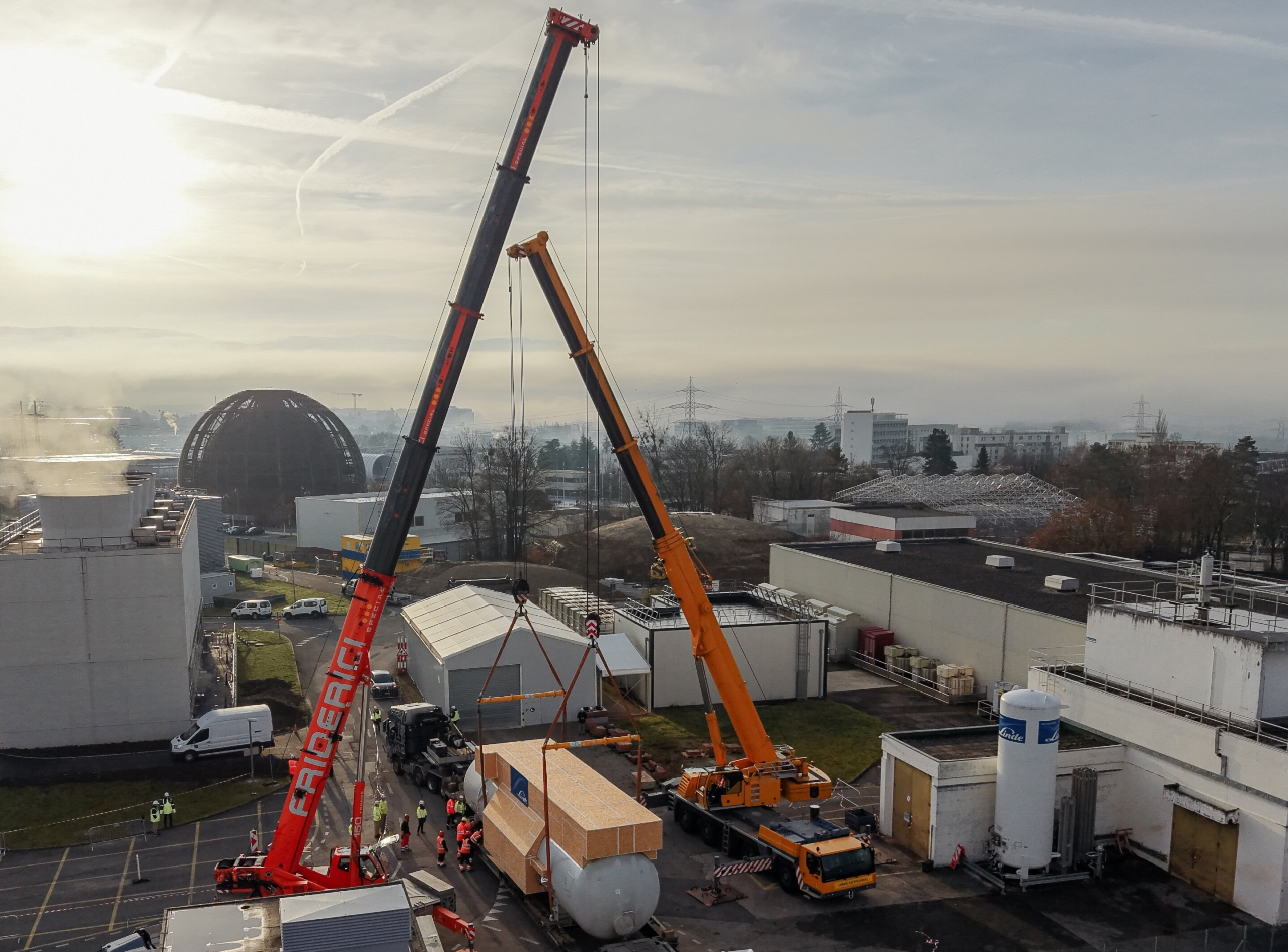
In October, CERN completed the installation of six large helium compression units, a key milestone in the upgrade process. More recently, work advanced with the arrival and installation of two huge cold boxes at the ATLAS and CMS sites.
These cold boxes are cylindrical giants, each measuring 16 meters in length and 3.5 meters in diameter. They were manufactured in Germany by Linde, a company with extensive experience in industrial cryogenics. Getting them to CERN was a logistical operation in itself. The cold boxes traveled by barge along the Danube, the Main, and the Rhine, before continuing their journey by road via Basel to reach the CERN site.
Once installed, these cold boxes will play a central role in providing the additional cooling power required by the HL-LHC.
What Comes Next Underground
The work is far from over. Throughout the coming year, teams will focus on connecting all system components and installing advanced control systems to manage the complex cryogenic operations. At the same time, engineers will install cryogenic transfer lines that carry helium from the surface installations down into the underground accelerator tunnel.
In February, another important step is planned: the installation of two smaller cold boxes underground. These units handle the final stage of cooling, lowering the helium temperature by the last few crucial degrees to reach 1.9 Kelvin.
Testing Before Full Operation
By the end of 2026, CERN expects the new cryogenic installations to be fully assembled and ready for testing. Instead of immediately cooling the accelerator components, engineers will first use heating systems that simulate real thermal loads. These tests will mimic the heat produced by magnets, cavities, cold powering systems, and other equipment that requires cooling.
This careful testing phase is essential. Operating at such extreme temperatures leaves little room for error, and every component must perform flawlessly before the HL-LHC enters routine operation.
Why Cryogenics Matter So Much in Particle Physics
Cryogenics is often overlooked when people talk about particle accelerators, yet it is one of the enabling technologies that make modern high-energy physics possible. Without superconducting magnets—and without the ability to keep them cold—machines like the LHC simply could not exist in their current form.
The HL-LHC upgrade highlights how advances in physics are tightly linked to advances in engineering, materials science, and industrial refrigeration. Improving luminosity is not just about better detectors or smarter data analysis; it also depends on the ability to manage enormous thermal and electrical demands reliably over decades of operation.
Looking Toward 2030 and Beyond
The High-Luminosity LHC is scheduled to begin operation around 2030, and when it does, it will open a new chapter in particle physics. With vastly increased collision rates, researchers hope to gain deeper insights into the Higgs boson, search for signs of new physics beyond the Standard Model, and explore phenomena that are currently just beyond reach.
None of that will happen without a cryogenic system capable of sustaining one of the coldest environments ever created on Earth. As CERN expands and reinforces this frozen backbone of the accelerator, it is quietly laying the groundwork for discoveries that could reshape our understanding of the universe.
Research reference: https://cds.cern.ch/record/2937834