Journey to the Center of a Quantized Vortex Shows How Microscopic Friction Controls Superfluid Dissipation
Superfluids are among the strangest forms of matter known to physics. Unlike everyday liquids such as water, oil, or syrup, a superfluid can flow without viscosity, meaning it experiences no resistance as it moves. Once set in motion, it can, in principle, keep flowing forever. This remarkable behavior defies common intuition and has fascinated scientists for decades. A new international study now takes a deep dive into one of the most important features of superfluids—quantized vortices—to uncover how energy dissipation still occurs at the microscopic level.
The research, led by scientists at the European Laboratory for Non-Linear Spectroscopy (LENS) and involving collaborators from CNR-INO, the Universities of Florence, Bologna, Trieste, Augsburg, and the Warsaw University of Technology, investigates how vortices behave inside a strongly interacting superfluid. The findings reveal how subtle internal forces, known as mutual friction, govern vortex motion and ultimately control how superfluids lose energy despite their frictionless nature. The study has been published in Nature Communications.
Understanding quantized vortices in superfluids
In a superfluid, motion does not occur in a smooth, continuous way as it does in ordinary fluids. Instead, it organizes itself into quantized vortices—tiny whirlpools that carry angular momentum in discrete units. These vortices are long-lived, stable objects and form the basic building blocks of superfluid flow. Because conventional decay mechanisms are suppressed, vortices play a central role in determining how superfluids behave over time.
Even though superfluids lack ordinary friction, they are not completely immune to energy loss. At finite temperatures, superfluids consist of both a superfluid component and a normal component. Interactions between these two components generate internal forces that act directly on vortices. This process is known as mutual friction, and it is the key mechanism behind superfluid dissipation.
By closely examining how vortices move, scientists can probe the microscopic physics that governs mutual friction. This is precisely the approach taken in the new study.
A clean and controllable experimental platform
The researchers used an ultracold gas of lithium atoms, cooled to just ten billionths of a degree above absolute zero, to create a strongly interacting fermionic superfluid. Ultracold atomic gases offer a uniquely clean and programmable environment compared to traditional systems like superfluid helium or solid-state superconductors. In those systems, experiments often involve large numbers of interacting vortices arranged in complex configurations that are difficult to control or interpret.
In contrast, ultracold gases allow scientists to engineer and observe individual vortices with exceptional precision. Using carefully shaped laser light, the team generated quantized vortices by moving an optical potential through the superfluid. This technique made it possible to create arbitrary vortex configurations and isolate the dynamics of a single vortex.
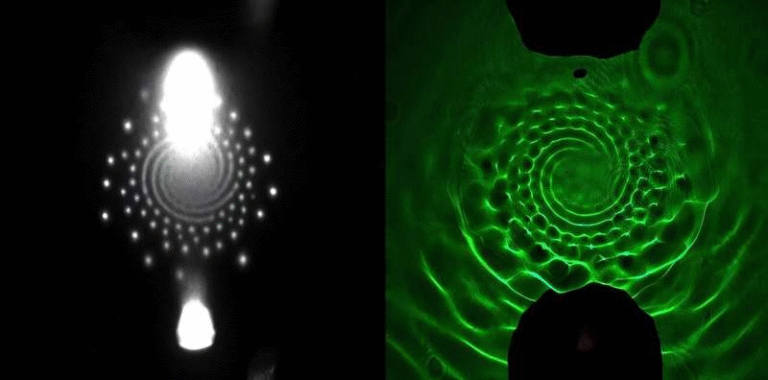
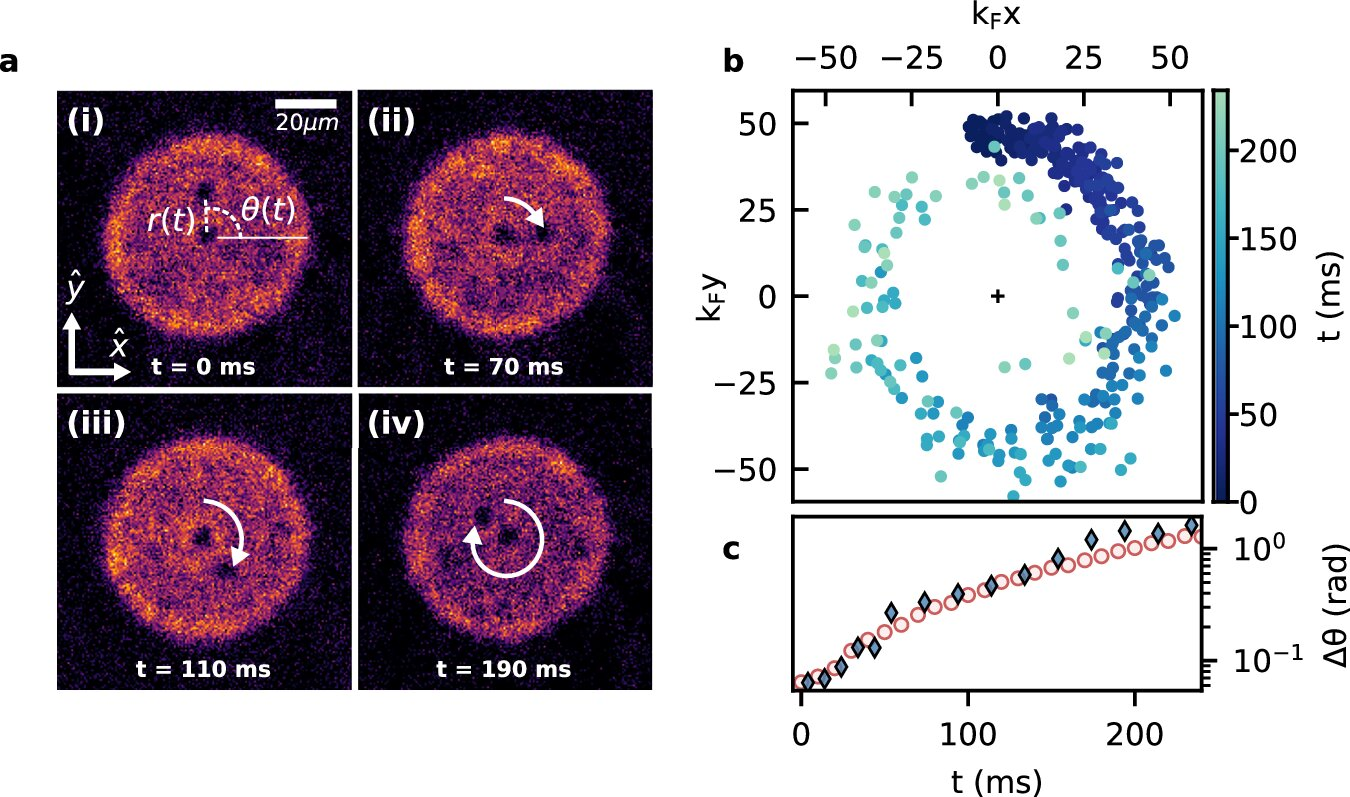
The experiment focused on a disk-shaped superfluid containing one vortex pinned at the center and another free vortex orbiting around it. By imaging the system at different times and averaging over multiple experimental realizations, the researchers were able to reconstruct the vortex trajectories with high accuracy.
Observing vortex motion and dissipation
As the free vortex orbited the pinned one, its motion gradually changed over time. Rather than maintaining a perfectly circular orbit, the vortex followed a spiraling trajectory, indicating the presence of dissipative forces. By analyzing these trajectories in detail, the team extracted key information about how mutual friction influences vortex motion.
The experimental data were compared with simulations based on a dissipative point-vortex model (DPVM). Thousands of independent simulations were performed, each starting with slightly different initial vortex positions within the experimentally measured uncertainty. The close agreement between the experimental observations and the theoretical model allowed the researchers to identify the microscopic processes responsible for the observed dissipation.
One of the most significant findings is that vortex dynamics in this regime are strongly affected by quasiparticles trapped inside the vortex core. These quasiparticles occupy quantum states known as Caroli–de Gennes–Matricon states, which were originally predicted in the context of superconductors. The results provide the first indirect experimental evidence that these states play an active role in vortex dynamics within a strongly interacting fermionic superfluid.
Why mutual friction matters
Mutual friction is a fundamental concept in the physics of superfluids and superconductors. It determines how efficiently currents can flow and how energy is dissipated when vortices move. By directly measuring how vortices respond to internal forces, the study sheds light on the microscopic origins of dissipation in systems that were once thought to be entirely frictionless.
These insights are relevant far beyond ultracold atomic gases. Similar vortex dynamics occur in superfluid helium-3, superconductors, and even in extreme astrophysical environments such as the interiors of neutron stars. In all of these systems, vortex motion plays a crucial role in determining macroscopic behavior.
Broader implications and future directions
According to the researchers, ultracold atomic gases provide an unparalleled platform for exploring exotic superfluid phenomena. The level of control achieved in these experiments makes it possible to recreate conditions that are otherwise inaccessible in conventional materials. Understanding vortex dynamics at this level is essential for designing highly efficient quantum devices, where minimizing energy dissipation is a major goal.
The experimental platform can also be extended to study systems with many interacting vortices, opening the door to controlled investigations of superfluid turbulence. Turbulence in quantum fluids is a rich and complex phenomenon with implications ranging from fundamental physics to advanced technological applications.
Extra background: why vortices are so important in quantum fluids
Vortices are not just curiosities; they are central to how quantum fluids behave. In classical fluids, turbulence involves chaotic swirls across many length scales. In quantum fluids, turbulence is instead built from networks of quantized vortices, each carrying an identical amount of circulation. Studying single-vortex dynamics is therefore a crucial step toward understanding collective vortex behavior.
In superconductors, vortices determine how magnetic fields penetrate materials and directly affect electrical resistance. In neutron stars, vortex motion is thought to be linked to sudden changes in rotation known as glitches. Insights gained from tabletop experiments with ultracold atoms can thus inform our understanding of some of the most extreme environments in the universe.
By connecting precise experimental observations with microscopic theory, this study marks an important step forward in quantum fluid research. It demonstrates that even in a world without ordinary friction, dissipation still finds a way, governed by the subtle quantum structure hidden at the center of a vortex.
Research paper: https://www.nature.com/articles/s41467-025-64992-w