Promising New Superconducting Material Discovered With the Help of AI
Researchers from Tohoku University and Fujitsu Limited have demonstrated how artificial intelligence can play a direct and meaningful role in advancing materials science, particularly in the long-standing challenge of understanding superconductivity. By applying AI-based causal discovery techniques to complex experimental data, the team uncovered new insights into the superconducting mechanism of a promising material, potentially opening doors to faster and more efficient materials development across multiple industries.
The research, published in Scientific Reports in 2025, focuses on how AI can move beyond pattern recognition and instead identify cause-and-effect relationships in massive scientific datasets. This is a crucial step toward automating parts of scientific discovery that have traditionally depended heavily on human intuition and experience.
Using AI to Understand Superconductivity at a Deeper Level
Superconductivity is a phenomenon where a material can conduct electricity without resistance, usually at very low temperatures. While superconductors have enormous potential—ranging from energy transmission to advanced electronics—the mechanisms behind superconductivity in many modern materials remain poorly understood.
In this study, Tohoku University and Fujitsu used AI to analyze experimental data and clarify how electrons interact inside a superconducting material. The goal was not just to process data faster, but to extract meaningful causal relationships that explain why superconductivity occurs.
The AI technology used in this work is part of Fujitsu Kozuchi, Fujitsu’s advanced AI platform. Specifically, the researchers developed a new discovery intelligence technique that can estimate causal relationships with high accuracy. Fujitsu has announced plans to offer a trial environment for this technology starting in March 2026, signaling an intention to make these tools more widely available for research and development.
The Role of NanoTerasu and ARPES Measurements
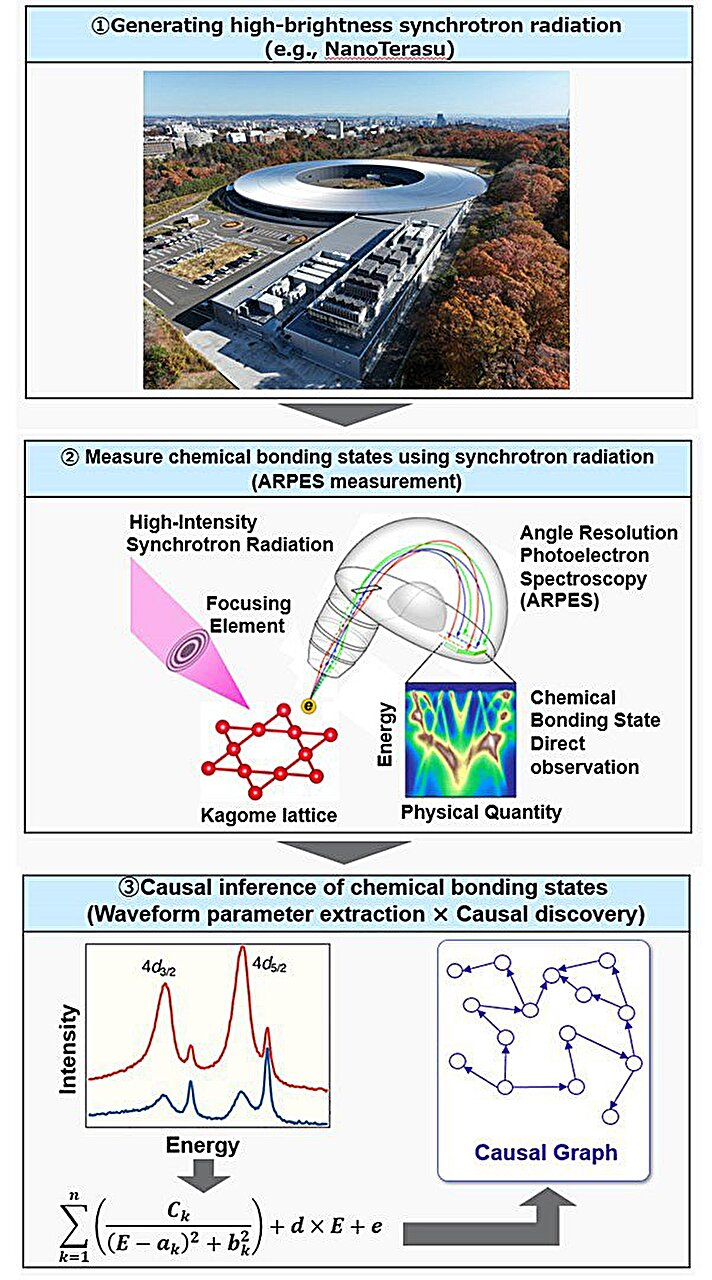
A key part of this research involved experimental data collected at NanoTerasu, a next-generation synchrotron light source located in Japan. NanoTerasu began operation in April 2024 and is known for its nanometer-level spatial resolution, allowing scientists to observe molecular, atomic, and electronic states with exceptional precision.
The data analyzed by the AI came from angle-resolved photoemission spectroscopy (ARPES), a widely used experimental technique in materials science. ARPES allows researchers to directly observe the behavior and energy states of electrons inside a material, making it particularly valuable for studying superconductors.
However, ARPES experiments generate enormous volumes of data. As measurement performance improves, the complexity and scale of this data grow rapidly, making traditional analysis methods increasingly impractical.
Solving the Big Data Problem in Materials Science
One of the major challenges addressed in this research is the difficulty of extracting useful insights from massive datasets. In ARPES data analysis, constructing a causal graph directly from raw data can result in a graph with an overwhelming number of nodes, making it nearly impossible to interpret.
To address this, the researchers developed a method that significantly compresses the scale of the causal graph. Instead of building the graph from raw measurement data, the AI first performs fitting based on a model equation for the spectroscopy data. From this process, only key parameters are extracted, and the causal graph is constructed using these parameters rather than the full dataset.
In addition, the team introduced techniques to further simplify the causal graphs and reduce the impact of noise. As a result, the size of the causal graph was reduced to less than one-twentieth of what would be produced using conventional approaches. This dramatic reduction made it possible to efficiently identify meaningful relationships that would otherwise be hidden.
The Superconducting Material: CsV₃Sb₅
The AI-driven analysis was applied to a material known as cesium vanadium antimonide (CsV₃Sb₅). This compound belongs to a class of materials called kagome superconductors, named after their distinctive lattice structure.
CsV₃Sb₅ has attracted attention because of its potential as a high-temperature superconductor, but its superconducting mechanism has not been fully understood. Previous theories suggested that superconductivity in this material was driven mainly by interactions involving vanadium electrons, or possibly a combination of vanadium and antimony electrons.
The new AI-based analysis revealed something important: cesium electrons also play a significant role. According to the causal relationships identified by the AI, superconductivity in CsV₃Sb₅ arises from the interaction of vanadium, antimony, and cesium electrons together, rather than from a more limited subset of elements.
This finding provides a clearer picture of the microscopic processes underlying superconductivity in this material and helps resolve uncertainties that could not be fully addressed using traditional analysis alone.
Why This Matters for Future Technologies
The implications of this work extend well beyond a single material. By demonstrating that AI can automatically extract causal relationships from complex experimental data, the study highlights a powerful new approach to materials discovery and development.
Potential application areas include high-temperature superconductors, next-generation low-power electronic devices, and technologies aimed at addressing environmental and energy challenges. Fujitsu has identified environmental sustainability as one of its key priorities, and advances in superconductivity could contribute to more efficient energy systems.
The collaboration also aligns with the mission of NanoTerasu, which aims to support the development of new functional materials that drive innovation while helping to resolve societal issues.
A Long-Term Collaborative Effort
This research is part of a broader partnership between Tohoku University and Fujitsu. In October 2022, the two organizations established the Fujitsu x Tohoku University Discovery Intelligence Laboratory under Fujitsu’s Small Research Lab initiative. The program places Fujitsu researchers within universities to promote long-term collaboration, accelerate joint research, and develop human resources.
Together with the Advanced Institute for Materials Research (WPI-AIMR) at Tohoku University, the teams are working toward the social implementation of discovery intelligence, where AI helps identify solutions to complex problems directly from data.
AI and the Future of Scientific Research
As scientific instruments become more advanced, researchers are increasingly faced with a paradox: more data than ever, but limited ability to analyze it efficiently. This study shows how AI can help bridge that gap by reducing reliance on human intuition and advancing the automation of scientific research processes.
By combining world-class experimental facilities like NanoTerasu with AI-driven causal discovery, the researchers have taken an important step toward a future where AI actively contributes to uncovering the fundamental mechanisms behind complex physical phenomena.
Research Paper:
Extracting causality from spectroscopy – Scientific Reports (2025)
https://doi.org/10.1038/s41598-025-29687-8