Researchers Develop a Reconfigurable On-Chip Platform That Can Dramatically Slow Down Light for Advanced Photonic Engineering
Photonic chips have long been viewed as the natural successor to traditional electronic chips. Instead of relying on moving electrons, these chips use light to carry and process information, promising faster speeds and lower energy consumption. While the idea is powerful, practical challenges—especially related to light loss and fabrication defects—have limited how far photonic chips can go. Now, researchers from the University of Illinois Urbana-Champaign’s Grainger College of Engineering have demonstrated a major breakthrough that could push on-chip photonics much closer to its full potential.
The team has developed a reconfigurable slow-light platform that can dramatically reduce the speed of light as it travels through a photonic chip—by nearly 1,000 times. This approach effectively allows light to linger longer inside the chip, opening new possibilities for high-resolution photonics, quantum memory, and advanced optical signal processing. Their work was published in Nature Communications in 2025.
Why Slowing Light on a Chip Matters
In conventional electronic chips, data storage and processing depend on how long electrical signals can be held and controlled. Photonic chips face a similar challenge, but instead of electrons, they must manage photons. The key component used for this task is an optical resonator, a structure that traps light and makes it circulate repeatedly.
The performance of these resonators is measured using a parameter called the quality factor, or Q-factor. A higher Q-factor means that light remains trapped for a longer time, which translates to better spectral resolution and more precise control. However, on-chip resonators often suffer from imperfections introduced during manufacturing, which cause light to leak out quickly and limit achievable Q-factors.
The Illinois research team took a different approach. Instead of trying to eliminate every defect, they focused on extending the time light spends inside the device by slowing its propagation. When light moves more slowly, it effectively behaves as if it is being stored—even without a physically larger device.
How the Slow-Light Effect Was Achieved
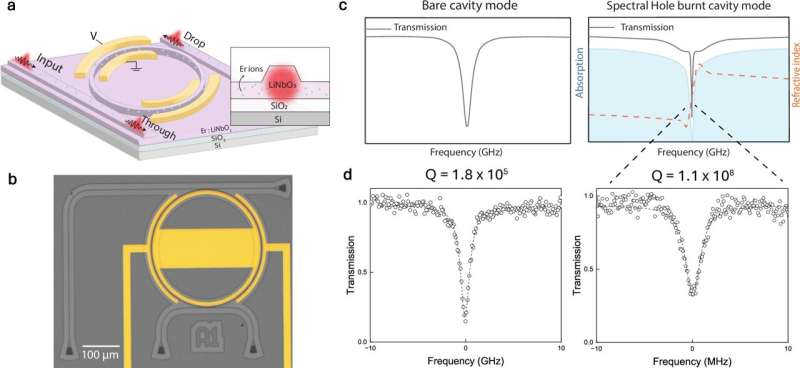
The breakthrough relies on a phenomenon known as spectral hole burning, applied within a carefully chosen material system. The researchers used erbium-doped lithium niobate, a material already well known in photonics for its excellent optical properties, high coherence, and compatibility with integrated platforms.
Spectral hole burning works by creating narrow transparency windows—“holes”—inside a broader absorption profile of the material. These holes produce extremely steep changes in optical dispersion. As a result, the group velocity of light—the speed at which optical information travels—drops dramatically.
By engineering these spectral features inside microring resonators, the team was able to create a slow-light effect directly on a photonic chip. This slowed propagation significantly increased the effective Q-factor of the resonators, reaching ultra-high values exceeding 100 million. Importantly, this enhancement did not require changes to the chip’s physical geometry.
An Unexpected Discovery Leads to a New Platform
The slow-light behavior was initially discovered unintentionally. While working on improving quantum memory efficiency, the researchers noticed unexpected dips in their spectral measurements. Further investigation revealed that these anomalies were not experimental errors but signatures of slowed light inside the resonator.
Recognizing the importance of this effect, the team systematically developed it into a fully tunable and reconfigurable platform. Unlike conventional photonic devices that are designed for a single function, this system allows the optical properties to be reprogrammed repeatedly by modifying the spectral hole pattern.
This flexibility is one of the most important aspects of the work. Instead of fabricating a new device for every application, engineers can dynamically adjust the same chip to perform different tasks, all through optical control.
Implications for Quantum Memory and Quantum Photonics
One of the most promising applications of this research lies in quantum memory, a critical component for future quantum networks and quantum computers. Quantum memory requires storing light without destroying the delicate quantum information it carries—a task that is notoriously difficult on integrated platforms.
Until now, high-performance quantum memories have relied on bulk optical systems, which are large, fragile, and difficult to scale. The new slow-light platform provides a path toward on-chip quantum memory, combining compact size with long photon storage times.
Slowing light also enables better interaction between photons and matter, which is essential for quantum operations such as entanglement generation and single-photon storage. The ability to slow single photons on a chip could significantly advance scalable quantum technologies.
Benefits for Classical Photonic Technologies
While quantum applications often get the spotlight, the impact on classical photonics is equally important. High-Q resonators with slow-light enhancement can dramatically improve:
- Optical filters with extremely narrow linewidths
- Delay lines for signal processing
- Laser stabilization systems
- High-precision optical sensors
Because the platform is tunable across a large bandwidth, it can adapt to different wavelengths and operational needs, making it valuable for telecommunications and integrated optical circuits.
Why Lithium Niobate and Erbium Are Key
Lithium niobate has emerged as one of the most important materials in modern photonics due to its electro-optic properties, which allow optical signals to be controlled with electrical inputs. Adding erbium ions introduces absorption features at telecom-relevant wavelengths, making the material ideal for both classical and quantum systems.
In this work, erbium not only enables spectral hole burning but also provides long coherence times, which are essential for maintaining optical information. The combination of these properties makes erbium-doped lithium niobate uniquely suited for reconfigurable slow-light devices.
A Platform Designed for Reconfiguration
One of the standout aspects of this research is its reconfigurability. Traditional photonic devices are static: once fabricated, their function is fixed. In contrast, the Illinois platform allows engineers to reshape its optical response repeatedly without altering the hardware.
By burning different spectral holes, researchers can create more complex dispersion structures, opening the door to custom photonic functionalities that go far beyond simple light storage. This makes the platform more like a toolkit than a single-purpose device.
Looking Ahead
The researchers see this work as a foundation rather than a final product. Future efforts will explore more complex spectral structures, improved coherence, and integration with other photonic and quantum components. The ultimate goal is a fully integrated, scalable photonic platform capable of supporting advanced classical and quantum technologies.
In simple terms, by learning how to slow light down on a chip, the team has unlocked new ways to control, store, and manipulate photons—bringing photonic engineering one step closer to matching the versatility of electronic circuits, while surpassing them in speed and efficiency.
Research Paper Reference:
https://www.nature.com/articles/s41467-025-65533-1