Scientists Discover a New Way Cells Use Electricity Through Tiny Internal Droplets
Electricity plays a central role in biology. It controls how nerves fire, how hearts beat, and how molecules move in and out of cells. For decades, scientists believed they had a solid understanding of how electrical signals are generated and regulated in living systems. Now, new research from Scripps Research has revealed a surprising and entirely new contributor to cellular electricity: biomolecular condensates—droplet-like structures inside cells that can directly alter membrane voltage.
This discovery adds a fresh layer to our understanding of bioelectricity, showing that cells may regulate electrical signals not only through ion channels and membranes, but also through internal, membrane-less structures acting almost like tiny biological batteries.
A New Player in Cellular Bioelectricity
The study shows that biomolecular condensates, which were previously known mainly for organizing cellular components, can locally change the electrical properties of cell membranes. When these condensates come into contact with a membrane, they can induce a measurable change in voltage right at the point of contact.
This is significant because membrane voltage influences countless cellular processes, including the activation of ion channels, signaling pathways, and transport mechanisms. Until now, membrane voltage was largely thought of as a global property of the cell. This research demonstrates that highly localized voltage changes can also occur, driven by internal structures.
What Are Biomolecular Condensates?
Biomolecular condensates are droplet-like assemblies of proteins and nucleic acids that form through a process called phase separation. Unlike familiar organelles such as the nucleus or mitochondria, condensates are not enclosed by membranes. Instead, they are held together by molecular interactions and electrical forces.
These condensates are involved in a wide range of essential cellular functions, including:
- Compartmentalizing biochemical reactions
- Organizing proteins and RNA
- Regulating signaling pathways
- Facilitating interactions between different cellular components
They also exist outside of cells, for example at neuronal synapses, where communication between nerve cells occurs. While scientists already knew that condensates often carry electrical charges on their surfaces, how those charges might affect cellular electrical behavior remained largely unexplored—until now.
How Researchers Tested the Idea
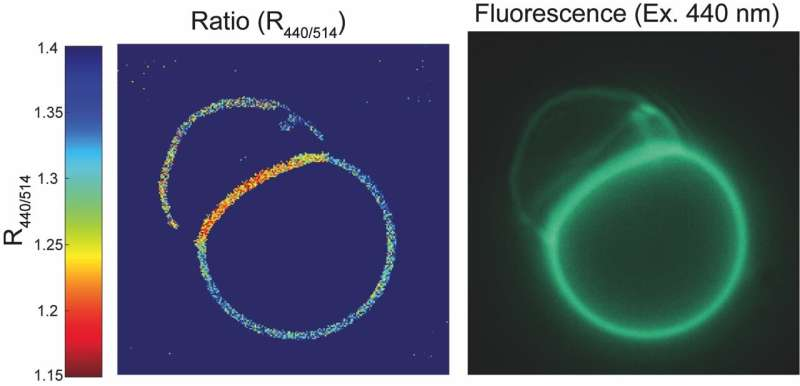
To investigate whether condensates could influence membrane voltage, researchers used a simplified cell model called Giant Unilamellar Vesicles (GUVs). These are large, spherical structures made of lipid membranes that closely mimic the properties of real cell membranes.
The membranes of these vesicles were stained with a voltage-sensitive dye that changes color depending on electrical charge. This allowed the researchers to visually track changes in membrane voltage in real time.
Lab-made condensates with varying electrical charges were then introduced into the same environment as the GUVs. Using advanced microscopy, scientists observed what happened when the condensates collided with the vesicle membranes.
What They Found
The results were clear and striking:
- When a charged condensate touched a membrane, it caused a local change in membrane voltage at the contact point
- The magnitude of the voltage change depended on how much electrical charge the condensate carried
- Condensates with higher surface charge produced larger voltage shifts
- The shape of the condensates also appeared to influence the strength and pattern of the voltage change
In some cases, the induced voltage changes were comparable in scale to those seen during nerve impulses, which is remarkable given that these effects occurred without traditional ion channel activity.
Why Local Voltage Changes Matter
Many cellular proteins are voltage-sensitive, meaning their behavior changes depending on the electrical state of the membrane. Ion channels, for example, open and close in response to voltage fluctuations, allowing charged particles to flow across membranes.
Local voltage changes caused by condensates could potentially:
- Activate or deactivate nearby ion channels
- Alter signaling pathways at precise locations
- Influence how cells respond to stimuli
- Fine-tune electrical communication in neurons
This suggests that cells may use condensates to precisely control electrical behavior at very small spatial scales, adding a level of regulation that was previously unrecognized.
A Shift in How Scientists Think About Bioelectricity
Traditionally, bioelectricity has been studied in terms of large-scale electrical gradients across entire cell membranes. This research challenges that view by showing that internal structures can locally modulate membrane voltage without changing the overall electrical state of the cell.
This new perspective could help explain biological phenomena that previously didn’t fit neatly into existing models of electrical signaling, particularly in complex systems like the brain.
Broader Implications for Health and Disease
Although the study was conducted using model systems, the findings raise important questions about how this mechanism might function in living organisms.
If condensate-induced voltage changes are shown to affect real cellular behavior, they could have implications for:
- Neurological disorders, where electrical signaling is disrupted
- Heart conditions, where precise electrical timing is critical
- Cell signaling diseases, including certain cancers
Understanding this mechanism could also inspire new therapeutic strategies, such as designing treatments that target condensate behavior to modulate cellular electrical activity in controlled ways.
What Comes Next
Researchers emphasize that more work is needed to understand the exact physical mechanisms behind these voltage changes and to determine whether they play a functional role in living cells and organisms.
Future studies will likely focus on:
- Observing condensate-induced voltage changes in real cells
- Determining how long these local voltage changes persist
- Investigating how ion channels and membrane proteins respond
- Exploring whether cells actively regulate condensate charge for signaling purposes
If these effects are confirmed in biological systems, they could represent a fundamental new principle of cell biology.
Extra Context: Bioelectricity Beyond Nerves
While bioelectricity is often associated with neurons and muscles, all cells maintain electrical gradients across their membranes. These gradients influence cell division, migration, development, and even tissue regeneration.
Recent research has increasingly shown that electrical signals play roles in:
- Embryonic development
- Wound healing
- Pattern formation in tissues
The discovery that condensates can locally alter membrane voltage fits into this broader picture, highlighting how physics, chemistry, and biology intersect at the cellular level.
A Small Discovery With Big Potential
This study reveals that something once thought to be purely organizational—the humble biomolecular condensate—may also act as an active regulator of cellular electricity. It opens up new questions about how cells fine-tune their internal environments and how electrical signals are generated and controlled at microscopic scales.
As research continues, these tiny droplets could reshape how scientists think about electrical signaling, not just in neurons, but across all of biology.
Research Paper:
https://doi.org/10.1002/smll.202509591