CMS Scientists Decode the Quantum Nature of All-Charm Tetraquarks at the Large Hadron Collider
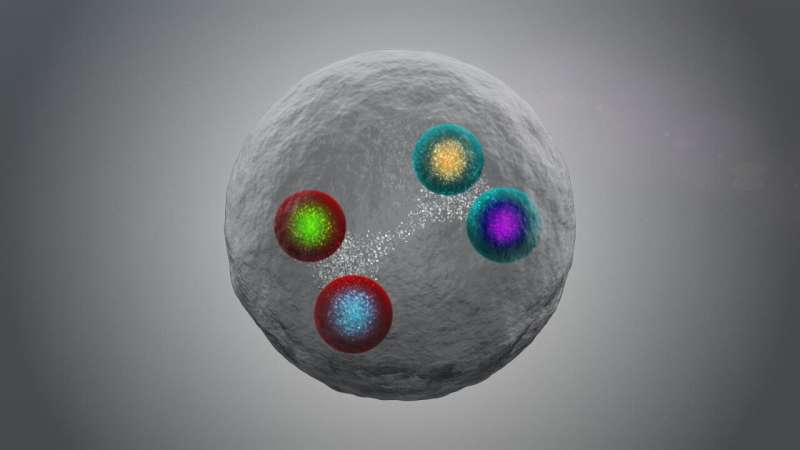
The world of particle physics just became a little clearer—and a lot more interesting. Scientists working with the CMS (Compact Muon Solenoid) experiment at CERN’s Large Hadron Collider (LHC) have achieved a major milestone by measuring, for the first time, the quantum properties of a rare and exotic family of particles known as all-charm tetraquarks. These findings, published in the journal Nature in 2025, bring researchers closer to understanding how the strong nuclear force binds quarks together in ways that go beyond traditional particle models.
Understanding the Landscape of Particle Discoveries at the LHC
Since it began operations, the LHC has discovered around 80 new particles, expanding our understanding of the subatomic world. The most famous of these is, of course, the Higgs boson, but the vast majority of discoveries belong to a broader category called hadrons—particles made of quarks held together by the strong force.
Traditionally, hadrons fall into two well-known groups. Mesons are composed of one quark and one antiquark, while baryons consist of three quarks. Protons and neutrons, which make up atomic nuclei and ultimately all visible matter, are baryons.
However, over the past decade, experiments at the LHC and other colliders have confirmed the existence of exotic hadrons—particles made of four or five quarks, known as tetraquarks and pentaquarks. These discoveries challenged long-standing assumptions about how quarks can combine.
What Makes Exotic Hadrons So Mysterious
Although exotic hadrons are now firmly established as real particles, their internal structure remains one of the most debated topics in modern particle physics. Competing theoretical models describe them in different ways. Some suggest they are tightly bound clusters of four quarks, while others propose they are loosely bound molecules made of two conventional mesons. There are also hybrid models that blend aspects of both ideas.
Determining which picture is correct requires precise measurements of a particle’s quantum numbers, such as spin and symmetry properties. This is exactly where the new CMS study makes its mark.
A Closer Look at All-Charm Tetraquarks
Most exotic hadrons discovered so far include a mix of heavy and light quarks—typically a charm quark and a charm antiquark, along with lighter up, down, or strange quarks. The particles studied in this new CMS analysis are different and particularly intriguing.
These are all-charm tetraquarks, meaning they are composed exclusively of two charm quarks and two charm antiquarks. Because charm quarks are relatively heavy, such systems provide a more theoretically clean and controllable environment for studying the strong force.
The CMS collaboration focused on a family of three such particles:
- X(6600)
- X(6900)
- X(7100)
The numbers in parentheses represent their approximate masses in million electron volts (MeV). Among these, X(6900) was first reported by the LHCb collaboration in 2020 and later confirmed independently by ATLAS and CMS. CMS has since also reported evidence for the lighter X(6600) and the heavier X(7100) states.
How CMS Measured Their Quantum Properties
To uncover the quantum nature of these particles, the CMS team analyzed data collected between 2016 and 2018, during Run 2 of the LHC. The analysis focused on how each tetraquark decays.
Each of the three X particles decays into two J/psi mesons, which themselves are made of a charm quark and a charm antiquark. Each J/psi then decays into two muons, particles that can be tracked with high precision in the CMS detector.
By carefully studying the angular distributions and correlations of these decay products, researchers were able to measure three key quantum properties:
- Spin, which describes intrinsic angular momentum
- Parity, which relates to how a system behaves under mirror reflection
- Charge conjugation, which describes how a particle behaves when particles are replaced with their antiparticles
The Key Results and What They Tell Us
The measurements revealed a striking consistency across all three tetraquarks. For X(6600), X(6900), and X(7100), the results showed:
- Spin consistent with 2
- Parity equal to +1
- Charge conjugation equal to +1
Together, these values strongly constrain how the quarks inside these particles can be arranged. Importantly, the results favor a compact, tightly bound tetraquark structure, rather than a loosely bound molecular configuration of two mesons. While the findings do not completely rule out alternative models, they significantly narrow the range of viable explanations.
Why This Matters for the Strong Nuclear Force
The strong nuclear force is the most powerful fundamental force in nature, yet it is also the least intuitive. It binds quarks into hadrons and holds atomic nuclei together, but its behavior becomes extraordinarily complex when multiple quarks interact.
All-charm tetraquarks serve as an extreme testing ground for theories of the strong force. Because they contain only heavy quarks, they are easier to model using advanced computational techniques like lattice quantum chromodynamics (QCD). Precise experimental data, such as the quantum numbers measured by CMS, are essential for testing and refining these theoretical approaches.
A Growing Family of Exotic States
The fact that all three particles share the same quantum properties suggests they may belong to a related family of states, possibly representing different excitations of the same underlying quark configuration. This opens the door to a more systematic understanding of exotic hadrons, rather than treating each new discovery as an isolated curiosity.
What Comes Next
The LHC is currently operating in Run 3, delivering even larger datasets than before. Looking further ahead, the High-Luminosity LHC is expected to dramatically increase the number of recorded collisions. This will allow physicists to:
- Refine measurements of quantum properties
- Search for additional all-charm and multi-heavy exotic states
- Further distinguish between competing theoretical models
Each new piece of data brings scientists closer to a unified picture of how quarks behave under the strongest force known in nature.
Research Reference
Determination of the spin and parity of all-charm tetraquarks, Nature (2025)
https://doi.org/10.1038/s41586-025-09711-7