Nanowire Technology Reveals How Astrocytes Really Behave in Their Natural State
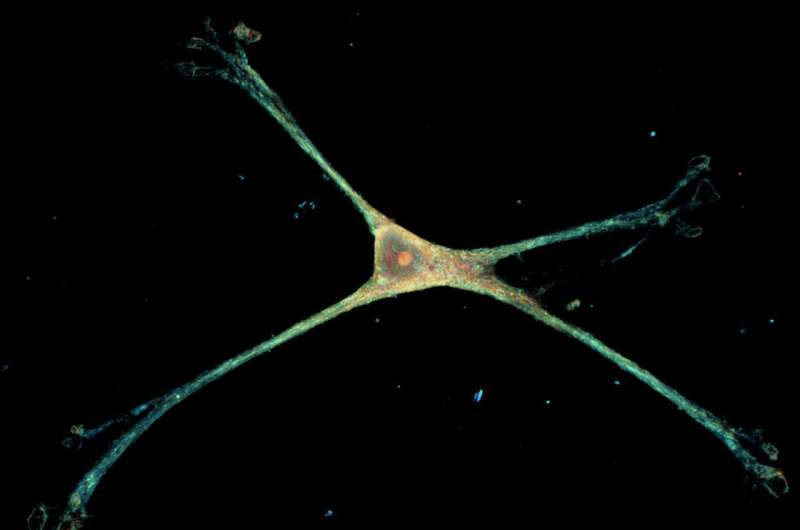
Scientists have achieved a breakthrough in understanding astrocytes, the star-shaped support cells that quietly keep the brain running. A team from Johns Hopkins University and the National Research Council of Italy has engineered a nanowire platform that finally allows researchers to study astrocytes in a form that closely matches how they exist inside the living brain. This matters because astrocytes are among the brain’s most abundant cells, yet their true structure and behavior have been notoriously difficult to capture in laboratory settings. Traditional flat glass surfaces—used everywhere in biology labs—cause these cells to collapse into unnatural shapes. As a result, scientists have long been left with an incomplete understanding of how astrocytes function, communicate, and support neural health.
The new platform, made of disordered glass nanowire mats, mimics the physical texture of brain tissue while remaining transparent enough for high-resolution imaging. When astrocytes are grown on these nanowires, they recover their complex, branching, signature star-like morphology, something they simply cannot maintain on standard petri dishes. This is important because the shape of an astrocyte is strongly tied to how it performs its roles in the brain, including maintaining the blood-brain barrier, regulating neuron signaling, and forming the structural framework that keeps neural networks stable.
Researchers point out that the vast diversity of astrocyte shapes—and how these shapes shift as the cells respond to signals—has remained largely elusive. Their structure collapses when studied in vitro, meaning scientists have spent decades trying to understand a cell whose true identity was physically flattened by the tools used to study it. The new nanowire system solves this problem in a surprisingly elegant way: by creating a culture surface that resembles the tangled, fibrous environment of the brain. The astrocytes respond to this environment by branching, maturing, and behaving as they normally do within living tissue.
Another major advancement from this project is the integration of label-free, high-resolution 3D imaging. Instead of relying on fluorescent tags or chemical stains—which can alter cell behavior—the researchers used a technique that allows them to view astrocytes in fine detail without disturbing them. This imaging form, compatible with the nanowire substrate, captures how astrocytes grow, change shape, and interact with their surroundings. It provides precise measurements of their morphology and enables scientists to observe dynamic processes that were previously inaccessible.
When astrocytes were placed on nanowire mats, the difference compared to traditional glass surfaces was dramatic. On standard glass, astrocytes lose their branching structure and collapse into simpler, rounded forms. On nanowires, they develop extensive processes that resemble those observed in actual brain tissue. This result alone marks a significant leap in brain cell research because morphology influences everything from how astrocytes support neurons to how they respond to injury or disease.
The study’s authors believe the platform will have wide-ranging applications. It could improve brain-on-a-chip models, provide more realistic environments for testing drugs, and support the development of organoids and other engineered tissues. Since malfunctioning astrocytes are linked to Alzheimer’s disease, Parkinson’s disease, and numerous other neurological disorders, having a system that preserves their natural structure could advance how researchers study these conditions. Better models mean better predictions about how cells behave under stress, how drugs may affect them, and how their interactions with neurons may change with disease progression.
Understanding Astrocytes and Why Their Shape Matters
Astrocytes are not just filler cells—they are active participants in nearly every aspect of brain function. Their long, branching arms help them monitor neuronal activity, regulate neurotransmitters, repair damage, and shuttle nutrients throughout the brain. Because of this, the loss of their natural shape in traditional lab environments has long been a barrier. Many hypotheses about astrocyte behavior have been built on distorted versions of these cells. With this new nanowire approach, researchers can finally examine astrocytes in a structure that more closely resembles reality.
Interestingly, astrocytes are shape-shifters. They change form depending on their state, environment, or physiological role. Some extend long fibers to wrap around blood vessels, helping maintain the vital blood-brain barrier. Others enmesh themselves around groups of neurons. Understanding these structural variations is essential, and now scientists can observe them without forcing cells into an unnatural geometry.
Why Nanowires Work So Well
Glass nanowires offer several advantages:
- They create a three-dimensional texture, unlike flat glass.
- They are transparent, allowing imaging without interference.
- They encourage cells to anchor and branch as they would in the brain’s extracellular matrix.
- They are compatible with advanced imaging systems.
This combination is rare. Many synthetic tissue-like structures compromise visibility or imaging compatibility, but the nanowire system avoids those trade-offs.
Label-Free Imaging: A Complementary Breakthrough
The researchers paired their substrate with a form of label-free imaging that provides high-resolution, 3D volumetric views. This avoids fluorescent dyes, which can stress cells or change their behavior. Instead, the imaging system reads variations in light passing through the cell, allowing the reconstruction of detailed inner structures.
This means scientists can finally quantify astrocyte morphology with accuracy—measuring branching length, density, changes over time, and structural responses to stimuli. Such data will be crucial in refining computational models, drug discovery pipelines, and advanced simulations of brain function.
How This Breakthrough May Shape Future Research
The team anticipates that the technology could transform several fields:
- Neurodegenerative disease research: More accurate cell models may clarify how astrocytes contribute to disease progression.
- Drug testing: Pharmaceutical compounds can be evaluated in environments that better approximate real brain tissue.
- Regenerative medicine: Engineers could build improved scaffolds for repairing brain injuries.
- Organoid development: Brain organoids might develop more realistic architecture if grown on these substrates.
Because the nanowire mats are relatively simple to fabricate compared to other complex biomaterials, the technology has the potential to be widely adopted.
Additional Context: Astrocytes in Brain Science
Astrocytes are increasingly recognized as central players in neuroscience. Once thought to be passive “support” cells, they are now understood to:
- Regulate synaptic communication
- Maintain ion balance
- Respond to and repair injury
- Shape the development of neural circuits
- Influence learning and memory
Some even participate in “gliotransmission,” a process similar to neuronal signaling. Their dysfunction is associated not just with degenerative diseases but also stroke, epilepsy, and traumatic brain injury.
Yet, despite their importance, they have remained difficult to study accurately. The new nanowire system stands to change that by making cell cultures that reflect real tissue conditions far more attainable.
Research Reference
Disordered Glass Nanowire Substrates Produce in Vivo-Like Astrocyte Morphology Revealed by Low-Coherence Holotomography
https://doi.org/10.1002/advs.202513424