Scientists Are Systematically Searching for Quantum-Ready 2D Materials With Exceptionally Long Qubit Coherence Times
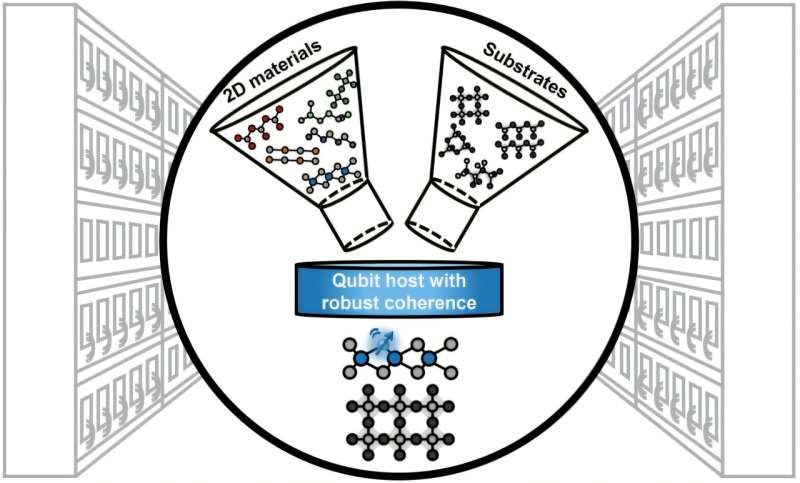
Quantum technologies are steadily moving from theory to real-world devices, but one major challenge still stands in the way: keeping qubits stable long enough to do useful work. A new study from researchers at the University of Chicago Pritzker School of Molecular Engineering (UChicago PME) takes a major step toward solving this problem by identifying hundreds of two-dimensional (2D) materials that could host qubits with remarkably long coherence times.
The research, published in npj 2D Materials and Applications, introduces a large-scale, computational strategy to predict how long qubits can maintain their quantum states when embedded in 2D materials and placed on realistic substrates. The results suggest that the pool of materials suitable for quantum technologies is far larger than previously believed.
Why Qubit Coherence Time Matters
At the heart of any quantum technology is the qubit, the quantum equivalent of a classical bit. Unlike classical bits, qubits rely on fragile quantum states that are extremely sensitive to their surroundings. One of the most important performance metrics is the spin coherence time, which measures how long a qubit can retain its quantum information before environmental noise causes it to decohere.
Noise often comes from nuclear spins in the surrounding material. These spins create fluctuating magnetic fields that disturb the qubit, shortening its usable lifetime. Even in well-known systems like diamond, which hosts nitrogen-vacancy spin qubits, nuclear spin noise remains a limiting factor unless isotopic purification is used.
This is where 2D materials become especially interesting.
Why 2D Materials Offer a Quiet Environment
2D materials are atomically thin sheets, sometimes just a single layer of atoms. Their reduced dimensionality naturally limits the number of nuclear spins that can interact with a qubit. In principle, this makes them quieter environments and potentially excellent hosts for spin qubits.
However, only a small number of 2D materials have been studied so far for quantum applications. There has been no comprehensive roadmap to guide researchers toward the most promising candidates, especially when real devices require these materials to sit on substrates rather than floating freely.
The new study directly addresses this gap.
A High-Throughput Computational Strategy
The UChicago PME team developed an automated, high-throughput computational framework capable of evaluating qubit coherence times across thousands of materials. Their approach is built on the cluster correlation expansion (CCE) method, a well-established technique for simulating how nuclear spins interact with a central qubit.
Using this framework, the researchers calculated spin coherence times for more than 1,000 2D monolayers. This alone represents one of the most extensive theoretical screenings of quantum host materials ever performed.
The results were striking. Out of the materials studied, 189 monolayers were predicted to support coherence times longer than diamond, which is currently one of the most popular solid-state platforms for spin qubits.
Materials With Exceptional Predicted Performance
Among the most promising materials identified were tungsten disulfide (WS₂) and several gold oxyselenides. These compounds showed predicted coherence times in the tens of milliseconds, which is exceptional for solid-state systems operating without extreme isotopic engineering.
What makes these materials special is not just one factor, but a combination of features. They tend to contain very few nuclei with strong magnetic moments, and many of their constituent elements naturally occur in spin-free isotopes. This significantly reduces nuclear spin noise at the atomic level.
In addition, certain structural motifs, such as square-planar transition-metal–oxygen units, appear to be particularly favorable for hosting qubits with desirable electronic properties.
Substrates Can Make or Break a Qubit
In real devices, qubits do not exist in isolation. Every 2D material must be supported by a substrate, and that substrate can introduce its own nuclear spin noise. To account for this, the researchers expanded their study to include more than 1,500 combinations of 2D materials and substrates.
The findings were clear: even an excellent 2D host material can suffer dramatic coherence loss if paired with a noisy substrate. However, the study also identified a solution. Substrates with intrinsically low nuclear-spin noise, particularly certain oxides, help preserve long coherence times.
Materials like ceria (CeO₂) and calcium oxide (CaO) emerged as especially promising substrate choices. When paired with quiet 2D hosts, these substrates allow much of the intrinsic coherence advantage to survive in realistic device geometries.
This result provides a practical design rule for future quantum devices: both the host material and the substrate must be carefully chosen to minimize decoherence.
Analytical Models for Faster Discovery
Running detailed quantum simulations for thousands of materials is computationally expensive. To make large-scale screening feasible, the authors also developed analytical models that capture the essential physics of decoherence in 2D materials and their heterostructures.
These models are inspired by earlier work on three-dimensional materials and provide simple, structure-based formulas that can quickly estimate coherence times. While less detailed than full simulations, they are accurate enough to guide discovery and dramatically speed up the search process.
Using these analytical tools, the team expanded their screening to nearly 5,000 additional 2D materials from public databases. This broader search uncovered over 500 new candidates with long predicted spin coherence times.
What This Means for Quantum Technology
The broader implication of this work is that the space of quantum-ready 2D materials is far richer than previously assumed. Rather than relying on a handful of well-known systems, researchers now have access to hundreds of theoretically validated candidates.
The study also demonstrates the power of data-driven materials discovery. By combining high-throughput simulations, analytical modeling, and physical insight, the researchers have transformed what was once a trial-and-error process into a systematic, rational search.
Looking ahead, the authors suggest that AI-inspired generative models could eventually be used to design entirely new 2D materials optimized specifically for quantum coherence, pushing performance even further.
A Growing Role for 2D Materials in Quantum Devices
Beyond spin qubits, 2D materials already play an expanding role in modern electronics, photonics, and sensing technologies. Their compatibility with existing fabrication techniques makes them particularly attractive for scalable quantum hardware.
Longer coherence times mean more reliable quantum operations, better error correction, and higher sensitivity in quantum sensors. If even a fraction of the newly identified materials can be realized experimentally, they could significantly accelerate the development of practical quantum technologies.
Research paper:
https://www.nature.com/articles/s41699-025-00623-8