University of Iowa Scientists Find a Way to Purify Single Photons for Faster and More Secure Quantum Technology
Researchers at the University of Iowa have made a significant theoretical breakthrough that could improve how future quantum computers and quantum communication systems work. Their new approach focuses on something deceptively simple yet incredibly important in quantum science: producing a clean, reliable stream of single photons. While this may sound technical, it addresses one of the biggest roadblocks in building practical and secure quantum technologies.
The study, published in the journal Optica Quantum, explains how unwanted noise in photon generation—long seen as a major nuisance—can actually be used to improve the quality of single-photon sources. By carefully tuning how lasers interact with atoms, the researchers show that extra photons can be canceled out, leaving behind a purer and more controlled photon stream.
Why Single Photons Matter So Much in Quantum Technology
In classical computing, information is processed using bits, which are either a 0 or a 1. Quantum computers, on the other hand, rely on qubits, which can exist in multiple states at once. Photons—individual particles of light—are among the most promising candidates for qubits, especially in photonic quantum computing and quantum communication networks.
Single photons are valued because they are orderly, predictable, and easier to scale. When photons arrive one at a time, quantum circuits can perform precise operations with fewer errors. This is especially important for quantum encryption, where even small disturbances can compromise security.
However, creating a perfect single-photon source is extremely challenging. Real-world systems often produce extra photons, and those extra particles can disrupt calculations, introduce errors, or weaken communication security.
The Two Big Problems with Photon Generation
The University of Iowa team focused on two long-standing problems that affect photon purity.
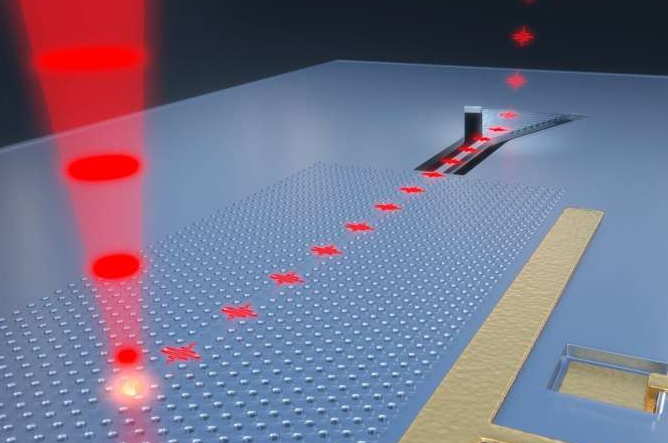
The first issue is laser scatter. In many systems, a laser is aimed at an atom to trigger the emission of a photon. While this works, the laser light itself can scatter and produce additional photons that are indistinguishable from the desired one. These extra photons act like electrical interference in a circuit, reducing efficiency and reliability.
The second problem is multi-photon emission. Ideally, when an atom is excited by a laser, it should emit exactly one photon. In rare but significant cases, an atom emits more than one photon. Even occasional multi-photon events can seriously harm the fidelity of a quantum system.
Until now, these two issues have been treated as unavoidable flaws that researchers try to filter out after the fact.
Turning Noise Into a Tool Instead of a Problem
The key insight came from Matthew Nelson, a graduate student in the University of Iowa’s Department of Physics and Astronomy. He found that when atoms emit unwanted extra photons, the wavelength spectrum and waveform of that emission are nearly identical to the laser light causing the problem in the first place.
This similarity opens the door to a clever solution. If two light waves have the same characteristics, they can be tuned to interfere destructively, meaning they cancel each other out. By carefully adjusting properties of the laser—such as its angle, shape, and interaction geometry—the unwanted photon emissions can be suppressed using the laser’s own scattered light.
In simple terms, instead of fighting noise, the researchers show how to use noise to cancel noise.
This approach theoretically eliminates both laser scatter and multi-photon emission at the source, resulting in a much purer stream of single photons.
A Step Forward for Photonic Quantum Computing
Photonic quantum computing is an area of growing interest, with many startups and research labs betting that light-based systems will play a central role in future quantum machines. Photons move quickly, interact weakly with the environment, and can operate at room temperature, making them attractive for scalable technologies.
However, photonic systems depend heavily on high-quality single-photon sources. Without them, error rates increase and scaling becomes impractical. The new theoretical model from the University of Iowa directly targets this bottleneck.
By improving photon purity at the generation stage, this research could help accelerate the development of faster quantum processors, more reliable quantum networks, and stronger quantum encryption systems.
Implications for Quantum Security
Security is another major beneficiary of this work. Quantum communication protocols rely on the fact that observing a quantum system changes its state. When single photons are used correctly, any attempt at eavesdropping becomes detectable.
Extra photons, however, create loopholes. Multi-photon emissions can allow attackers to siphon off information without detection. By suppressing these unwanted emissions, the new method strengthens the fundamental security guarantees of quantum communication systems.
In essence, a cleaner photon stream means less opportunity for hacking or interception.
From Theory to Experiment
It’s important to note that this research is currently theoretical. The models show that the approach should work, but experimental validation is the next step. The researchers plan to test these ideas in laboratory systems to see how well the photon purification holds up under real-world conditions.
If successful, the technique could be integrated into existing quantum optical platforms without requiring entirely new hardware, making it especially attractive for near-term applications.
A Broader Look at Single-Photon Sources
Single-photon sources are a central topic in quantum optics. Other methods for improving photon purity include heralded photon sources, quantum dots, and cavity-enhanced emission. Each approach has advantages and limitations related to efficiency, scalability, and noise.
What makes this new work stand out is its focus on interference-based cancellation rather than filtering or post-processing. By addressing the problem at its origin, the approach complements existing techniques and could be combined with them for even better performance.
Why This Research Matters
This study highlights an important shift in how scientists think about imperfections in quantum systems. Instead of treating noise as an enemy, the work shows that, under the right conditions, noise can become a useful resource.
That mindset could influence other areas of quantum research, encouraging new strategies for error reduction, system design, and performance optimization.
As quantum technologies move closer to practical deployment, ideas like this—elegant, physics-driven, and potentially scalable—will play a key role in shaping the future of computing and secure communication.
Research Paper:
Noise-assisted purification of a single-photon source – Optica Quantum (2025)
https://doi.org/10.1364/OPTICAQ.565878