Chicago’s Crime Landscape and Media Coverage Get a Fresh Look in a New Spatial Study
A new study from researchers at the University of Chicago takes a deep and methodical look at how crime actually plays out across the city and how Chicago’s media chooses to report it—and the two pictures don’t always line up. The research team analyzed 234,918 geocoded crime incidents from 2017 to 2023, paired with 3,507 local crime news reports from 2023 to 2024, using a blend of geographic tools and large-scale language-model analysis. Their goal was straightforward: identify how environmental and socioeconomic factors relate to different kinds of crime, and compare those realities with the narrative being shaped by the local press.
The findings reveal a clear pattern. While some types of crime occur frequently, they barely register in media coverage. Other crimes that happen less often receive a disproportionately large share of attention. The researchers also discovered that neighborhood characteristics—like walkability, road density, or economic activity—relate to crime differently depending on where in the city they occur. This means no single citywide solution can effectively address crime trends. Instead, different neighborhoods require their own tailored approaches.
Below is a detailed, directly informative breakdown of what the study uncovered.
Key Details From the Crime and Media Analysis
The research team assembled a large dataset of Chicago crime incidents spanning six years. This included theft, battery, criminal damage, homicide, assault, and other categories. They then compared these real-world incidents with thousands of local crime news stories, which were processed using GPT-3.5-Turbo to analyze topics, crime types, and spatial focus. The combination of GIS, econometric methods, and Geographically Weighted Regression (GWR) allowed them to examine how environmental and socioeconomic factors correlate with crime and how these correlations vary across neighborhoods.
One of the most significant findings is the imbalance between the frequency of certain crimes and how the media reports on them. Crimes like theft, criminal damage, and battery happen far more often than violent crimes like homicide, yet they appear less frequently in news coverage. In contrast, violent crimes—especially homicide and assault—receive heavy emphasis in local reporting even though they make up a smaller portion of total incidents. This mismatch can shape public perception, often leading people to believe crime trends are more severe or more violent than they actually are.
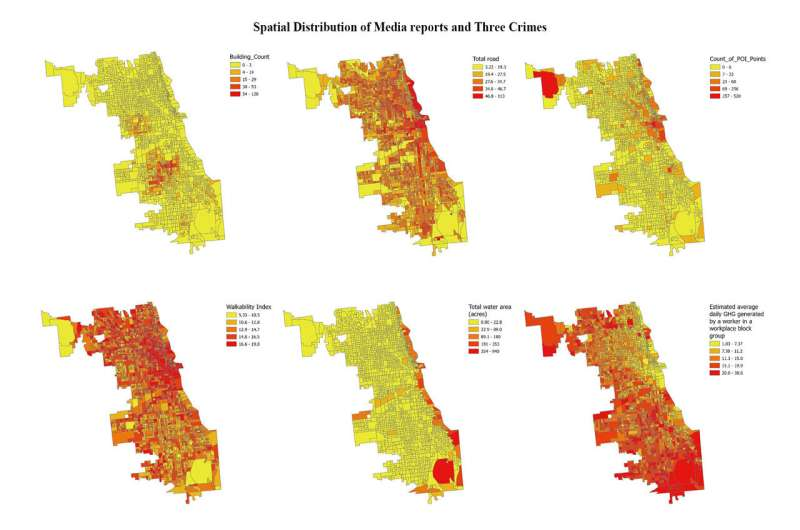
The researchers studied the geographical patterns of media reporting as well. They found clustering in areas such as downtown and certain sections of the North Side and South Side, while many other neighborhoods receive noticeably less media attention. This uneven focus means that some communities are repeatedly placed in the public spotlight while others remain practically invisible—even if they face significant crime issues.
What the Study Found About Environmental Factors and Crime
The study provides highly specific insights into how different neighborhood characteristics relate to crime rates:
Walkability
More walkable areas, which tend to have shops, foot traffic, and mixed-use development, showed higher rates of theft. At the same time, these walkable locations recorded lower rates of criminal damage and battery. This suggests a relationship between increased pedestrian presence and opportunities for quick theft-related incidents, while also possibly providing natural surveillance that discourages other types of crime.
Road Network Density
Areas with a dense network of roads experienced higher rates of all crime types. Dense road networks typically signal busier environments and more accessibility, which may create more opportunities for crime in general.
Building Density
Higher building density correlated with increases in each category of crime studied. Dense development often brings more activity, more social interactions, and more opportunities for criminal events.
Housing Density and Economic Activity
In downtown and northern neighborhoods, higher housing density and economic activity actually corresponded with lower crime rates. This suggests these areas may benefit from better infrastructure, more services, more active surveillance, or stronger community investment.
However, this pattern did not extend to the South Side, where similar levels of density and activity did not correlate with reduced crime. This underscores that the same factor can have completely different effects depending on local context.
This is why the authors emphasize that one-size-fits-all policies won’t work. Each neighborhood’s unique environment must be considered when designing strategies that reduce crime or improve safety.
What the Study Reveals About Media Patterns
The use of GPT-3.5-Turbo allowed researchers to process and categorize thousands of news reports efficiently, identifying the types of crime covered and the geographic focus of reporting. The model’s consistency with human coders was high, with an agreement level around 0.92, making it a reliable tool for large-scale content analysis.
The main takeaway: news organizations tend to focus on rare but dramatic crimes and on high-profile parts of the city. Whether intentional or not, this creates a narrative that may not reflect the day-to-day reality of crime for most Chicago residents. This imbalance can influence how people feel about safety, how communities are portrayed, and which areas draw public and political attention.
The researchers highlight that improving the accuracy and balance of media reporting could help shift public perception and encourage more targeted, equitable policymaking.
Additional Context: How Media Shapes Crime Perception
The Chicago study aligns with broader findings about how news coverage influences public understanding of crime. National research shows that the more people watch or read crime news, the more likely they are to believe crime is rising—even if crime rates are stable or declining. A study from the Pew Research Center found that consumers of frequent crime-focused news express higher levels of concern than those who rely less on such content.
This shows why accurate, balanced crime reporting matters. When news outlets emphasize violent incidents disproportionately, they can distort a city’s reputation, heighten fear, and push policy discussions toward sensational cases rather than common, everyday issues.
Why This Study Matters
Chicago has long been a focal point in national conversations about crime. This research brings new clarity by combining high-resolution geographic data with modern AI-driven text analysis. It shows that:
- Common crimes do not receive proportional media attention.
- Geographic reporting patterns highlight certain neighborhoods while ignoring others.
- Environmental factors influence crime differently depending on local conditions.
- Policy solutions must be spatially specific rather than applied uniformly across the city.
It also demonstrates how large language models can support social science research by quickly analyzing large bodies of text—something that would take teams of researchers months to complete manually.
By understanding where crime actually occurs, how it relates to the built environment, and how the media frames it, city planners, journalists, policymakers, and residents can gain a clearer, more nuanced picture of urban safety.
Research Paper:
https://journals.plos.org/plosone/article?id=10.1371/journal.pone.0331788