Large-Scale VR Classroom Experiment Shows How Immersive Tech Can Transform University Education
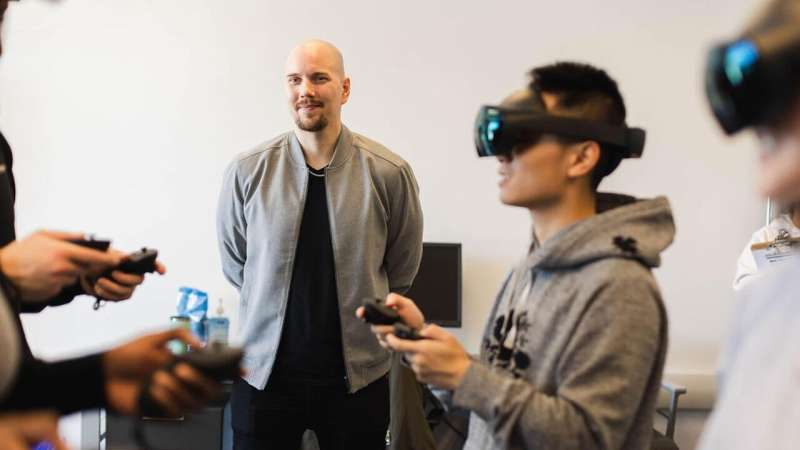
The University of Waterloo has carried out one of the first large-scale classroom implementations of virtual reality in Canada, and the results reveal how immersive tools can reshape design education when deployed thoughtfully and at scale. Led by researcher Dr. Ville Mäkelä, with colleagues Dr. Daniel Harley and Dr. Cayley MacArthur, the project turned a normally traditional 3D design course into a living laboratory, where hundreds of students engaged with VR headsets, experimented with professional-grade software, and even contributed feedback to shape future course offerings.
The initiative began in 2024 at the Stratford School of Interaction Design and Business, where the team piloted a VR-centered design class that used Gravity Sketch, a 3D creation tool adopted by companies such as New Balance for industrial and product design. The core idea was straightforward: if VR is becoming increasingly relevant across multiple industries, then students should graduate knowing how to use it effectively, understand its limitations, and navigate its unique design workflows. Since the first offering, four sections totaling 200 students have completed the course, marking one of the most extensive university-level VR deployments to date.
To make the class possible, however, instructors had to address several major logistical challenges. VR at scale is not as simple as purchasing headsets and handing them out. For one, the university had to plan a substantial equipment budget and carefully select which VR headset models would be most reliable, comfortable, and suitable for extended design work. Storage, charging, maintenance, and tracking also had to be built into the course infrastructure. On top of that, staff had to designate a physical space large enough for multi-user VR sessions, ensuring that dozens of students could safely move around without colliding.
Once the class launched, the team encountered one of the biggest obstacles in VR deployment: cyber sickness. This motion-related discomfort varied widely among students. Some experienced symptoms quickly; others had no issues at all. To support everyone, instructors implemented usage moderation guidelines, encouraged frequent breaks, and made sure non-VR alternatives were always available for assignments. Even with these challenges, student responses were overwhelmingly positive. Many appreciated being exposed to emerging tools that are already influencing professional design practices.
Another major challenge was communication. Teaching VR is complicated because, while students are physically present in the classroom, they are simultaneously immersed in separate virtual environments. Demonstrating a workflow or teaching a concept inside VR is difficult when everyone sees something different. To address this, Mäkelä introduced screencasting, allowing the view from inside a headset to be streamed to an external display. This innovation allowed the instructor to give mass tutorials and made peer learning easier, as classmates could watch in real time how others approached design tasks. Although screencasting required experimentation and practice, it ultimately became one of the most effective teaching tools in the course.
A defining feature of this VR program was the active role students played in shaping the class. As first-time users of VR—and for many, first-time designers in immersive environments—they provided continuous feedback that the instructors used to refine lesson plans, adjust policies, and improve the overall experience. Students like Brooke Eyram, who completed the first iteration of the course during her final year, highlighted how empowering it felt to meaningfully contribute to course development. The collaborative spirit between faculty and students became a hallmark of the project.
It also became clear that the experience had long-term value beyond the classroom. Many students recognized that familiarity with VR—much like familiarity with AI tools—positions them advantageously in a rapidly changing job market. Companies across product design, architecture, automotive, entertainment, and data visualization are exploring VR as both a design environment and a training tool. Exposure at the university level prepares students to enter these fields with confidence, rather than learning these tools for the first time under industry pressure.
The research team formalized their findings in a paper presented at the 2025 CHI Conference on Human Factors in Computing Systems. The study outlines how large-scale VR integration requires careful planning, flexibility, collaboration, and student-driven learning approaches. It also details the practical issues—budgeting, equipment choice, cyber sickness, infrastructure, and communication strategies—and offers best practices for educators interested in similar implementations. Because the study is one of the first of its kind, it serves as an important guide for universities exploring immersive technologies.
A key insight from the study is the way VR transforms the nature of design education. Creating objects or characters in an immersive space changes how students perceive form, proportion, and spatial relationships. VR does not simply replicate existing tools; it enhances embodied learning, letting students manipulate shapes in full 3D rather than interpreting them through flat screens. According to the researchers, this creates a more experiential design practice, offering learning opportunities that traditional approaches cannot match.
To give readers additional context, it’s worth understanding why VR is becoming such a strong candidate for modern education. Over the last decade, VR head-mounted displays (HMDs) have become more affordable, more comfortable, and more technically capable. Improvements in motion tracking, hand controllers, passthrough cameras, and wireless operation have opened the door to classroom-friendly systems that don’t require heavy computers or complex installations. As more companies develop spatial computing applications, universities are under increasing pressure to provide relevant training. Yet, few have attempted VR at scale—not because of lack of interest, but because large deployments remain difficult to coordinate. Waterloo’s project demonstrates how a structured, research-driven approach can make such deployments feasible.
In addition to design education, VR has growing potential across fields like medicine, engineering, psychology, and data science. In medicine, VR simulations allow students to practice surgical procedures or explore anatomical structures with higher interactivity than textbooks or videos provide. Engineering programs are using VR for virtual prototyping, enabling quick experimentation with large-scale structures. Psychologists use VR environments to study memory, spatial navigation, or phobias in controlled settings. As these industries adopt VR technologies, the skills taught in courses like Mäkelä’s become widely transferable.
For educators, Waterloo’s experience underscores the importance of building flexibility into VR curricula. Not every student will adapt at the same pace, and not every design task is equally suited for immersive environments. A successful VR course must provide alternative pathways for students who prefer traditional tools or who experience physical discomfort. It must also provide technical support that goes beyond what a typical classroom setup requires. Training staff, preparing troubleshooting guides, and maintaining hardware become part of the teaching strategy.
Overall, the University of Waterloo’s large-scale VR initiative is a detailed look at what it truly takes to integrate immersive technology into higher education. It is not a small demo or an experimental sidebar—it is a fully structured academic offering backed by research, iteration, and genuine collaboration between instructors and students. With VR becoming increasingly relevant to future careers, programs like this show how universities can prepare students to engage with emerging technologies early and meaningfully.
Research Reference:
Integrating Virtual Reality Head-Mounted Displays into Higher Education Classrooms on a Large Scale – https://doi.org/10.1145/3706598.3713690