Lighting Has a Powerful Impact on How We Experience Music, According to New Research
Lighting is often treated as a background detail when we listen to music, but new research suggests it plays a far more important role than most people realize. A recent scientific study shows that the color and tone of indoor lighting can significantly shape how music feels, influencing emotional reactions, enjoyment levels, and even how well the music and environment seem to “fit” together.
The findings come from a multidisciplinary research team involving University of California, Davis, Arizona State University, and Clemson University, and they highlight how lighting design could be used more intentionally in places like concert halls, healthcare facilities, and even homes.
Why Researchers Looked at Lighting and Music Together
Music is already well known for its ability to trigger emotions, alter mood, and create psychological release. However, far less research has explored how indoor environmental factors, especially lighting, interact with music perception.
While some performance venues already use color-changing LED lighting, most of those choices are based on aesthetic preferences rather than scientific evidence. Designers often do not know which lighting colors best support specific emotional responses in listeners.
This study aimed to fill that gap by examining whether lighting could intentionally enhance emotional responses to music, rather than just serving as visual decoration.
Who Conducted the Study
The study was led by Dongwoo (Jason) Yeom, who began the research while at Arizona State University and continued it in his current role at Clemson University, where he serves as a Penney Endowed Distinguished Associate Professor in the Richard A. McMahan School of Architecture.
One of the co-authors, Jae Yong Suk, is an associate professor in the Department of Design at UC Davis and director of the California Lighting Technology Center. His previous work has explored how lighting affects stress and anxiety, making him well-positioned to study lighting’s emotional impact.
How the Experiment Was Designed
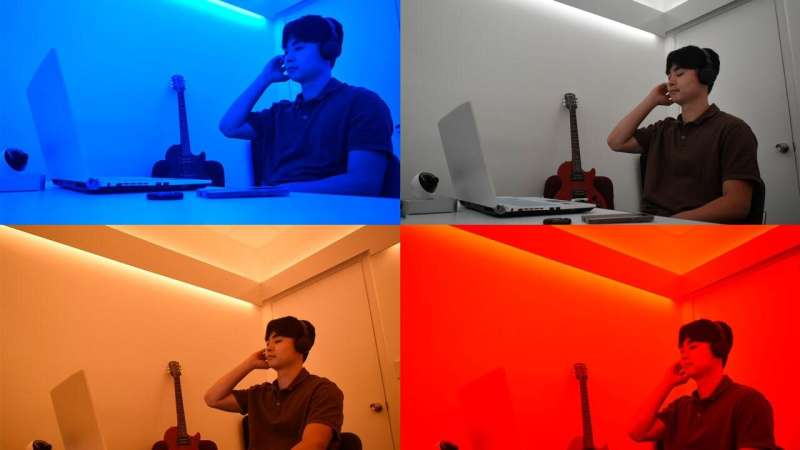
The experiment took place in a specially designed indoor environment at Arizona State University. The space was equipped with 12 LED smart lights connected to a programmable lighting control system, allowing researchers to precisely adjust lighting color and tone.
A total of 22 participants took part in the study. Each participant was randomly assigned to experience different lighting conditions while listening to music.
The researchers tested four lighting conditions:
- Blue lighting
- Cool white lighting
- Red lighting
- Warm white lighting
Participants listened to two distinct types of music:
- Happy music
- Sad music
The musical excerpts were carefully selected from popular music pieces that had already been used in previous music-and-emotion studies and had been reliably rated as either happy or sad.
What Participants Were Asked to Evaluate
After listening to each music clip under a specific lighting condition, participants were asked to rate:
- How positive or enjoyable the music felt
- How well the lighting matched the emotional tone of the music
- Overall satisfaction with the lighting
This allowed researchers to measure not just emotional reactions, but also lighting-music compatibility, an area that had rarely been studied before.
How Lighting Affected Happy Music
One of the clearest findings was that happy music benefited strongly from warm lighting.
When participants listened to happy music under warm white lighting, they gave the highest positivity ratings. The music felt more enjoyable and emotionally aligned with the environment.
In contrast, blue lighting produced the least positive response for happy music. Participants felt that the emotional tone of upbeat music clashed with the cooler, more detached feel of blue light.
Interestingly, cool white lighting, which is often considered visually acceptable and neutral, was rated as the worst match for happy music. While people did not dislike the lighting itself, it felt emotionally disconnected from upbeat music.
This suggests that lighting commonly used in offices or modern interiors may unintentionally dull the emotional impact of cheerful music.
How Lighting Affected Sad Music
The results for sad music revealed some surprising patterns.
Participants gave the lowest ratings to red lighting when listening to sad music. Red light appeared to clash emotionally with music meant to convey melancholy or emotional depth.
On the other hand, blue lighting received the highest ratings for sad music. This finding stood out because previous research has often associated blue wavelengths with alertness and stimulation, not emotional calm or sadness.
In this context, however, blue lighting seemed to support emotional reflection and alignment with sad music, possibly because of cultural associations between blue tones and introspection or melancholy.
Lighting Satisfaction Versus Emotional Fit
Another important takeaway from the study was that visual comfort alone is not enough.
Cool white lighting, for example, was generally considered acceptable and visually comfortable. However, it scored poorly when participants evaluated how well it fit the emotional tone of happy music.
This indicates that designers should think beyond brightness and clarity. Emotional compatibility between lighting and music matters just as much as visual comfort, especially in environments where music is meant to influence mood.
Why These Findings Matter
The study’s findings have practical implications across many settings.
In concert halls and performance venues, lighting designers could use warmer tones to amplify joyful or energetic music, while cooler tones could be reserved for slower, more emotional pieces.
In healthcare and long-term care environments, carefully matched lighting and music could help support mood regulation, emotional comfort, and recovery, particularly for patients who spend long periods indoors.
At home, the rise of smart lighting systems and music streaming platforms opens the door to personalized environments where lighting automatically adapts to music type, enhancing relaxation, focus, or emotional release.
How This Research Fits into the Bigger Picture
Most previous lighting research has focused on productivity, visual comfort, or circadian rhythms. This study adds to a growing body of work showing that lighting also plays a key role in emotional and psychological experiences.
By combining music psychology with lighting science, the researchers demonstrate that human perception is deeply multisensory. What we hear does not exist in isolation from what we see.
What This Means for Designers and Listeners
The core message of the study is simple but powerful: lighting choices should be intentional.
Rather than treating lighting as a purely decorative element, designers, venue managers, and even homeowners can use it as an emotional tool. Matching lighting color to music type can create experiences that feel more immersive, supportive, and emotionally resonant.
As smart lighting becomes more accessible, these insights may soon shape how we experience music in everyday life, not just in high-end venues.
Research Paper Reference:
https://journals.sagepub.com/doi/10.1177/03606325251397028