Narcissism Is Not Just an American Trait According to a Large Global Psychology Study

For years, popular culture, media commentary, and even academic discussions have often painted narcissism as a particularly American phenomenon. From stereotypes about self-absorbed celebrities and politicians to claims that individualistic Western societies encourage excessive self-focus, the United States has frequently been portrayed as the global epicenter of narcissistic behavior. However, a new large-scale psychological study challenges that assumption in a decisive way.
Researchers from Michigan State University’s Department of Psychology have found that narcissism is not uniquely American. Instead, it appears to be a universal human personality trait, showing remarkably consistent patterns across cultures, age groups, and genders. Even more surprising, the United States does not rank among the top five most narcissistic countries in the world.
What the Study Looked At
The study, published in the academic journal Self and Identity, analyzed survey data from more than 45,000 individuals across 53 countries. This makes it one of the largest and most culturally diverse datasets ever used to study narcissism on a global scale.
Participants completed standardized psychological measures designed to assess narcissism, including its two major components:
- Narcissistic admiration, which reflects self-confidence, assertiveness, and a desire for recognition
- Narcissistic rivalry, which involves defensiveness, antagonism, and a tendency to devalue others
By examining both of these dimensions, the researchers were able to capture a more nuanced and accurate picture of how narcissism appears across different societies.
In addition to personality data, the study also analyzed demographic variables such as age, gender, perceived social status, national economic conditions, and cultural values like individualism versus collectivism.
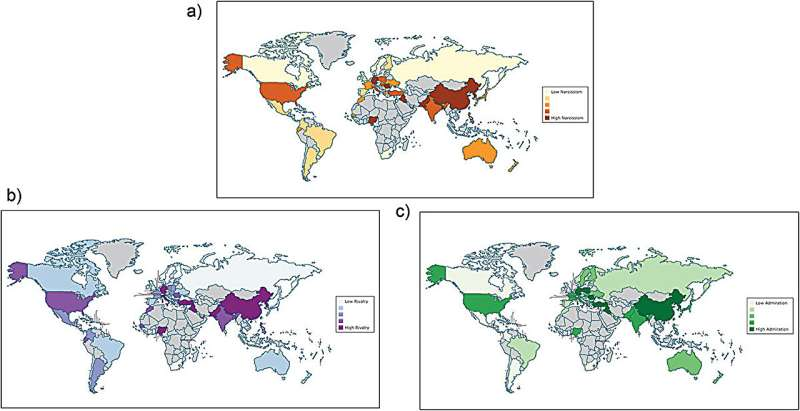
Credit: Michigan State University
The United States Is Not as Narcissistic as Many Assume
One of the most eye-catching findings is where the United States actually falls on the global scale. Contrary to popular belief, the U.S. ranked 16th out of 53 countries in overall narcissism levels.
The five countries with the highest overall narcissism scores were:
- Germany
- Iraq
- China
- Nepal
- South Korea
On the opposite end of the spectrum, the countries with the lowest narcissism scores included:
- Serbia
- Ireland
- The United Kingdom
- The Netherlands
- Denmark
These rankings alone dismantle the idea that narcissism is primarily a Western or American issue. Instead, narcissistic traits appear in many cultural contexts, including countries often described as collectivistic or group-oriented.
Age and Gender Patterns Hold Across Cultures
While countries differed in their average narcissism levels, the demographic patterns were strikingly consistent worldwide.
Across nearly every country studied:
- Young adults scored higher on narcissism than older adults
- Men scored higher than women
These trends appeared regardless of cultural norms, political systems, or economic development. Whether participants lived in highly individualistic societies or collectivistic ones, the same age and gender differences repeatedly emerged.
This consistency suggests that developmental and biological factors may play a stronger role in shaping narcissism than previously assumed. Youth, in particular, seems to be a life stage marked by heightened self-focus almost everywhere in the world.
The Role of Wealth and Economic Development
The study also explored how national wealth, measured through gross domestic product (GDP), relates to narcissism. The findings showed that people living in higher-GDP countries tended to report higher levels of narcissism overall.
However, GDP did not significantly change how narcissism varied by age. In other words, while wealthier countries showed higher average narcissism, the difference between younger and older adults remained similar across nations. Growing older appears to reduce narcissistic tendencies in much the same way worldwide, regardless of economic context.
Individualism vs. Collectivism Did Not Matter as Much as Expected
One of the most surprising outcomes involved cultural values. Many psychologists have long assumed that individualistic cultures would encourage narcissism, while collectivistic cultures would suppress it. This study did not strongly support that assumption.
People from highly collectivistic societies showed similar patterns of narcissism to those in more individualistic cultures. This finding suggests that being part of a group-oriented society does not necessarily eliminate self-focused attitudes or behaviors.
Instead, narcissism appears to coexist with a wide range of cultural values, challenging simplified ideas about how culture shapes personality.
What Narcissism Actually Is (and Is Not)
It is important to clarify that narcissism exists on a spectrum. The type measured in this study refers to personality traits, not clinical narcissistic personality disorder.
In everyday terms, narcissism includes:
- Elevated self-esteem
- Desire for admiration or recognition
- Confidence in one’s abilities
At the same time, it often involves:
- Lower empathy
- Excessive self-focus
- Sensitivity to criticism
Not all narcissistic traits are inherently harmful. Some aspects, such as confidence and assertiveness, can be socially or professionally beneficial. Problems arise when narcissism becomes extreme, rigid, or exploitative.
Why This Study Matters
This research challenges deeply ingrained stereotypes about national character and personality. It shows that narcissism is not a cultural flaw unique to one country, but a widely shared human trait shaped by a combination of biology, development, economics, and lived experience.
By using an unusually large and diverse sample, the study also strengthens the credibility of its conclusions. Smaller, culturally narrow studies often exaggerate differences between societies. This research instead highlights how similar people are across borders, especially when it comes to fundamental psychological traits.
Broader Implications for Psychology and Society
The findings encourage researchers and the public alike to rethink how personality traits develop. While culture certainly matters, this study suggests that age-related life experiences, such as increased responsibility, setbacks, and social feedback, may play a powerful role in reducing narcissism over time.
It also opens new avenues for future research into how economic conditions, social expectations, and generational change interact to shape personality across the lifespan.
Final Thoughts
The idea that narcissism is a uniquely American trait does not hold up under close scientific scrutiny. This global study shows that narcissism is everywhere, influenced by age, gender, and economic context, but remarkably consistent across cultures. In many ways, the research reminds us that despite cultural differences, human psychology follows shared patterns across the world.
Research paper:
https://doi.org/10.1080/15298868.2025.2593298