Women View Artificial Intelligence as Riskier Than Men, New Study Suggests
Women tend to approach artificial intelligence with more caution than men, according to a detailed new study published in PNAS Nexus. The research digs into not just whether women are more skeptical of AI, but why that skepticism exists, pointing to a combination of greater risk aversion and higher real-world exposure to AI-related risks.
The study, led by researcher Beatrice Magistro and her colleagues, looks beyond surface-level opinions and instead connects attitudes toward AI with broader economic behavior, job security, and uncertainty about technological change. Rather than framing women’s skepticism as resistance to innovation, the findings suggest it is rooted in rational assessments of risk.
How the Study Was Conducted
To test their ideas, the researchers surveyed around 3,000 adults in the United States and Canada in November 2023. The survey was carried out using YouGov’s opt-in panel, a widely used platform for social science research. Responses were statistically weighted to better reflect the general population.
Participants were asked several types of questions. One key question measured how strongly they agreed with the statement that the risks of generative AI outweigh its benefits, using a scale from 1 to 10. This allowed researchers to quantify differences in perception rather than rely on vague impressions.
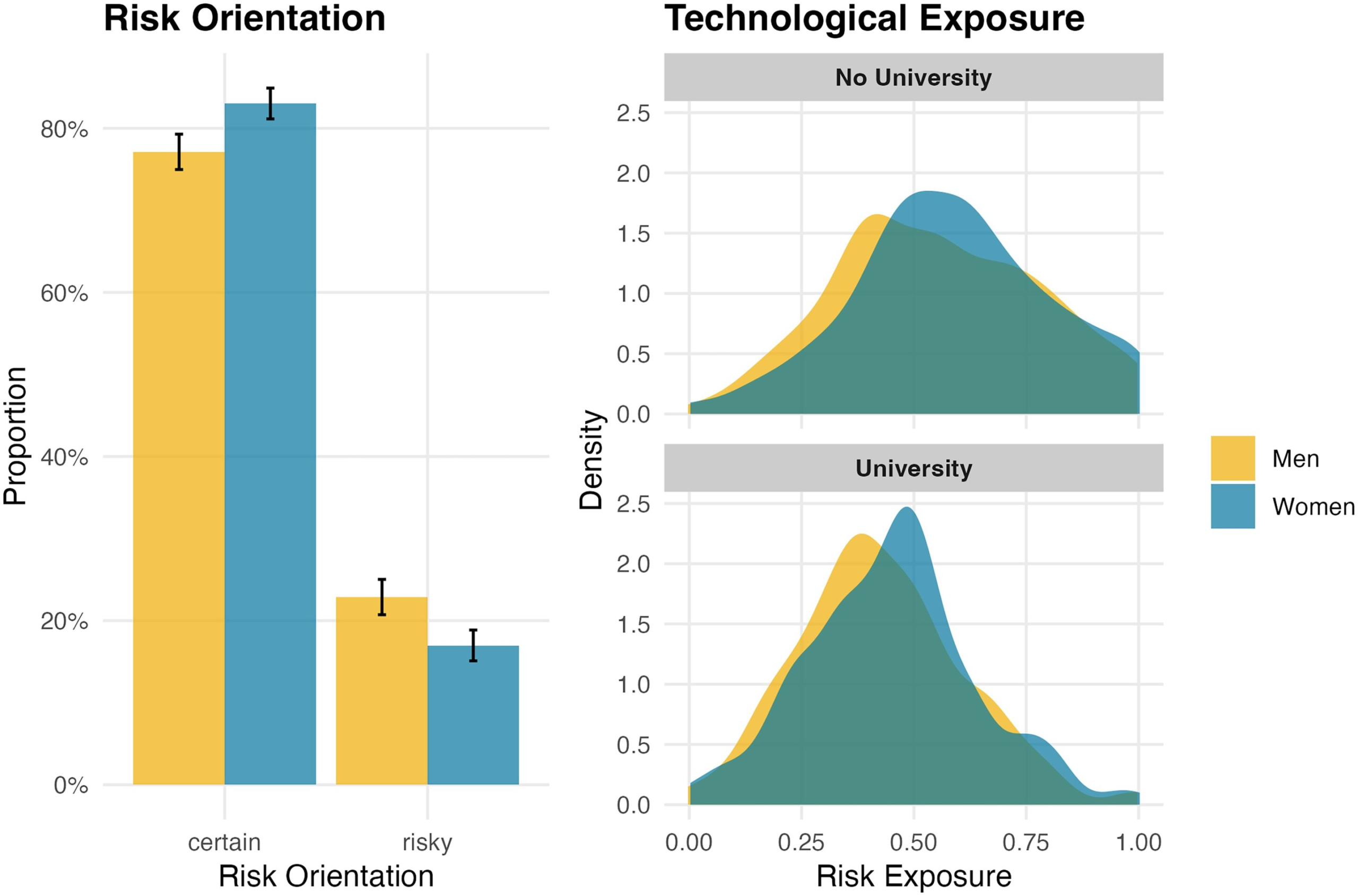
The study also included lottery-style questions designed to measure general risk orientation. For example, respondents were asked whether they would prefer a guaranteed $1,000 or a 50% chance of winning $2,000. Choices like these are commonly used in economics to evaluate how comfortable people are with uncertainty.
Women Consistently Rated AI as Riskier
When the results were analyzed, a clear pattern emerged. On average, men rated AI risk at 4.38, while women rated it at 4.87 on the 10-point scale. That difference represents an 11% higher risk perception among women, a gap large enough to be statistically meaningful.
This difference held even after accounting for factors such as age and education. In other words, it wasn’t simply that women were less familiar with technology or less educated. In fact, the study found that women with higher education levels still viewed AI as riskier than men with similar educational backgrounds.
However, the gap was not fixed or absolute. When respondents were presented with a hypothetical scenario in which AI adoption at a company was guaranteed to benefit employees, women’s support for AI rose significantly. In those conditions, women supported AI nearly as much as men did, suggesting that skepticism is closely tied to uncertainty rather than opposition to the technology itself.
Risk Aversion Plays a Major Role
One of the study’s core findings is that women, on average, are more risk-averse in general than men. This was clearly reflected in the lottery questions. Women were more likely to choose the guaranteed payout, while men were more willing to gamble for a potentially higher reward.
This broader tendency toward caution helps explain why women might be more skeptical of AI, especially when its long-term effects are unclear. Artificial intelligence often comes with promises of efficiency and productivity, but it also brings unknown consequences, particularly in the workplace. For individuals who are already more cautious about risk, these uncertainties carry extra weight.
Importantly, the researchers emphasize that risk aversion is not a flaw. In many economic contexts, being risk-averse can be a rational and protective strategy, especially when potential losses are significant.
Women Face Greater Exposure to AI Risks
Beyond general risk orientation, the study also examined risk exposure, meaning how likely someone is to be personally affected by AI-driven change. The researchers used post-secondary education as one proxy, assuming that higher education often provides more flexibility and adaptability in the labor market.
To strengthen this analysis, they also looked at job-level exposure to automation and AI, examining which occupations are more likely to be affected by technological disruption. The findings suggest that women are more likely than men to work in roles that are vulnerable to automation or AI-driven restructuring.
This higher exposure makes skepticism even more understandable. If AI threatens job stability, wages, or career progression, those most affected have stronger incentives to question its rapid adoption.
Differences in How Men and Women Talk About AI
The study also included open-ended questions asking respondents what they saw as the benefits of AI. Here, the gender differences became even more apparent.
Women were more likely to express uncertainty or skepticism, often indicating that they were unsure what benefits AI would bring or that they saw little to no benefit at all. Men, by contrast, were more likely to confidently list potential advantages, even when those benefits were speculative.
This does not mean women were less informed. Instead, it suggests that women may be more cautious about overstating benefits when outcomes are uncertain, again aligning with the broader pattern of risk awareness highlighted throughout the study.
Why These Findings Matter
According to the authors, these results have important implications for AI policy, workplace adoption, and public communication. If policymakers and companies fail to address gender-specific concerns, AI could end up reinforcing existing inequalities rather than reducing them.
For example, if women are more exposed to AI-related job risks but less involved in shaping AI systems, the technology may evolve in ways that overlook their needs and perspectives. This could also lead to political resistance or backlash, especially if large segments of the population feel that AI is being imposed without adequate safeguards.
The study suggests that increasing transparency, clarifying benefits, and reducing uncertainty around AI adoption could go a long way toward building broader trust.
Broader Context on Gender and AI
This research fits into a growing body of evidence showing gender gaps in AI usage and attitudes. Other studies have found that men are more likely to adopt generative AI tools early, while women often report higher levels of anxiety or concern about AI systems.
These differences matter because they influence who uses AI, who shapes it, and who benefits from it. If women remain underrepresented in AI development and decision-making, their concerns may continue to be overlooked, creating a feedback loop of skepticism and exclusion.
Looking Ahead
Rather than framing women’s skepticism as resistance to progress, this study reframes it as a reasonable response to uneven risk and uncertainty. The findings highlight the importance of designing AI systems and policies that are not just technologically advanced, but also socially aware.
As AI continues to reshape workplaces and economies, understanding how different groups perceive and experience its risks will be crucial. Addressing those concerns openly may be one of the most effective ways to ensure that AI adoption is both inclusive and sustainable.
Research paper: https://academic.oup.com/pnasnexus/article/5/1/pgaf399