A Missing Radio Signal from the K2-18 System Reveals New Clues About an Alien World

Astronomers studying the distant K2-18 system have uncovered something surprising—not what they found, but what they didn’t find. A new radio survey using the Karl G. Jansky Very Large Array (VLA) set out to detect emissions from the star K2-18, the host of the much-debated exoplanet K2-18 b, famous for earlier hints of possible biosignature gases. After 12 weeks of observations covering frequencies from 2 to 10 gigahertz, the research team detected no radio emission at all. And that silence says more about this alien system than an active signal ever could.
What the Researchers Looked For—and Didn’t Find
The VLA observations were designed to search for two main things:
- Steady radio output from the star’s corona (the hot outer atmosphere).
- Short, intense bursts associated with magnetic flares or potential auroral activity driven by planets.
Across every observed band, the star remained undetectable. The upper limits reported were extremely strict, placing the star among the quietest radio emitters known in its class. The team observed the system in short 10-minute snapshots spread across three months. Even though this means the coverage was limited, the consistent lack of detection across all sessions paints a picture of a low-activity star, especially when compared to typical M-dwarf stars, which are known for strong magnetic storms.
For a system that has drawn major attention for possible biosignatures, this finding is particularly important. Magnetic storms, powerful stellar winds, and intense radiation can erode the atmosphere of a close-orbiting planet over time. For many worlds around M-dwarfs, this is a major obstacle to habitability. K2-18’s quietness therefore becomes a key factor in understanding whether K2-18 b could maintain a stable atmosphere.
Why a Quiet Star Matters for K2-18 b
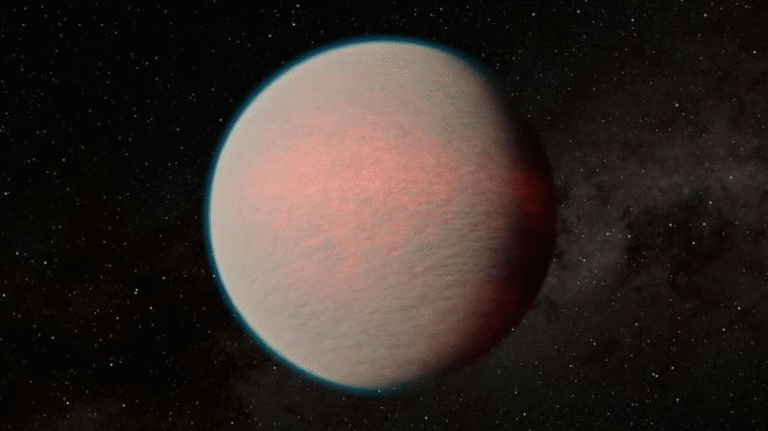
K2-18 b lies about 124 light-years away and has been the center of scientific excitement due to earlier James Webb Space Telescope (JWST) findings. Last year, researchers using JWST reported possible detections of methane, carbon dioxide, and even dimethyl sulfide (DMS)—a gas that on Earth is produced almost exclusively by living organisms such as phytoplankton.
The idea of a distant world showing such a combination of gases naturally sparked speculation about life. But before jumping to conclusions, scientists must confirm whether the planet’s atmosphere could even survive its star’s long-term influence. This is where the new VLA study becomes crucial.
The lack of detected radio activity aligns with earlier X-ray studies, which also found K2-18 to be a faint emitter. Low-energy output means the star generates fewer harmful extreme ultraviolet (EUV) photons, which are capable of stripping atmospheres from close planets. Previous modeling suggested that with such low stellar activity, K2-18 b would lose only about 3% of its mass over its entire lifetime—far less than what happens in more violent systems.
In other words, a quiet star provides a safer environment for a planet like K2-18 b to retain a thick atmosphere. And for studying a world’s atmospheric composition—especially through transmission spectra—stable, intact atmospheres are exactly what astronomers need.
The Caveats of the Radio Search
While the results strongly point toward a calm star, the study is not without limitations. The researchers observed the system in brief snapshots rather than continuous monitoring. Over the course of the study, they covered only small portions of the planet’s 33-day orbit. That means it’s still possible that K2-18 occasionally produces bursts or large flares that simply weren’t captured.
Even so, the team argues that the overall lack of radio detection across multiple frequency bands gives confidence that strong or frequent flares are unlikely. For an M-dwarf, this is highly unusual—most are known for being volatile and energetic. K2-18 appears to be an exception.
How This Fits Into the Biosignature Debate
The question of possible biosignatures in the K2-18 system remains one of the most intriguing—and controversial—topics in exoplanet science.
When JWST initially detected gases like methane and carbon dioxide in K2-18 b’s atmosphere, researchers also reported signatures resembling dimethyl sulfide. On Earth, DMS is strongly tied to biological activity, which made the discovery sound extraordinary. But later analyses, including a re-evaluation of the original JWST data, emphasized that the evidence for DMS was not statistically strong enough and did not reach the confidence required for a claim of detection.
Moreover, DMS can theoretically be produced by non-biological processes in hydrogen-rich atmospheres, and stellar contamination or instrumental noise can sometimes mimic such signals. So while the atmospheric measurements remain exciting, nothing yet confirms biological activity.
Still, the new radio findings add an important piece to the puzzle: if K2-18 b truly has a rich atmosphere, the star appears calm enough to allow it to exist long-term. This alone makes the system an excellent target for future observation campaigns.
Additional Background: Why Radio Emissions Matter in Exoplanet Studies
Radio astronomy is not just about detecting emissions from galaxies or supernova remnants—it’s also an essential tool for understanding the environments around stars and their planets.
Here’s why radio signals are important:
1. They reveal stellar magnetic activity.
Active stars produce bright, often chaotic radio bursts. These bursts correspond to space weather conditions that can strip or damage planetary atmospheres.
2. They help identify stellar flares.
Radio bursts can indicate explosive events on stars that may bombard planets with charged particles.
3. They can detect aurorae on exoplanets.
Radio emissions sometimes arise from interactions between a planet’s magnetic field and its parent star. Detecting these would help confirm planetary magnetic fields, an important factor for habitability.
4. They complement X-ray and UV observations.
A multi-wavelength approach gives scientists a fuller picture of how hostile or friendly a star’s environment is.
For K2-18, the radio silence reinforces the idea that the system is calmer than expected, especially for an M-dwarf—a class of stars notorious for being anything but quiet.
Extra Insight: What Makes K2-18 b a Special Target?
K2-18 b is categorized as a sub-Neptune, meaning it is larger than Earth but smaller than Neptune. It is believed to have a hydrogen-rich atmosphere, and possibly an ocean layer below. This has led some scientists to propose that it could be a Hycean world—a theoretical type of planet with a global ocean beneath a hydrogen atmosphere.
Hycean worlds could be capable of hosting life under certain conditions, particularly if the atmosphere provides sufficient pressure and temperature stability. But these planets are difficult to study because their atmospheric compositions are unlike anything in our solar system.
The combination of:
- potential biosignature gases
- a hydrogen-dominated atmosphere
- a surprisingly calm host star
- and favorable orbital characteristics
makes K2-18 b one of the most compelling exoplanets currently known, even if the case for life remains far from proven.
Final Thoughts
The new VLA observations may not have detected a signal, but that absence is scientifically valuable. By confirming that K2-18 is an unusually quiet star, the study strengthens the possibility that its planets can maintain stable atmospheres—and that future observations will be clear and interpretable. For researchers exploring distant worlds and searching for signs of life, a calm cosmic environment is an encouraging sign.
Whether or not K2-18 b hosts life, or even just Earth-like atmospheric chemistry, remains an open question. But thanks to these radio observations, astronomers now have a better understanding of the environment in which this intriguing world resides.
Research Paper:
Upper Limits on Radio Emission from the K2-18 System – https://arxiv.org/abs/2511.05427