A New Five-Year Survey Will Take an Unprecedented Deep Dive Into the Magellanic Clouds
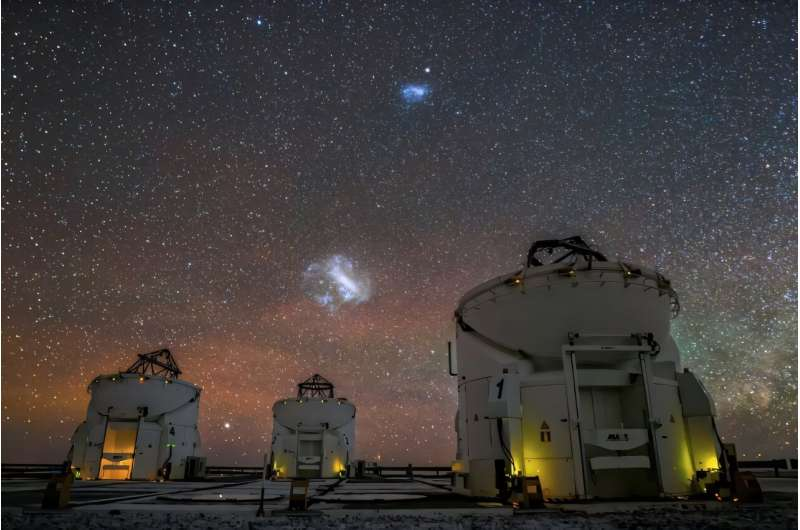
A major new astronomy project is about to transform what we know about the Large and Small Magellanic Clouds, the Milky Way’s closest galactic neighbors. Beginning full science operations in 2026, a five-year observational campaign will dedicate some of the world’s most powerful survey instruments entirely to these two nearby dwarf galaxies. The goal is simple but ambitious: to understand how the Magellanic Clouds formed, how they evolved, how they interact with each other and the Milky Way, and what they can teach us about galaxy evolution across the universe.
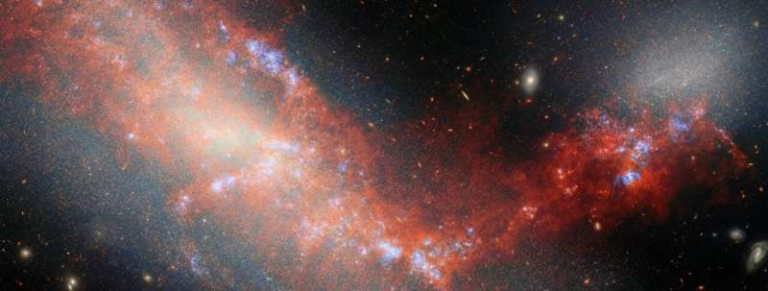
The Large Magellanic Cloud (LMC) and Small Magellanic Cloud (SMC) are irregular dwarf galaxies orbiting the Milky Way. The LMC lies about 163,000 light-years away, while the SMC is slightly farther at around 206,000 light-years. Their closeness makes them exceptional natural laboratories for astronomers. Unlike distant galaxies, individual stars inside the Clouds can be resolved and studied in detail, something that is not possible for most galaxies beyond our own.
A new research group dedicated entirely to the Magellanic Clouds is being formed at the Leibniz Institute for Astrophysics Potsdam (AIP) in Germany. The group will officially begin work in 2026 and will focus on unraveling the formation history, structure, and chemical evolution of both Clouds using an unprecedented volume of spectroscopic data.
Why the Magellanic Clouds Matter So Much
Studying star formation and galaxy evolution inside the Milky Way is surprisingly difficult because we are embedded within it. Dust, gas, and our internal vantage point limit our ability to see the galaxy as a whole. The Magellanic Clouds offer a clearer view. Astronomers can observe them from the outside while still resolving individual stars, making them ideal for studying how galaxies grow and change over time.
Both Clouds are packed with fascinating features. The Large Magellanic Cloud hosts the Tarantula Nebula, one of the most active star-forming regions known, containing some of the most massive stars ever discovered. The Small Magellanic Cloud contains NGC 346, an open star cluster that continues to form large numbers of high-mass stars. The Clouds also contain many variable stars, including Cepheids, which play a crucial role as standard candles used to measure cosmic distances.
Another intriguing aspect is their chemical makeup. Compared to the Milky Way, the Magellanic Clouds are more gas-rich but lower in metallicity, meaning they contain fewer heavy elements. Their star formation appears to occur in episodic bursts rather than at a steady pace, raising fundamental questions about what triggers these bursts and how long they last.
The Instruments Behind the Survey: VISTA and 4MOST
At the heart of the new survey are two powerful tools located at Paranal Observatory in Chile: VISTA and 4MOST.
VISTA (Visible and Infrared Survey Telescope for Astronomy) is a wide-field telescope with a 4.1-meter primary mirror designed to observe the southern sky in the near-infrared. It is the largest telescope in the world dedicated solely to infrared survey work and is equipped with a massive 67-megapixel camera weighing around three tons.
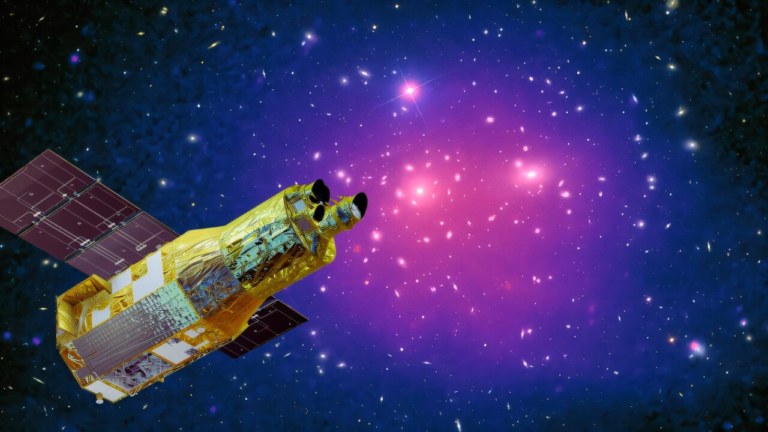
Attached to VISTA is 4MOST (the Four-metre Multi-Object Spectroscopic Telescope), a fiber-fed spectrograph capable of collecting light from thousands of stars at once. While imaging surveys show astronomers what stars look like and where they are, spectroscopy reveals how stars move and what they are made of.
For an extraordinary five-year period, VISTA and 4MOST will be fully dedicated to survey programs, excluding all other observational work. 4MOST saw first light in October 2025, is currently undergoing commissioning, and is scheduled to begin full science operations in the second quarter of 2026.
The 1001 Magellanic Fields Survey
The flagship project targeting the Clouds is known as One Thousand and One Magellanic Fields (1001MC). This ambitious survey aims to collect high-quality spectra for around half a million stars across the LMC, SMC, and their extended outskirts.
The survey will measure stellar kinematics (how stars move) and elemental abundances (what stars are made of) across a vast range of stellar populations and evolutionary stages. This level of detail will allow astronomers to reconstruct how different parts of the Clouds formed, merged, and evolved.
Unlike earlier studies, 1001MC will provide high-resolution spectroscopy, enabling a technique called chemical tagging. This method allows researchers to identify groups of stars that formed together by comparing their chemical fingerprints, even if those stars are now widely scattered.
A New Research Group With a Clear Focus
The new Magellanic Clouds research group at AIP will be led by Dr. Lara Cullinane, an astrophysicist whose work centers on the photometric, kinematic, and chemical properties of individual stars within their larger galactic environments. Her research aims to trace how interactions between galaxies shape their stellar populations, especially in the outer regions where signs of past encounters are preserved.
The group’s work will heavily rely on data from 1001MC and other complementary surveys, combining spectroscopy with existing photometric datasets and measurements from the Gaia mission.
Unanswered Questions the Survey Hopes to Resolve
Despite decades of study, many fundamental questions about the Magellanic Clouds remain open.
One major mystery involves their orbital history. Astronomers long believed the Clouds had been orbiting the Milky Way for billions of years. However, precise measurements from Gaia suggest they may be on their first close passage, which would dramatically change how scientists interpret their structure and star formation history.
Another puzzle is the origin of the Magellanic Stream, a massive ribbon of gas trailing behind the Clouds and extending deep into the Milky Way’s halo. Along with the Leading Arm, this structure may have formed through tidal stripping, ram-pressure effects, interactions between the Clouds, or some combination of all three.
The survey will also investigate why star formation in the Clouds occurs in bursts. Are these bursts triggered by interactions between the LMC and SMC? By encounters with the Milky Way? Or by internal processes within the galaxies themselves?
Chemical evolution is another key focus. By mapping metallicity gradients and abundance patterns across the Clouds, astronomers hope to understand how gas flows, mixes, and forms stars over cosmic timescales.
How This Survey Builds on Earlier Work
Previous surveys such as VMC, STEP, SMASH, and OGLE have already provided a wealth of photometric data on the Magellanic Clouds. However, these projects largely lacked the spectroscopic depth and resolution needed to fully exploit chemical and kinematic information.
According to official European Southern Observatory documentation, there has been a pronounced shortage of high-quality spectroscopy across the diverse stellar populations of the Clouds. The 1001MC survey is designed specifically to fill this gap.
A Broader Impact on Galaxy Evolution Studies
The importance of this five-year survey goes far beyond the Magellanic Clouds themselves. Dwarf galaxies are the building blocks of larger galaxies, and understanding their evolution is essential to understanding the universe as a whole.
By the end of the project, astronomers will have one of the most detailed spectroscopic datasets ever assembled for any external galaxy. This will provide new insights into star formation, chemical enrichment, galactic interactions, and the life cycles of galaxies, helping to refine models of how galaxies grow and evolve across cosmic history.
Research paper:
https://arxiv.org/abs/1903.02475