A New Look at Supernova Standard Candles Could Ease the Long-Standing Hubble Tension
For years, cosmologists have wrestled with a stubborn problem known as the Hubble tension—a mismatch in measurements of how fast the universe is expanding. Now, a new study suggests that a major piece of the puzzle may be hiding in plain sight: the assumption that Type Ia supernovae are perfect, unchanging standard candles. By factoring in the age of the galaxies hosting these explosions, researchers have found that supernova-based measurements of cosmic expansion shift noticeably closer to other major techniques. If this result holds up, it could reshape how we understand cosmic growth and even the role of dark energy.
What the Hubble Constant Actually Measures
The Hubble constant (H₀) describes how quickly the universe is expanding right now. It’s measured in kilometers per second per megaparsec, meaning how fast galaxies move away per unit distance. Its importance can’t be overstated: it influences estimates of the universe’s age, its size, and the long-term behavior of cosmic expansion.
Today, three primary approaches are used to measure H₀:
- Type Ia supernovae, treated as objects with known brightness
- Cosmic Microwave Background (CMB) measurements
- Baryon Acoustic Oscillations (BAO)—imprints from early-universe sound waves embedded in galaxy clustering patterns
Ideally, these methods should agree. But they don’t.
- Supernovae yield 71–75 km/s/Mpc
- CMB data from missions like Planck suggest 67–68 km/s/Mpc
- BAO observations fall around 66–69 km/s/Mpc
This persistent disagreement is what scientists call the Hubble tension.
Why the Supernova Method May Be Off
Type Ia supernovae have long been treated as reliable cosmic yardsticks because they supposedly explode with the same intrinsic luminosity. But as researchers dug deeper, they began noticing variations tied to environment, metallicity, and now—according to this new study—the age of the host galaxy.
The paper’s central argument is straightforward:
Supernovae occurring in younger galaxies behave differently than those in older galaxies, and these differences affect how bright they appear. Since brightness is the basis for calculating distance, even a small systematic error can ripple into a large error in H₀.
When the authors corrected for host-galaxy age, the value of the Hubble constant from supernova data shifted closer to the values from CMB and BAO techniques. This adjustment doesn’t fully eliminate the tension, but it significantly reduces it, hinting that some of the discrepancy stems from how we’ve been interpreting supernova brightness.
The Role of the FLRW Metric and the Standard Cosmological Model
To understand why this matters, it helps to recall the cosmological framework underlying these measurements—the Friedmann–Lemaître–Robertson–Walker (FLRW) metric. This is the mathematical model describing a universe that is uniform and expanding.
The FLRW metric relies on:
- Dark energy (represented by Λ, the cosmological constant)
- Dark matter
- Ordinary matter
- The distribution of matter over large scales
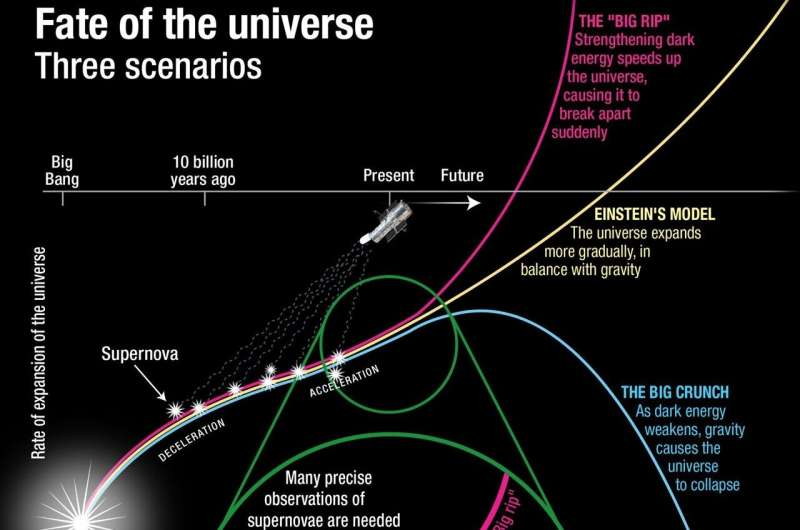
These factors combine to produce the universe’s expansion rate. Discoveries in the late 1990s showed that cosmic expansion is accelerating, establishing dark energy as a dominant force pushing galaxies apart. This made precise measurements of H₀ even more important.
If supernova-based measurements shift due to host galaxy age, then other aspects of the standard model—especially how we treat dark energy—may also need reconsideration.
Why This Study Is Interesting
Unlike theories that require exotic new physics, this study simply points to an overlooked assumption in one of our most widely used measurement tools. It doesn’t challenge the Big Bang, the expansion of the universe, or the validity of redshift-distance relationships. It only suggests that we may have misinterpreted how reliable Type Ia supernovae really are.
A few strengths of the study include:
- It evaluates the three major methods—supernovae, CMB, and BAO—side by side.
- It shows that when supernova ages are controlled, the measurement aligns more closely with the other two.
- It confirms earlier suspicions that some systematic bias exists in supernova luminosity calibration.
This is a promising direction because it points toward a mundane systematic error, rather than invoking unknown particles, modified gravity, or exotic dark energy behavior.
The Limits of the Current Data
The authors are careful to emphasize that their findings are not conclusive yet. Only around 300 galaxies meet all criteria for the analysis:
- A well-observed Type Ia supernova
- A reliable spectrum to determine the galaxy’s age
This is a surprisingly small sample for a problem of this scale. With such a limited dataset, the results are compelling but still require verification.
The upcoming Vera C. Rubin Observatory, set to go online soon, is expected to dramatically expand the number of supernova observations. Within a few years, researchers will have thousands of galaxies with both supernova data and detailed age spectra. That influx of information will allow scientists to test whether host-galaxy age is truly the culprit.
Additional Background: Why Standard Candles Matter
Type Ia supernovae originate from white dwarfs in binary systems. When a white dwarf accumulates too much mass—either through accretion or through merging—it triggers a thermonuclear explosion. Because these explosions were once thought to occur at a predictable mass threshold, astronomers treated them as standard candles, meaning their true brightness was assumed to be constant.
But later discoveries have complicated this picture:
- Some Type Ia supernovae are over-luminous due to unusual progenitor systems.
- Others may burn differently depending on metallicity or environmental conditions.
- Younger stellar populations produce different types of white dwarf systems compared to older ones.
All of these factors create subtle but important variations in brightness.
If brightness varies, then distance calculations vary. And if distances are off, the Hubble constant is off.
How a Revised Hubble Constant Could Affect Cosmology
If future observations confirm that supernova ages shift H₀ downward toward the CMB and BAO values, the long-standing Hubble tension may essentially vanish. This would have several consequences:
- Dark energy models might not need to be modified or expanded.
- The dramatic “late-time acceleration anomaly” might weaken or disappear.
- The universe’s age might be recalculated slightly upward.
- Cosmology would regain a consistent, unified measurement framework.
On the other hand, if the tension remains after age corrections, it would point even more strongly toward new physics.
Either way, the scientific payoff will be significant.
The Road Ahead
The next few years will be crucial. With massive new datasets coming from Rubin Observatory and other surveys, researchers will soon determine whether the supernova standard candle assumption can be repaired—or whether something deeper is at play.
For now, the new study offers a simple and promising possibility: maybe our cosmic measuring stick just isn’t as standard as we thought.