AI Mapping Breakthrough Reveals the Sun’s Magnetic Field in Stunning 3D Detail
Scientists are getting closer to fully understanding the Sun’s magnetic behavior, and a new artificial intelligence breakthrough is playing a major role in that progress. Researchers at the University of Hawaiʻi Institute for Astronomy (IfA) have developed an advanced AI-based method that can map the Sun’s magnetic field in three dimensions with a level of accuracy that was not previously possible. This work directly supports observations from the Daniel K. Inouye Solar Telescope (DKIST), the world’s most powerful solar telescope, located on Haleakalā in Maui and operated by the NSF National Solar Observatory (NSO).
The findings were published in The Astrophysical Journal, marking a significant milestone in solar physics and space weather research.
Why the Sun’s Magnetic Field Matters So Much
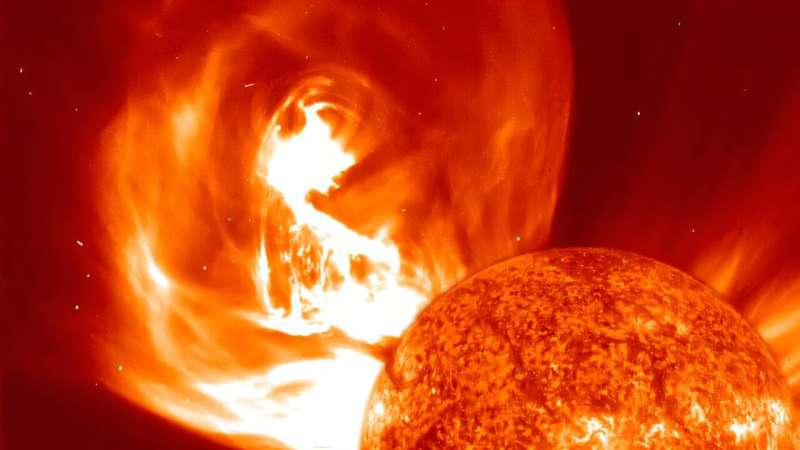
The Sun is not just a glowing ball of gas providing light and heat. It is also the strongest driver of space weather, which can have very real consequences for life on Earth. Solar flares and coronal mass ejections (CMEs)—massive bursts of plasma and magnetic energy—are powered by the Sun’s magnetic field. When directed toward Earth, these events can disrupt satellites, power grids, GPS systems, and radio communications.
As society becomes more dependent on technology, understanding and predicting solar activity is increasingly important. Accurate magnetic field measurements are essential because the Sun’s magnetic structure determines when, where, and how these explosive events occur.
The Longstanding Challenge of Measuring Solar Magnetism
Despite decades of research, measuring the Sun’s magnetic field has always been extremely difficult. Traditional instruments can observe how magnetic fields are tilted relative to the solar surface, but they struggle to determine directionality—whether the field is pointing toward Earth or away from it. This is known as the 180-degree ambiguity problem.
Another major obstacle is determining height. When scientists observe the Sun, they are often seeing multiple atmospheric layers at the same time. This overlap makes it hard to know the exact altitude of magnetic structures. The problem becomes even more complex in sunspots, where intense magnetic forces push the solar surface downward, creating a physical dip that distorts measurements.
These limitations have made it challenging to create reliable three-dimensional magnetic maps of the Sun—until now.
How AI Is Solving These Problems
The IfA-led team developed a machine-learning system called the Haleakalā Disambiguation Decoder, designed specifically to overcome these long-standing issues. The researchers partnered with the National Solar Observatory and the High Altitude Observatory at the NSF National Center for Atmospheric Research to build an AI model that combines real observational data with the fundamental laws of physics.
One key physical principle guides the system: magnetic field lines form continuous loops and do not begin or end in empty space. By enforcing this rule, the AI can determine the true direction of the magnetic field, resolving the ambiguity that has troubled solar scientists for years.
The system also estimates the correct geometric height of magnetic structures by analyzing how light interacts with different layers of the solar atmosphere. Instead of treating height as an unknown, the AI learns to reconstruct it as part of the solution.
Tested Across the Sun’s Most Complex Regions
Before being applied to real telescope data, the AI method was tested extensively on high-resolution computer simulations of the Sun. These simulations included a wide range of solar environments, such as calm regions, highly active areas, and magnetically intense sunspots.
The results showed that the system performs reliably across all these scenarios. Its ability to interpret complex magnetic configurations makes it especially well suited for the ultra-detailed observations produced by the Daniel K. Inouye Solar Telescope, which generates enormous volumes of spectropolarimetric data.
This means scientists can now extract far more physical meaning from DKIST observations than ever before.
New Insights Beyond Magnetic Fields
One of the most exciting aspects of this AI approach is that it does more than just map magnetic fields. The system also reveals vector electric currents in the solar atmosphere—features that were previously extremely difficult to measure directly.
Electric currents play a crucial role in storing and releasing magnetic energy, which ultimately leads to solar eruptions. Being able to observe these currents alongside magnetic fields provides researchers with a much clearer picture of what drives solar flares and coronal mass ejections.
This added layer of information significantly improves the scientific value of solar observations.
What This Means for Space Weather Forecasting
Better three-dimensional magnetic maps translate directly into improved space weather forecasts. With more accurate models of the Sun’s magnetic structure, scientists can better identify regions that are likely to produce powerful eruptions.
Earlier and more reliable warnings give satellite operators, power grid managers, and communication providers more time to prepare and protect critical infrastructure. In practical terms, this research helps reduce the risk of widespread technological disruptions caused by solar storms.
A Closer Look at the Daniel K. Inouye Solar Telescope
The Daniel K. Inouye Solar Telescope is central to this breakthrough. As the largest solar telescope ever built, DKIST can observe the Sun at resolutions never achieved before. It captures detailed measurements of light polarization, which carry information about magnetic fields.
However, the sheer complexity of this data has been a major challenge. The new AI tool effectively acts as a translator, turning raw observations into physically meaningful three-dimensional maps that scientists can analyze and model.
This synergy between cutting-edge instrumentation and physics-informed AI represents a new era in solar research.
Understanding the Sun’s Magnetic Landscape
The Sun’s magnetic field is generated by complex motions of hot plasma deep inside the star, a process known as the solar dynamo. Over time, these magnetic fields twist, stretch, and emerge through the solar surface, forming sunspots and active regions.
When magnetic stress becomes too intense, it can be released suddenly in the form of flares or CMEs. Studying the three-dimensional structure of magnetic fields helps scientists understand how energy builds up and how it is eventually released.
This research brings scientists closer to answering long-standing questions about why some active regions erupt while others remain stable.
A Step Forward for Solar Physics
By blending AI with physical laws, the researchers have shown that machine learning does not have to be a “black box.” Instead, it can be a powerful scientific tool that respects known physics while extracting hidden information from complex data.
This approach is likely to influence future research not only in solar physics but also in other fields where indirect measurements and layered structures make interpretation difficult.
As solar activity continues to rise and fall with the Sun’s natural cycles, tools like this will be essential for keeping pace with the dynamic star that shapes conditions throughout our solar system.
Research Paper Reference:
https://doi.org/10.3847/1538-4357/ae12ef