Astronomers May Have Found the Universe’s First Stars in a Galaxy That Shouldn’t Exist
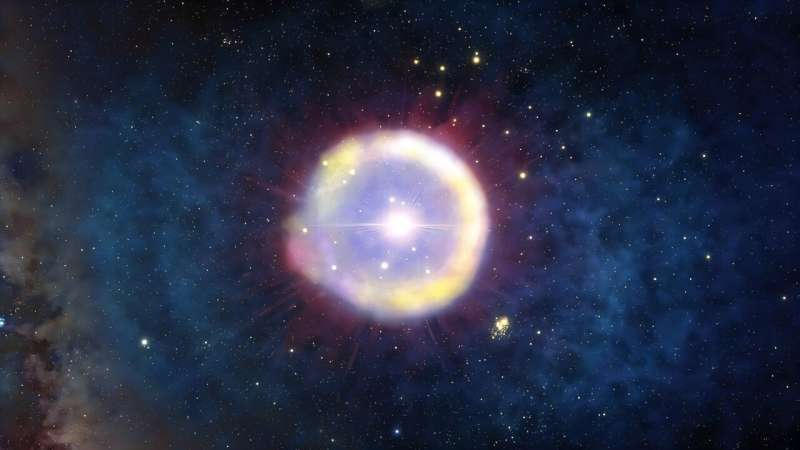
Astronomers have uncovered something genuinely surprising: a galaxy that appears to contain metal-free stars, similar to the Universe’s very first generation of stars, known as Population III (Pop III) stars. Even more astonishing, this galaxy—named MPG-CR3 or simply CR3—formed roughly 11 billion years ago, far later than when scientists believed Pop III stars should have existed. A new study led by Sijia Cai, a Ph.D. researcher at Tsinghua University, presents detailed observations suggesting that CR3 may have formed from pristine, untouched gas, making it one of the strongest Pop III candidates ever discovered.
The Discovery of Galaxy CR3
The Universe has been expanding since the Big Bang, allowing astronomers to look back in time by observing very distant objects. Typically, searches for Pop III stars focus on the Epoch of Reionization, around 500 million to 1 billion years after the Big Bang, when the first stars are expected to have appeared.
CR3 breaks that expectation entirely.
This galaxy formed 2 billion years later than those early epochs, during a cosmic era astronomers call Cosmic Noon, when galaxies across the Universe were already actively forming stars enriched with heavier elements. Yet CR3’s spectrum tells a completely different story.
Using combined observations from the James Webb Space Telescope (JWST), the Very Large Telescope (VLT), and the Subaru Telescope, researchers detected extremely clean hydrogen and helium signals in CR3—with almost no signs of metals like oxygen or carbon. Metal-free stars are the defining trait of Pop III stars, because the earliest stars were formed before heavier elements existed. Metals are only produced through nuclear fusion inside stars and spread into space when stars die in supernova explosions.
The team measured an upper limit of only 0.7% of the Sun’s metallicity in CR3. This means the gas forming this galaxy is nearly untouched by previous generations of stars. In technical terms, metallicity calculations show limits such as 12 + log(O/H) < 6.52, indicating extraordinarily little oxygen—far lower than typical galaxies from that era.
CR3 also appears to be extremely young, only around 2 million years old at the moment we observe it. It hosts small, low-mass stars (relative to what is usually seen in ancient galaxies), is almost dust-free, and exhibits unusually strong emissions from hydrogen and helium. These include a massive Lyα line and a powerful Hα signal, consistent with vigorous, very young star formation.
Why This Discovery Is So Unexpected
The puzzling part is timing. By the time this galaxy formed, the Universe had already experienced multiple generations of star birth and death. Those earlier stars should have polluted surrounding gas with metals, making it impossible for a metal-free galaxy like CR3 to form so late.
So how did CR3 remain pristine?
The researchers propose that CR3 formed inside an underdense region, meaning an unusually empty part of space. Because it was so isolated, the gas cloud that eventually collapsed to become CR3 may have avoided contamination from neighboring galaxies. Isolation allowed it to remain pristine for billions of years, until it finally formed its first stars.
This possibility challenges long-standing models of galaxy evolution. If CR3 truly hosts Pop III stars, it means the Universe might have had pockets of untouched gas surviving far longer than previously believed.
The Mystery of the Missing He II Line
A crucial hallmark of Pop III stars is the He II (helium-two) emission line, which signals extremely hot, massive stars typical of the first generation. In CR3, this key feature is absent—but there are potential explanations.
The authors offer two:
● A strong OH sky emission line interfered with the wavelengths where He II would appear, possibly masking it.
● The He II signal may have already faded. These signals weaken dramatically just a few million years after star formation begins, and CR3 is estimated to be about 2 million years old.
This means the absence of He II does not rule out Pop III star formation. However, astronomers will need further observations to confirm the signature or explain its absence more conclusively.
What Makes Pop III Stars Special?
Since this article expands to provide readers extra background, here’s a helpful overview of what Pop III stars are and why scientists want to find them.
What Are Population III Stars?
Pop III stars are theorized to be the first stars ever formed, beginning the cosmic chain reaction that created all heavier elements in existence. Before them, the Universe contained only hydrogen, helium, and trace amounts of lithium.
Characteristics of Pop III stars:
- Zero metal content (by definition)
- Extremely massive, possibly hundreds of times the mass of the Sun
- Very hot and bright, with surface temperatures over 100,000 K
- Short-lived, often exploding as supernovae within a few million years
- Creators of the first metals, enabling the formation of planets and later, life
Scientists have searched for Pop III stars for decades but have never conclusively identified them. Most theories placed them only in the earliest cosmic epochs. CR3 suggests they may have formed in rare pockets much later.
Why Is Metallicity So Important?
“Metallicity” in astronomy refers to the fraction of a star or galaxy made of elements heavier than helium. Even tiny amounts can reveal whether the gas being observed has been influenced by previous star generations.
CR3’s extraordinarily low metallicity:
● Shows minimal heavy-element pollution
● Supports the idea that its gas is “pristine”
● Makes it one of the strongest candidates ever found for containing Pop III stars
This is why the absence of oxygen or carbon in its spectrum is such a big deal. It suggests not just low metal content, but possibly complete metal absence, depending on observational limits.
Broader Impact on Our Understanding of the Universe
If CR3 is confirmed to host Pop III stars, it would reshape several major ideas in cosmology:
Models of Chemical Enrichment
Galaxies were thought to enrich their surroundings rapidly. CR3 suggests this process can be delayed in underdense regions, where gas remains isolated.
Pop III Formation Windows
Instead of ending quickly after the Big Bang, Pop III star formation might have occurred much later and across a wider range of environments.
Opportunities for Study
A Pop III candidate at z ≈ 3.19 is far more accessible than objects deeper in space. Future telescopes could gather higher-quality data, making it easier to study the Universe’s first stars.
What Happens Next?
Astronomers plan to:
- Conduct deeper spectroscopic observations to search for the missing He II line
- More precisely measure CR3’s metallicity
- Search for other galaxies in similar isolated environments
- Test whether low-density pockets commonly preserve pristine gas
If more galaxies like CR3 are found, they could reveal how rare or common this phenomenon is.
CR3 may represent a turning point—evidence that some parts of the Universe stayed chemically untouched for billions of years, allowing the “first stars” to appear unexpectedly late.
Research Paper:
A Metal-free Galaxy at z = 3.19? Evidence of Late Population III Star Formation at Cosmic Noon
https://doi.org/10.3847/2041-8213/ae1608