Betelgeuse’s Elusive Companion Star Siwarha Leaves a Detectable Wake in the Giant Star’s Atmosphere
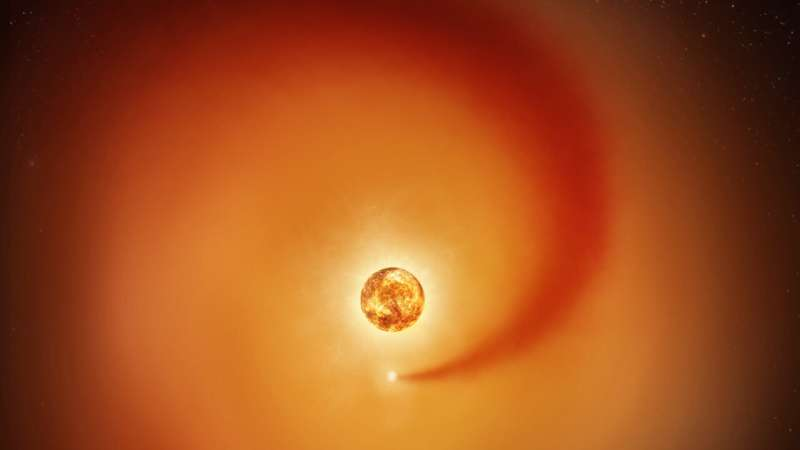
Astronomers have uncovered some of the clearest evidence yet that the famous red supergiant Betelgeuse is not alone. Using a combination of long-term observations from NASA’s Hubble Space Telescope and powerful ground-based observatories, scientists have now directly detected the wake of dense gas created by a small companion star named Siwarha as it moves through Betelgeuse’s vast outer atmosphere. This discovery finally confirms a theory that has been debated for decades and helps explain why Betelgeuse behaves in such strange and unpredictable ways.
Betelgeuse, located about 650 light-years away in the constellation Orion, is one of the largest and most studied stars in the night sky. It is a red supergiant, so enormous that more than 400 million Suns could fit inside it. Because of its size and relative proximity to Earth, astronomers can directly observe its surface and extended atmosphere, making it a natural laboratory for studying how massive stars age, lose material, and ultimately explode as supernovae.
For years, scientists have suspected that Betelgeuse’s unusual brightness variations and atmospheric motions could be influenced by an unseen companion star. That suspicion has now been confirmed.
How Scientists Detected Siwarha’s Wake
The new findings come from nearly eight years of careful observations. Researchers tracked subtle changes in Betelgeuse’s light using Hubble, focusing especially on ultraviolet wavelengths that reveal the behavior of hot, ionized gas. They paid close attention to light emitted by ionized iron (Fe II), a reliable tracer of motion within stellar atmospheres.
As gas moves toward Earth, its light becomes blueshifted, shifting to shorter wavelengths. By measuring how this blueshifted iron emission changed over time, astronomers noticed a repeating pattern tied to the motion of the companion star.
When Siwarha is in front of Betelgeuse from our point of view, the iron emission appears stronger. When the companion passes through the supergiant’s atmosphere and moves behind it, a dense wake of gas forms and absorbs some of that light, causing the signal to weaken. This behavior is exactly what scientists would expect if a companion star were plowing through Betelgeuse’s outer layers, leaving a trail behind it.
Ground-based telescopes at the Fred Lawrence Whipple Observatory in Arizona and the Roque de Los Muchachos Observatory in the Canary Islands helped confirm these patterns by tracking changes in Betelgeuse’s spectrum and gas motions over time.
A Companion Orbiting Inside a Giant Atmosphere
What makes this discovery especially remarkable is where Siwarha is located. The companion star orbits deep within Betelgeuse’s extended atmosphere, at a distance roughly 2.3 times the radius of Betelgeuse itself. That means Siwarha is not orbiting in empty space but is actually moving through tenuous stellar gas.
The orbit takes about 2,100 days, or roughly six years, to complete. Each time Siwarha passes directly between Betelgeuse and Earth, its wake becomes detectable shortly afterward. This repeating cycle matches theoretical predictions and provides strong confirmation that the companion is real and actively shaping Betelgeuse’s behavior.
Although Siwarha is tiny compared to Betelgeuse—essentially a pinprick next to a colossal sphere—its influence is surprisingly significant. Like a boat moving through water, the companion star creates ripples and disturbances that propagate outward through the supergiant’s atmosphere.
Solving Longstanding Mysteries About Betelgeuse
This discovery helps resolve several long-standing puzzles. Betelgeuse is known to vary in brightness in two main cycles. One is a shorter period of about 400 days, now understood to be caused by pulsations within the star itself. The other is a much longer secondary period of around 2,100 days, which until recently had no clear explanation.
Over the years, scientists proposed many possibilities, including giant convection cells, clouds of dust, magnetic activity, and surface eruptions. The idea of a hidden companion gained traction, especially after studies suggested that such a star could explain the long secondary period. However, direct evidence was missing.
That changed with this detection of Siwarha’s wake. The timing of the wake, the changes in gas velocity, and the variations in ultraviolet emission all line up with the companion’s predicted orbit. For the first time, astronomers have direct observational proof that a companion star is disturbing Betelgeuse’s atmosphere.
The Context of Betelgeuse’s Recent Behavior
Interest in Betelgeuse intensified dramatically in 2020, when the star unexpectedly dimmed, an event sometimes referred to as the “Great Dimming.” At the time, some speculated that Betelgeuse might be on the verge of exploding as a supernova. Later research showed that the dimming was likely caused by a combination of surface cooling and dust expelled into space.
The confirmation of Siwarha adds another important piece to this puzzle. A companion star moving through Betelgeuse’s atmosphere can influence how gas is lifted, cooled, and expelled, potentially contributing to the star’s changing appearance over time.
Why This Matters for Stellar Evolution
Beyond Betelgeuse itself, this discovery has broader implications for astronomy. Many giant and supergiant stars show unexplained long-term variations similar to Betelgeuse’s. The detection of Siwarha’s wake suggests that close, low-mass companions may be more common than previously thought and could play a major role in how massive stars lose material and evolve.
Understanding these interactions is critical because mass loss strongly affects when and how a massive star will eventually collapse and explode as a supernova. Betelgeuse now offers astronomers a rare, close-up view of these processes in action.
What Comes Next
From Earth’s perspective, Betelgeuse is currently eclipsing its companion, meaning Siwarha is hidden behind the supergiant. Astronomers are already planning new observations for 2027, when the companion is expected to emerge again. These future observations could reveal even more details about the wake, the orbit, and the physical properties of Siwarha itself.
As research continues, Betelgeuse remains one of the most fascinating stars in the sky—not because it is about to explode tomorrow, but because it allows scientists to watch, in real time, how massive stars live out their final chapters.
Research paper:
https://arxiv.org/abs/2601.00470