Curiosity Sends a Holiday Postcard From Mars
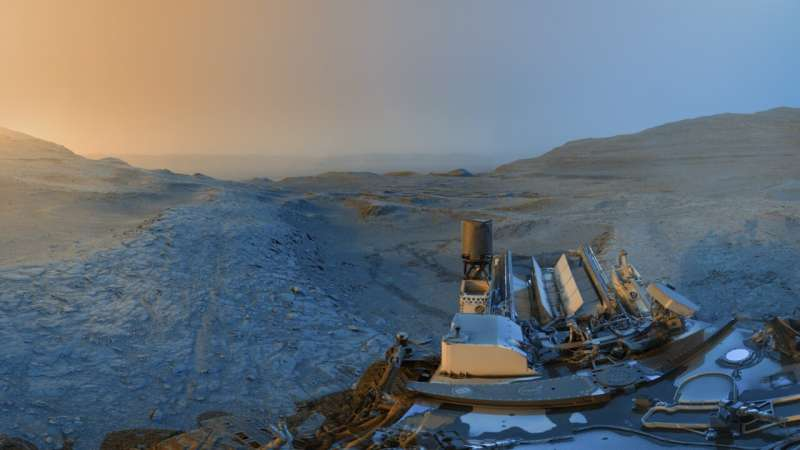
NASA’s Curiosity Mars rover has once again delivered a striking visual from the Red Planet, this time in the form of a carefully crafted holiday postcard from Mars. The image is not a single photograph but a thoughtfully assembled panorama that captures the same Martian landscape at two different times of day, offering both scientific value and visual appeal.
This special postcard was created by the mission team by commanding Curiosity to take panoramic images on November 18, 2025, during two separate Martian days, known as sols. These sols were numbered 4,722 and 4,723 of Curiosity’s long-running mission, a reminder of just how long the rover has been actively exploring Mars.
Two Moments in One Martian Scene
The first set of images was captured at 4:15 p.m. local Mars time on Sol 4,722, during the late afternoon. The second set followed the next morning at 8:20 a.m. on Sol 4,723. Although these images were taken hours apart and under very different lighting conditions, they show the same stretch of terrain inside Gale Crater, Curiosity’s home since it landed in 2012.
Once transmitted back to Earth, the images were merged into a single panorama, creating a seamless view that blends morning and afternoon on Mars. To help distinguish between the two time periods, the team added color afterward as part of an artistic interpretation. In the final postcard, blue tones represent the morning panorama, while yellow tones highlight the afternoon view. This color treatment is not meant to show what Mars would look like to the human eye, but rather to make subtle surface details easier to see.
Why Color Matters in Mars Images
Curiosity’s navigation cameras typically capture images in black and white, which is ideal for scientific analysis and rover operations. However, when multiple images are combined into panoramas, adding color can help surface textures, ridges, and geological features stand out more clearly. In this postcard, the color contrast helps reveal variations in the landscape that might otherwise blend together.
This technique has been used before. Similar dual-time panoramas were created by Curiosity in November 2021 and again in June 2023, making this 2025 postcard part of a growing tradition. Each version serves both as a scientific snapshot and as a way to share Mars exploration with the public in an engaging format.
What the Postcard Shows
The panorama looks out across a region of Gale Crater that Curiosity has been studying closely as it climbs the lower slopes of Mount Sharp, the central mountain within the crater. The foreground includes wheel tracks left by the rover, offering a visible record of its recent movements. These tracks are more than just marks in the soil; they help scientists understand surface conditions and how the rover interacts with different types of terrain.
The surrounding landscape features rocky ridges and layered formations, shaped by ancient geological processes. Some of these structures are believed to be remnants of mineral-rich fluids that once moved through cracks in the rock, later exposed by erosion. The merged panorama allows scientists to compare how shadows and highlights change across the same features at different times of day, which can reveal additional information about rock texture and surface relief.
A Mission That Keeps Going
Curiosity landed on Mars in August 2012, with an original mission planned to last just a couple of years. More than a decade later, the rover continues to operate well beyond expectations. Over time, it has traveled many kilometers across Gale Crater, drilled into rocks, analyzed soil samples, and provided strong evidence that Mars once had conditions suitable for microbial life.
The creation of this holiday postcard is a reminder that Curiosity is still healthy, still mobile, and still returning valuable data. Even after thousands of sols, the rover’s cameras and instruments remain critical tools for understanding Mars’ past environment.
The Science Behind Martian Sols
A sol is a single Martian day, which lasts about 24 hours and 39 minutes. Because Mars rotates more slowly than Earth, mission planners track time using sol numbers rather than Earth dates. This makes it easier to plan rover activities based on local daylight conditions.
By Sol 4,723, Curiosity had already spent over 12 Earth years on Mars. Capturing images that span two consecutive sols highlights both the rover’s longevity and the careful planning that goes into every observation.
Why NASA Creates “Postcards” From Mars
These postcard-style images are not just about aesthetics. They serve several important purposes. Scientifically, they provide context images that help researchers understand where detailed measurements were taken. Visually, they help communicate the scale and complexity of the Martian surface to people on Earth.
Public engagement is also a key goal. Images like this help bridge the gap between raw scientific data and public curiosity, making Mars exploration feel more immediate and relatable. Seeing a familiar concept like morning and afternoon applied to another planet helps people connect with the mission on a more human level.
A Look at Gale Crater and Mount Sharp
Gale Crater is about 154 kilometers wide and was selected as Curiosity’s landing site because it preserves a long record of Martian history. At its center stands Mount Sharp, a layered mountain formed over billions of years. Each layer represents a different chapter in Mars’ environmental past.
As Curiosity climbs higher, it encounters rocks that formed under changing conditions, from wetter periods to drier ones. The terrain seen in the holiday postcard is part of this ongoing journey, offering visual clues about how Mars evolved over time.
What Comes Next for Curiosity
Curiosity continues to study rock chemistry, mineral composition, and surface features as it moves forward. While newer rovers like Perseverance are exploring other regions of Mars, Curiosity remains a vital part of NASA’s exploration program. Its long-term data set allows scientists to compare findings across years and seasons on Mars.
The holiday postcard is a snapshot of that ongoing work, showing that even routine navigation images can be transformed into something that is both informative and visually compelling.
A Small Image With a Big Perspective
By combining two moments separated by time, Curiosity’s holiday postcard captures more than just a landscape. It reflects the patience, precision, and creativity behind Mars exploration. It also serves as a quiet reminder that, millions of kilometers away, a rover is still watching the Martian day begin and end, one sol at a time.
Research reference:
https://www.nasa.gov/image-article/curiosity-sends-holiday-postcard-from-mars/