Dark Stars Could Help Solve Three Pressing Puzzles of the High-Redshift Universe
A new astrophysics study is stirring serious excitement by suggesting that dark stars, a long-theorized but still unconfirmed class of objects, could explain several of the most confusing discoveries made by the James Webb Space Telescope (JWST). These discoveries all come from the cosmic dawn, the earliest era of star and galaxy formation, when the universe was only a few hundred million years old.
The research argues that dark stars may offer a single, unified explanation for three major mysteries: the emergence of ultra-bright blue monster galaxies, the existence of unexpectedly massive black holes very early in cosmic history, and the strange population of compact sources known as little red dots. Together, these findings challenge many long-standing assumptions about how the first stars, galaxies, and black holes formed.
The study was led by Cosmin Ilie, Assistant Professor of Physics and Astronomy at Colgate University, with collaborators from the University of Pennsylvania, the Space Telescope Science Institute, and the University of Texas at Austin. Their work was published in the peer-reviewed journal Universe in 2025.
The Cosmic Dawn and Why It Matters
The cosmic dawn marks a transformative chapter in the universe’s history. Roughly a few hundred million years after the Big Bang, clouds of hydrogen and helium cooled enough to collapse under gravity, forming the very first stars. These stars triggered the birth of the first galaxies and began shaping the large-scale structure of the universe we observe today.
For decades, astronomers believed they had a fairly solid picture of how this process unfolded. That confidence was shaken once JWST began delivering incredibly detailed observations of extremely distant objects. Many of these objects simply do not fit into pre-JWST models, suggesting that something important is missing from our understanding.
This is where dark stars come into play.
What Exactly Are Dark Stars?
Dark stars are hypothetical stellar objects that form in regions extremely rich in dark matter, particularly at the centers of early dark matter microhalos. Unlike normal stars, which are powered by nuclear fusion, dark stars are powered by dark matter annihilation.
When dark matter particles collide and annihilate, they release energy. In dense environments, that energy could heat a forming star and prevent it from collapsing and igniting fusion. This unusual power source allows dark stars to remain cool, bloated, and stable while continuing to pull in more mass from their surroundings.
Because they do not quickly burn through their fuel like ordinary stars, dark stars could grow to supermassive sizes, potentially reaching hundreds of thousands or even millions of times the mass of the Sun. Once the dark matter fuel is exhausted, these stars would collapse, leaving behind massive black hole remnants.
Puzzle One Blue Monster Galaxies
One of JWST’s biggest surprises has been the discovery of blue monster galaxies. These galaxies are extremely bright, very compact, and almost completely dust-free, which makes them appear unusually blue. Their brightness suggests rapid and efficient star formation, but their compact size and lack of dust are difficult to reconcile with existing galaxy formation models.
Before JWST, no simulations predicted that such galaxies should exist in large numbers at such early times. The new study proposes that many of these blue monsters may not be typical galaxies at all. Instead, they could be dominated by light from supermassive dark stars, whose radiation floods their host halos and mimics the appearance of an ultra-luminous galaxy.
If true, this interpretation would significantly reduce the tension between observations and theory by changing what astronomers think they are actually seeing.
Puzzle Two Overmassive Black Holes in the Early Universe
Another major problem comes from the discovery of supermassive black holes at incredibly high redshifts. Some of these black holes existed when the universe was less than 500 million years old, leaving very little time for them to grow through standard processes like accretion or mergers.
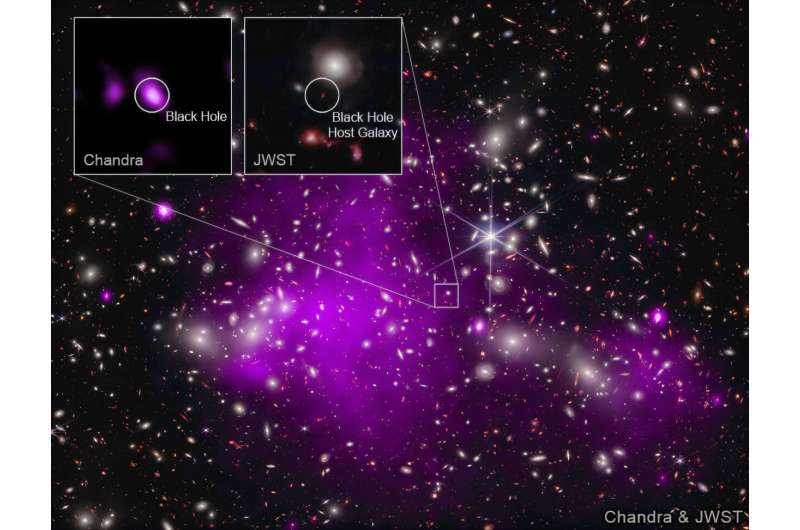
A striking example is UHZ1, a galaxy located about 13.2 billion light-years away, observed when the universe was only about 3 percent of its current age. UHZ1 appears to host a black hole far too massive to have formed from the collapse of ordinary stars alone.
The dark star model provides a natural solution. A supermassive dark star could collapse directly into a large black hole, creating a massive seed from the very beginning. This bypasses the need for unrealistically fast growth rates and offers a plausible pathway for forming early quasars.
Importantly, the mechanisms described in the study are not limited to UHZ1. They could explain a broader population of overmassive black hole galaxies now being identified by JWST.
Puzzle Three Little Red Dots
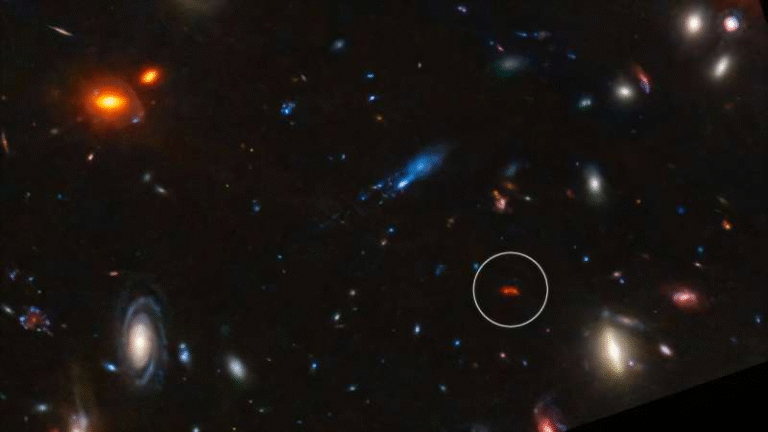
The third mystery involves objects known as little red dots. These are compact, dustless sources observed by JWST that emit very little X-ray radiation, which is unexpected if they host actively accreting black holes.
Standard models struggle to explain how such objects could exist without strong high-energy emissions. The study suggests that little red dots may be remnants of collapsed dark stars, surrounded by dense material that suppresses X-ray output while still allowing infrared emission.
This interpretation neatly explains their compact size, red color, and unusual emission properties without requiring exotic assumptions about black hole behavior.
Spectroscopic Clues and Observational Evidence
While dark stars remain theoretical, the study adds weight to the idea by discussing photometric and spectroscopic candidates identified in earlier research. Two separate studies published in PNAS in 2023 and 2025 reported possible observational signatures consistent with dark stars.
The new paper presents updated spectroscopic analysis showing potential helium absorption features, considered a key prediction of dark star atmospheres. These features were identified in JADES-GS-13-0, in addition to a previously reported signal in JADES-GS-14-0.
Although these findings are not definitive proof, they represent some of the strongest observational hints so far.
Why Dark Stars Would Be a Big Deal
Confirming the existence of dark stars would have profound implications. Beyond solving cosmic dawn puzzles, dark stars could offer a rare way to probe the physical properties of dark matter, including its particle mass and interaction behavior.
This would complement Earth-based experiments focused on direct detection or particle production, creating a powerful bridge between astrophysics and particle physics.
Looking Ahead
Future JWST observations, especially deeper spectroscopic surveys and improved modeling, will be crucial for testing the dark star hypothesis. Whether dark stars are ultimately confirmed or ruled out, their ability to explain multiple independent anomalies makes them one of the most intriguing ideas in modern cosmology.
At the very least, this research highlights how much we still have to learn about the universe’s earliest moments—and how JWST is forcing scientists to rethink what they thought they knew.
Research Paper:
Cosmin Ilie et al., Supermassive Dark Stars and Their Remnants as a Possible Solution to Three Recent Cosmic Dawn Puzzles, Universe (2025).
https://doi.org/10.3390/universe12010001