Earliest Barred Spiral Galaxy COSMOS-74706 Spotted Just 2 Billion Years After the Big Bang
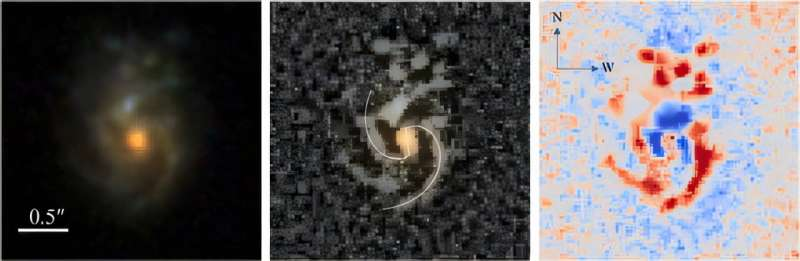
Astronomers have uncovered a remarkable cosmic discovery: a barred spiral galaxy that existed far earlier than previously confirmed examples. The galaxy, named COSMOS-74706, dates back to a time when the universe was only about 2 billion years old, meaning its light has traveled roughly 11.5 billion years to reach us. This makes it the earliest spectroscopically confirmed barred spiral galaxy known so far, and a crucial data point for understanding how galaxies evolved in the young universe.
This finding comes from research led by Daniel Ivanov, a graduate student in physics and astronomy at the University of Pittsburgh, and was scheduled to be presented at the 247th meeting of the American Astronomical Society in January 2026. The work focuses on answering a long-standing question in astronomy: how early could complex galaxy structures like bars and spiral arms form after the Big Bang?
Why COSMOS-74706 Is So Important
COSMOS-74706 is notable because it clearly shows both spiral arms and a central bar-like structure, features that are common in many nearby galaxies but were not expected to appear so early in cosmic history. Our own Milky Way is a barred spiral galaxy, so observing a similar structure at such an early epoch offers valuable insight into how familiar galaxies may have formed.
What truly sets this galaxy apart from earlier candidates is how confidently its distance and structure have been confirmed. In the past, astronomers have reported possible barred spiral galaxies at very high redshifts, but those claims often relied on photometric redshift estimates or galaxies whose shapes were distorted by gravitational lensing. In contrast, COSMOS-74706 was validated using spectroscopy, which provides a far more precise and reliable way to measure cosmic distances.
Because of this, COSMOS-74706 is currently regarded as the highest-redshift, spectroscopically confirmed, unlensed barred spiral galaxy ever observed.
How Old Is This Galaxy?
By analyzing the galaxy’s light, researchers determined that COSMOS-74706 existed approximately 11.5 billion years ago, placing it just 2 billion years after the Big Bang. In cosmological terms, this corresponds to a very high redshift, indicating that the galaxy formed during a period when the universe was still rapidly assembling its first large-scale structures.
This timing is especially important because it provides a hard observational limit on when stellar bars could first appear. While some computer simulations have suggested that bars might form as early as 12.5 billion years ago, observational evidence has been scarce. COSMOS-74706 helps narrow down that timeline with real data.
How the Galaxy Was Observed
The discovery of COSMOS-74706 relied heavily on observations from the James Webb Space Telescope (JWST). Using JWST’s Near-Infrared Camera (NIRCam), astronomers were able to detect the faint infrared light from this distant galaxy and resolve its overall structure, including its spiral arms and potential bar.
To confirm the galaxy’s age, the team followed up with spectroscopic observations using the MOSFIRE instrument on the Keck I telescope. Spectroscopy breaks down a galaxy’s light into its component wavelengths, allowing astronomers to measure its redshift with high precision. This step was crucial in confirming that COSMOS-74706 truly dates back to such an early period in the universe.
The combination of JWST imaging and ground-based spectroscopy makes this one of the most robust early-galaxy identifications to date.
What Exactly Is a Barred Spiral Galaxy?
To understand why this discovery matters, it helps to look at what defines a barred spiral galaxy.
- A spiral galaxy has a flat, rotating disk with arms that wind outward from the center.
- A barred spiral galaxy includes an additional feature: a bright, elongated bar of stars and gas stretching across the galaxy’s center.
This bar is not a solid object but a dense alignment of stars and gas. It plays a major role in how a galaxy evolves. Stellar bars can funnel gas inward, feeding the central supermassive black hole and influencing how and where new stars form. Over time, bars can also redistribute mass within a galaxy and even suppress star formation in the outer disk.
In the nearby universe, barred spiral galaxies are extremely common. Studies suggest that more than half of all disk galaxies today contain bars. The big mystery has been when these structures first appeared — and COSMOS-74706 pushes that answer much earlier than many astronomers expected.
Why This Changes Our Understanding of Galaxy Evolution
1. Complex Galaxies Formed Earlier Than Expected
For a long time, astronomers believed that early galaxies were mostly chaotic, irregular systems that needed many billions of years to settle into well-organized disks with spiral arms and bars. COSMOS-74706 challenges that view by showing that well-defined disk structures already existed when the universe was still very young.
This suggests that galaxy formation and stabilization may have happened faster and more efficiently than older models predicted.
2. Bars Can Form in a Young, Turbulent Universe
The early universe was a dynamic and often violent place, with frequent galaxy mergers and intense bursts of star formation. The presence of a bar in COSMOS-74706 implies that dynamical instabilities capable of producing bars can occur even under these conditions.
This helps refine theoretical models that describe how bars form and evolve over time, especially in environments very different from the modern universe.
3. A New Benchmark for Future Discoveries
While earlier barred spiral candidates have been reported, many of them suffered from uncertainties due to lensing or indirect distance measurements. COSMOS-74706 now serves as a benchmark object — a clear, well-measured example that future discoveries can be compared against.
As JWST continues to survey the distant universe, astronomers expect to find more galaxies like this one, helping to determine whether COSMOS-74706 is rare or part of a broader early population.
The Bigger Picture: Why Bars Matter in Galaxies
Bars are more than just visual features. They actively shape a galaxy’s life cycle by controlling how gas moves, where stars form, and how the central regions evolve. In some cases, bars are thought to trigger bursts of star formation, while in others they may help shut star formation down by stabilizing the disk.
Understanding when bars first appeared helps astronomers piece together the long-term evolution of galaxies, including how systems like the Milky Way came to look the way they do today.
What Comes Next?
The discovery of COSMOS-74706 highlights the power of modern astronomy tools, especially JWST, to peer deep into cosmic history. With continued observations, researchers hope to find even earlier examples of disk galaxies and determine how common bars were in the early universe.
Each new discovery adds another piece to the puzzle of how galaxies form, grow, and evolve — and COSMOS-74706 is a major step forward in that effort.
Research Paper:
https://aas.org/sites/default/files/2026-01/AAS247_Thu1_DanielIvanov.pdf