Earth’s Atmosphere May Be Helping Make the Moon More Livable for Humans
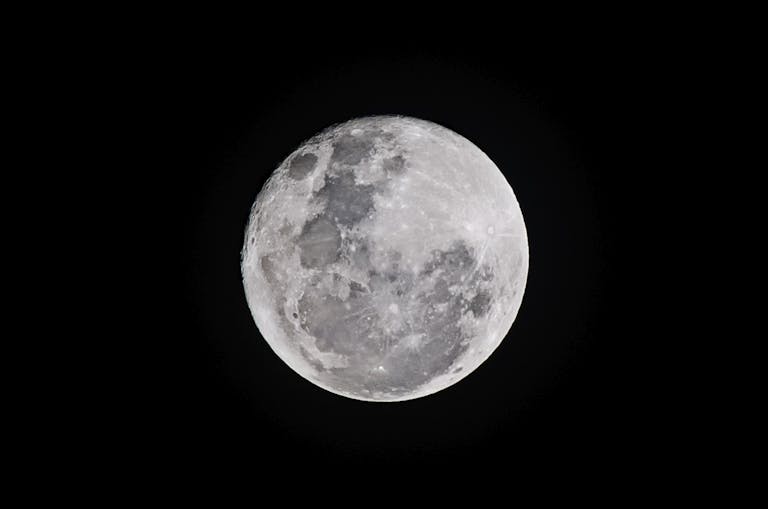
The Moon has long been described as a dry, lifeless, and barren world, covered in fine dust and exposed to the harsh environment of space. But new scientific research suggests this familiar picture may be incomplete. Over billions of years, tiny particles from Earth’s atmosphere have been quietly settling onto the Moon’s surface, potentially leaving behind materials that could support future human exploration.
A new study from researchers at the University of Rochester reveals that Earth’s atmosphere does not stay entirely bound to our planet. Instead, a small but steady stream of atmospheric ions has been traveling through space and embedding itself in the Moon’s soil. This discovery reshapes how scientists think about the Moon’s chemical makeup, Earth’s magnetic field, and the long-term exchange of material between Earth and its closest neighbor.
How Earth’s Atmosphere Reaches the Moon
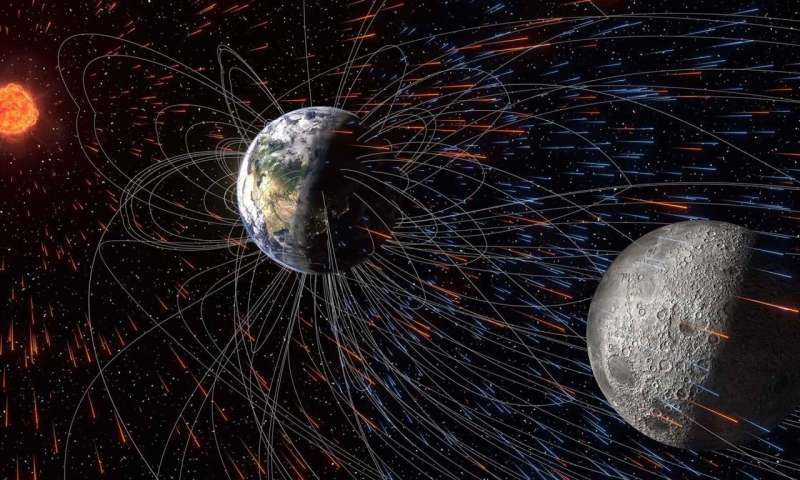
At the heart of this research is a surprising role played by Earth’s magnetic field. Traditionally, the magnetic field is viewed as a protective shield that blocks the solar wind—streams of charged particles emitted by the Sun—from stripping away Earth’s atmosphere. While this shielding effect is real, the new research shows it is not the whole story.
When solar wind interacts with Earth’s upper atmosphere, it can knock charged particles—known as atmospheric ions—loose. Instead of being scattered randomly or blocked entirely, some of these ions are guided along magnetic field lines that extend far into space. Certain field lines stretch outward enough to reach the Moon’s orbit, particularly when the Moon passes through Earth’s magnetotail, the elongated region of Earth’s magnetic field on the side facing away from the Sun.
Over extremely long periods of time, this process allows small amounts of Earth’s atmosphere to funnel toward the Moon, where the particles eventually settle into the lunar soil.
A Process That Has Been Happening for Billions of Years
One of the most important findings of the study is that this atmospheric transfer is not a recent phenomenon. Earth’s magnetic field has existed for billions of years, meaning the movement of atmospheric particles to the Moon could have been happening across most of Earth’s history.
Because the Moon lacks weather, plate tectonics, and liquid water erosion, materials deposited on its surface tend to remain preserved for immense spans of time. This makes the Moon a kind of natural archive, capable of storing chemical records that Earth itself has long since erased.
The researchers suggest that lunar soil may hold a layered history of Earth’s atmosphere, potentially revealing how it evolved as life emerged, oceans formed, and climate conditions changed.
Clues Hidden in Apollo-Era Lunar Soil
The idea that the Moon contains volatile elements is not new. Samples brought back during the Apollo missions of the 1960s and 1970s revealed that lunar regolith—the loose, dusty surface material—contains substances such as water, carbon dioxide, nitrogen, helium, and argon.
For years, scientists assumed most of these volatiles came from the solar wind, which constantly bombards the Moon due to its lack of a global magnetic field. However, some measurements—particularly the amount of nitrogen found in lunar samples—have been difficult to explain using solar wind alone.
In 2005, researchers from the University of Tokyo proposed that some of the Moon’s volatile elements could have originated from Earth’s atmosphere. At the time, they believed this transfer could only have occurred before Earth developed a magnetic field, assuming the field would prevent atmospheric escape.
The new University of Rochester study challenges that assumption.
Testing Early Earth vs. Modern Earth
To understand how atmospheric particles could reach the Moon, the research team used advanced computer simulations to model interactions between the solar wind, Earth’s atmosphere, and Earth’s magnetic field.
They tested two distinct scenarios:
- An early Earth with no magnetic field and a stronger solar wind
- A modern Earth with a strong magnetic field and a weaker solar wind
Surprisingly, the simulations showed that the modern Earth scenario was more efficient at transferring atmospheric particles to the Moon. Rather than blocking atmospheric escape, the magnetic field helps direct ions along specific pathways, effectively funneling them toward the Moon over time.
This result overturns earlier assumptions and highlights the magnetic field as an active participant in long-distance particle transport.
Why the Near Side of the Moon Matters
The study also suggests that Earth-derived atmospheric particles are most likely to accumulate on the Moon’s near side, the hemisphere that always faces Earth. This region spends more time connected to Earth’s magnetic field lines, increasing the likelihood of ion implantation into the lunar regolith.
This detail could become especially important for future missions, as many planned human landings and long-term lunar bases are focused on near-side locations due to communication advantages.
What This Means for Future Human Exploration
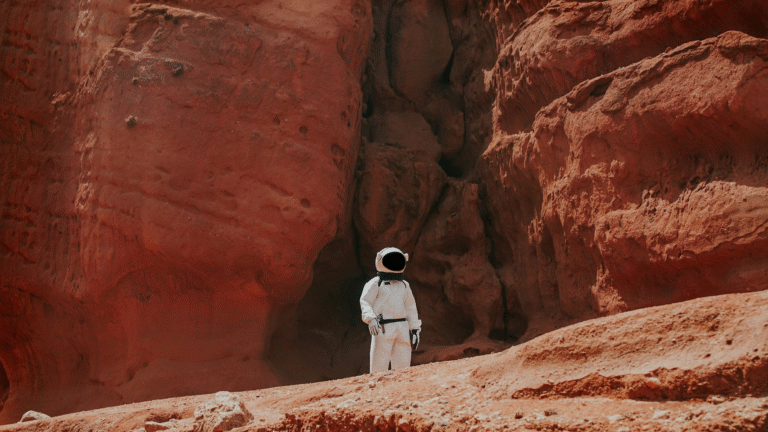
Beyond its scientific value, this discovery has practical implications. Volatile elements such as water and nitrogen are critical for sustaining human life. Water can be used for drinking, oxygen production, and rocket fuel, while nitrogen is essential for breathable air and agriculture.
If lunar soil contains more volatiles than previously believed, it strengthens the case for in-situ resource utilization, where astronauts extract and use local materials rather than transporting everything from Earth. Even small increases in available resources can dramatically reduce mission costs and increase the feasibility of long-term human presence on the Moon.
The Moon as a Record of Earth’s Past
Another major implication is the Moon’s potential role as a time capsule of Earth’s atmospheric history. Earth’s own geological processes constantly recycle and erase ancient atmospheric evidence. The Moon, by contrast, preserves it.
By studying isotopes and chemical signatures embedded in lunar soil, scientists may be able to reconstruct how Earth’s atmosphere changed over time, shedding light on the development of oceans, climate stability, and even the conditions that allowed life to flourish.
Broader Implications for Planetary Science
The findings also extend beyond Earth and the Moon. The research provides new insights into how planetary atmospheres evolve, particularly for planets like Mars, which once had a magnetic field and a thicker atmosphere but lost both over time.
Understanding how magnetic fields can both protect and leak atmospheric particles helps scientists better assess planetary habitability, both in our solar system and around distant stars.
A New Way to Look at Earth–Moon Connections
This research highlights a long-term and subtle connection between Earth and the Moon that goes far beyond gravity and tides. For billions of years, Earth has been quietly seeding the Moon with fragments of its atmosphere, leaving behind a chemical legacy that may one day help humans live and work there.
The Moon is no longer just a silent companion—it may be one of the best-preserved records of Earth’s own story.
Research paper:
https://www.nature.com/articles/s43247-025-02960-4