Flaring Black Hole Whips Up Ultra-Fast Winds at One-Fifth the Speed of Light
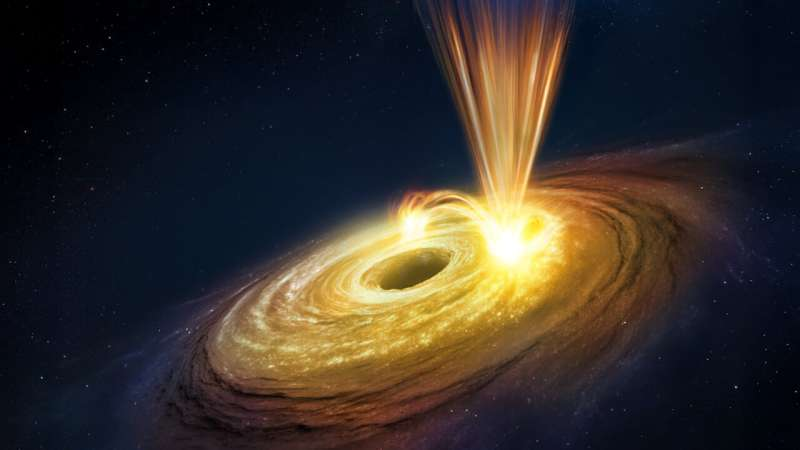
Astronomers have witnessed something truly extraordinary deep in space: a supermassive black hole unleashing a powerful blast that generated ultra-fast winds moving at nearly one-fifth the speed of light. This rare cosmic event was observed using two of the world’s most advanced X-ray space telescopes and offers new insight into how black holes interact with their surroundings and influence the evolution of entire galaxies.
The black hole at the center of this discovery resides in NGC 3783, a striking spiral galaxy that has also been imaged by the NASA/ESA Hubble Space Telescope. At its heart lies a supermassive black hole with a mass equivalent to 30 million Suns, actively feeding on surrounding material. As it does so, it powers a brilliantly energetic region known as an Active Galactic Nucleus (AGN).
Using the European Space Agency’s XMM-Newton and XRISM (X-Ray Imaging and Spectroscopy Mission)—a mission led by JAXA with ESA and NASA participation—scientists observed a sudden and intense X-ray flare erupt from this black hole. What made this event exceptional was not just the flare itself, but what followed immediately afterward.
As the X-ray brightness rapidly faded within hours, astronomers detected the emergence of powerful winds blasting outward at speeds of up to 60,000 kilometers per second. That translates to roughly 20% of the speed of light, making these winds among the fastest ever observed from a black hole. Even more remarkably, these winds appeared within just a single day of the flare—far faster than anything previously recorded.
This real-time connection between a flare and the birth of ultra-fast winds is something scientists have never directly observed before. It provides compelling evidence that black holes can respond almost instantly to sudden changes in their energy output.
To capture this fleeting event, the research team relied on the complementary strengths of the two telescopes. XMM-Newton monitored the evolution of the flare using its Optical Monitor and mapped the extent of the winds with its European Photon Imaging Camera (EPIC). At the same time, XRISM’s Resolve instrument delivered high-resolution X-ray spectra that allowed scientists to precisely measure the winds’ speed, structure, and composition, as well as gain clues about how they were launched.
The results show that the winds reached velocities of around 0.19 times the speed of light, placing them firmly in the category of ultrafast outflows (UFOs)—a phenomenon long suspected to exist around AGNs but rarely observed forming in real time.
One of the most intriguing aspects of this discovery is the mechanism thought to be responsible. The data suggest that the winds were created when the AGN’s intensely tangled magnetic fields suddenly rearranged and released energy, a process known as magnetic reconnection. This is strikingly similar to what happens during solar flares on our own Sun.
In fact, the researchers directly compare the black hole event to coronal mass ejections (CMEs)—massive eruptions in which the Sun hurls superheated plasma into space. While solar CMEs typically reach speeds of about 1,500 kilometers per second, the black hole-driven winds are vastly more powerful, yet governed by surprisingly similar physics. This parallel helps make supermassive black holes feel a little less alien and reinforces the idea that the same fundamental laws operate across wildly different scales in the universe.
NGC 3783’s AGN is already known to be highly active, emitting enormous amounts of energy across the electromagnetic spectrum and producing both jets and winds that extend far beyond the black hole itself. These outflows play a critical role in shaping the host galaxy. By heating, dispersing, or even ejecting gas, AGN winds can regulate star formation, influence the distribution of matter, and help determine how galaxies grow and evolve over billions of years.
This is why understanding how such winds are launched is so important. Until now, most models relied on indirect evidence or long-term averages. The new observations provide a clear cause-and-effect sequence: a sudden flare, followed almost immediately by the formation of an ultra-fast outflow. That timing strongly supports the idea that magnetic processes, rather than radiation pressure alone, can drive some of the most extreme winds seen in the universe.
The discovery also highlights the value of international collaboration in space science. XMM-Newton, which has been exploring the hot and energetic universe for over 25 years, brought long-term experience and broad coverage. XRISM, launched in September 2023, contributed cutting-edge spectroscopic precision that made it possible to study the fine details of the winds. Together, the two missions captured an event that neither could have fully understood on its own.
Beyond this specific black hole, the findings have broader implications for astrophysics. They suggest that AGN magnetism may be more dynamic and influential than previously thought. If similar flare-triggered winds occur in other galaxies—and there is reason to believe they do—then such events could be a common but short-lived phase in the life of active black holes.
This also opens up exciting connections between solar physics and high-energy astrophysics. The resemblance between black hole winds and solar eruptions hints that researchers studying the Sun and those studying distant galaxies may have more to learn from each other than expected.
The study detailing this discovery has been published in the journal Astronomy & Astrophysics, marking a significant milestone in our understanding of black hole behavior. By catching a supermassive black hole in the act of generating ultra-fast winds, astronomers have gained a rare glimpse into the rapid and violent processes that help shape the cosmos.
As X-ray observatories continue to work together and new missions come online, scientists expect to find more of these dramatic events. Each one brings us closer to answering some of the biggest questions in astronomy: how black holes influence their galaxies, how matter behaves under extreme conditions, and how familiar physical processes can manifest on the grandest scales imaginable.
Research paper:
https://doi.org/10.1051/0004-6361/202557189