How Astronauts Viewing Earth From Space Experience the Powerful Overview Effect After 25 Years on the ISS
For more than 25 years of continuous human presence in low Earth orbit, astronauts aboard the International Space Station (ISS) have shared a remarkable and deeply consistent experience: seeing Earth from space fundamentally changes how they think about the planet, humanity, and their place in the universe. This mental and emotional shift is widely known as the overview effect, and it has become one of the most profound psychological outcomes of human spaceflight.
The term overview effect was introduced in 1987 by space philosopher and author Frank White, who described it as a powerful cognitive transformation triggered by viewing Earth from space. Since then, NASA astronauts from multiple generations have echoed similar reflections, especially those who have lived and worked aboard the ISS. Their perspectives offer a unique window into how spaceflight reshapes human thinking at its deepest level.
From orbiting approximately 262 miles above Earth, astronauts witness a view that is both breathtaking and unsettling. Earth appears as a single, luminous sphere floating in the darkness of space. The atmosphere reveals itself as a thin blue line, and under certain lighting conditions, even a thin green glow becomes visible, highlighting just how delicate the protective layer around the planet truly is.
Astronauts frequently report that this visual realization leads to a sudden understanding: every person who has ever lived exists within that fragile atmospheric boundary, while everything beyond it is entirely inhospitable. From this vantage point, familiar divisions disappear. National borders, political boundaries, religious distinctions, and social separations simply do not exist when viewed from orbit. What remains is one shared planet sustaining all life.
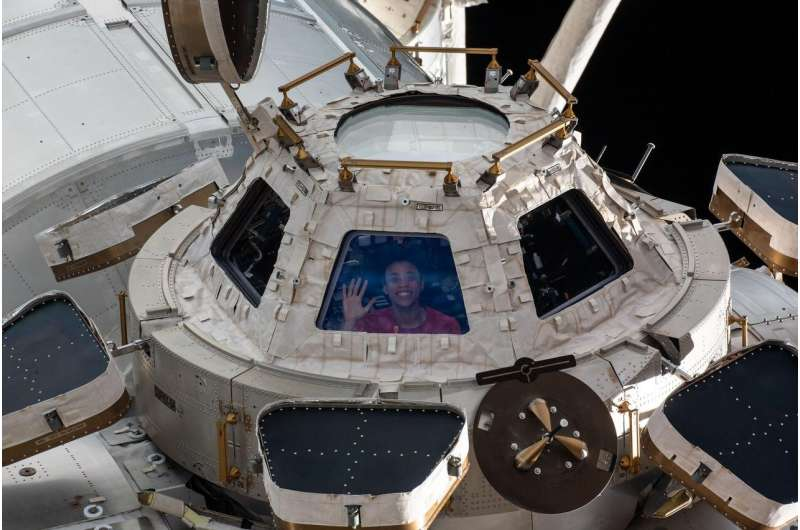
The ISS plays a central role in enabling this experience. One of its most iconic features is the cupola module, a seven-windowed observation dome designed specifically for Earth viewing and spacecraft monitoring. Astronauts often describe the cupola as the place where the overview effect becomes unavoidable. Spending time there, watching continents drift by, oceans shimmer, and storms swirl, leads many crew members into moments of deep reflection.
Several astronauts have spoken about how this perspective influences their sense of responsibility once they return to Earth. After coming back to what one astronaut described as “sea level,” individuals face a choice: whether to carry this expanded awareness into everyday life. Many do. The overview effect often leads to a stronger sense of global citizenship, with astronauts seeing themselves not just as representatives of a nation, but as members of a shared planetary community.
This sense of unity has particular relevance during moments of global crisis. Astronauts have reflected on how challenges such as pandemics, climate change, and geopolitical conflicts look very different after seeing Earth from space. From orbit, it becomes clear that these challenges do not belong to one country or region. They affect everyone, everywhere, all at once.
Another recurring theme among astronauts is the shifting definition of home. Many astronauts initially look forward to spotting familiar locations from space, such as their home state or country. Yet once they experience the overview effect, those places begin to feel like special parts of a much larger whole. Earth itself becomes home, and national identities take a secondary role to planetary identity.
Environmental awareness is one of the most consistent outcomes of the overview effect. Astronauts repeatedly note how fragile Earth appears from orbit, especially when observing the atmosphere’s thinness against the vast blackness of space. Many astronauts say that even those who were not deeply concerned about conservation before flight return with a heightened commitment to environmental protection and sustainability.
This realization is not driven by abstract data or scientific models, but by direct visual evidence. From space, pollution, deforestation, and atmospheric disturbances become visible on a planetary scale. Seeing these changes unfold in real time reinforces the understanding that Earth’s systems are interconnected and vulnerable.
Some astronauts feel a strong desire to share this perspective with others. They speak about the importance of giving more people access to space, whether through future missions, commercial spaceflight, or educational initiatives. Their hope is that wider exposure to the overview effect could inspire greater cooperation, empathy, and long-term thinking across societies.
The emotional intensity of the experience is also noteworthy. Veteran astronauts have described bringing first-time crew members to the cupola and watching them become overwhelmed. Tears are common. The reaction is not driven by fear, but by awe, humility, and an intense emotional connection to the planet below. Many describe the experience as heart-stopping, soul-pounding, and unforgettable.
Why the Overview Effect Matters Beyond Spaceflight
While only a small number of humans have traveled to space, the implications of the overview effect extend far beyond astronauts. Researchers, psychologists, and philosophers have studied this phenomenon as an example of how shifts in perspective can reshape values and behavior. The overview effect demonstrates how exposure to a larger context can encourage cooperation over conflict and stewardship over exploitation.
In recent years, virtual reality simulations and Earth observation imagery have been explored as ways to recreate elements of the overview effect for people on the ground. While these tools cannot fully replicate the experience of spaceflight, they highlight growing interest in using perspective shifts to promote global awareness and environmental responsibility.
The ISS and Its Role in Shaping Human Perspective
The International Space Station represents one of humanity’s most ambitious collaborative projects. Continuously inhabited since November 2000, the ISS is operated through international cooperation involving NASA, Roscosmos, ESA, JAXA, and CSA. Its very existence reinforces many of the values astronauts describe after experiencing the overview effect: shared goals, shared risks, and shared rewards.
The station’s cupola, installed during the STS-130 mission, has become symbolic of human curiosity and reflection. It is both a practical workspace and a place of contemplation, where astronauts are reminded daily of Earth’s beauty and vulnerability.
Looking Ahead to Future Space Missions
As humanity prepares for future missions beyond low Earth orbit, including lunar and Mars exploration, the overview effect may become even more powerful. Viewing Earth from greater distances could deepen the sense of planetary unity and further influence how explorers think about life, survival, and responsibility.
Astronauts who have experienced the overview effect consistently describe it as one of the most meaningful outcomes of their missions, rivaling scientific achievements and technical milestones. It is a reminder that space exploration does not just expand human knowledge outward, but also transforms understanding inward.