How Dark Energy Transformed Modern Cosmology and Why Scientists Believe Our Best Model Might Still Be Wrong
For more than a century, physicists have tried to understand what truly governs the universe on its largest scales. One idea in particular — dark energy — has repeatedly reshaped cosmology, forcing experts to adjust long-held assumptions about how the cosmos evolves. In recent years, and especially with renewed discussion following historical and modern observations, dark energy continues to be a central but puzzling piece of the cosmic story.
This article walks through the key discoveries, the details behind them, and why dark energy has become both a cornerstone of modern cosmology and a reminder that our understanding may still be incomplete.
The Early Days of Modern Cosmology
The story begins in 1917, when Albert Einstein applied his newly developed general theory of relativity to the entire universe. This was the first time anyone used a precise theory of gravity to understand the cosmos as a whole.
Einstein expected the universe to be static, because at the time, scientists believed the cosmos had always existed in an unchanging state. But his equations produced something surprising: a universe that naturally expands or contracts rather than staying still.
Instead of trusting this prediction, Einstein introduced a new term into his equations — the cosmological constant, symbolized by Lambda (Λ). This constant acted as a built-in gravitational effect permeating all space. Depending on its sign, it could behave as either a background attraction or a background repulsion. Einstein tuned Λ precisely to counteract the gravitational pull of matter, stabilizing the universe in the mathematical sense so that it would appear static.
But this adjustment didn’t age well.
The Discovery That Changed Everything
In the late 1920s, Edwin Hubble observed that galaxies were moving away from each other — clear evidence that the universe was expanding, just as Einstein’s original equations predicted before he added Λ. Other theorists, such as Alexander Friedmann, had also taken Einstein’s equations at face value and demonstrated that an expanding universe was the natural prediction.
Einstein later admitted that adding Λ to force a static universe was his greatest blunder, although modern science would end up bringing Λ back with a vengeance.
Fast-Forward to 1998: A Stunning Surprise
By the late 20th century, astronomers had mapped out the universe’s expansion and wanted to measure how quickly it was slowing down. After all, matter has gravity, and gravity should gradually decelerate expansion over time.
Two separate teams — the Supernova Cosmology Project and the High-Z Supernova Search Team — studied distant Type Ia supernovae, which act as extremely reliable cosmic distance markers. They expected to calculate the rate of deceleration.
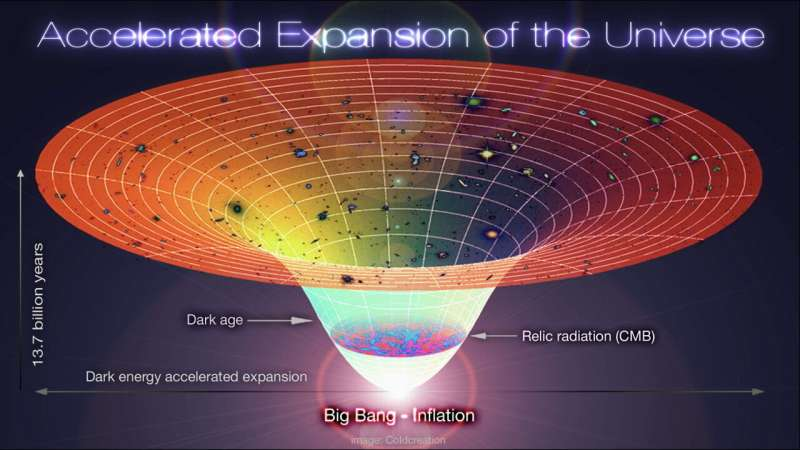
What they found instead was the opposite: the universe’s expansion was accelerating.
There wasn’t nearly enough matter to cause this acceleration. In fact, even the matter that did exist was insufficient to slow down the expansion as much as expected.
The simplest and most natural explanation was to revive the old term Λ, now interpreted as dark energy — a mysterious, pervasive energy with a repulsive gravitational effect.
This discovery fundamentally changed cosmology, earning its discoverers the 2011 Nobel Prize in Physics.
The Rise of the Standard Model of Cosmology
During the 1980s and 1990s, physicists built a comprehensive cosmological framework sometimes proudly called the Standard Model of Cosmology. It described matter, cosmic evolution, and structure formation with impressive accuracy.
But the 1998 discovery forced scientists to discard that model.
In its place came the current leading framework: ΛCDM cosmology.
- Λ (Lambda) represents dark energy, assumed to be constant throughout space and time.
- CDM (Cold Dark Matter) refers to a form of unseen matter that gravitationally dominates galaxies and large-scale structures.
ΛCDM is beloved for being both simple and extraordinarily effective. With just a few free parameters, it explains:
- the expansion history of the universe
- the cosmic microwave background (CMB) patterns
- baryon acoustic oscillations (BAO)
- galaxy formation
- large-scale cosmic structure
It is one of the most precisely tested models in science — and, paradoxically, almost certainly wrong, because it idealizes components (dark energy and dark matter) that we still don’t fully understand.
Why ΛCDM Might Not Be the Final Word
Although ΛCDM has been remarkably successful, scientists recognize its limits.
One major issue is the actual nature of dark energy. If it is simply a constant energy of empty space, why does it have the value we measure? The theory of quantum fields predicts a vacuum energy far larger than observed — a huge discrepancy.
Some researchers propose that dark energy may not be a constant at all. Instead, it might be a dynamic field, sometimes called quintessence, that changes over time.
This would mean:
- cosmic acceleration is not fixed
- the effect of dark energy may strengthen or weaken
- the ultimate fate of the universe could be very different
Modern surveys, such as DESI (Dark Energy Spectroscopic Instrument), have even hinted that dark energy may have evolved over cosmic time — a subtle but potentially revolutionary observation.
If confirmed, it would mean ΛCDM requires major revision.
What Dark Energy Means for the Universe
Dark energy influences nearly everything on cosmological scales:
- It determines how fast space expands.
- It shapes galaxy distribution across billions of light-years.
- It affects the growth of large-scale structure.
- It even dictates the future of the cosmos.
If dark energy remains constant, the universe will expand forever, becoming colder, emptier, and quieter with time.
If dark energy changes, then the universe’s future becomes uncertain — ranging from slowing expansion to potential collapse.
In short, dark energy isn’t just a theoretical curiosity. It is the dominant force steering the entire universe.
What We Still Don’t Know
Even after decades of study, dark energy remains one of the biggest mysteries in physics. We still lack answers to questions like:
- What exactly is dark energy?
- Why does it have its particular density?
- Has it changed over cosmic time?
- Is Λ simply a mathematical convenience, or a real property of spacetime?
- Are we misinterpreting gravity itself?
These questions continue to drive research, debate, and new observations.
The Bottom Line
Dark energy has fundamentally reshaped cosmology twice — first when Einstein introduced Λ, and again when astronomers discovered the universe’s accelerating expansion. Today, it remains both a practical necessity in cosmological equations and a profound mystery that challenges our understanding of physics.
As powerful new telescopes and sky surveys gather data, scientists expect more surprises. Dark energy may soon force another revolution in how we understand the universe.