How Quiet Galaxies Stay Quiet as Cool Gas Feeds Black Holes in Red Geysers
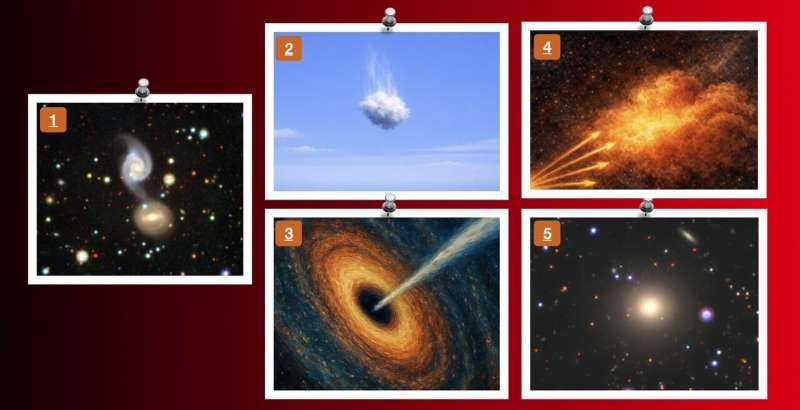
Astronomers have spent decades trying to understand a strange contradiction in the universe: some massive galaxies stop forming stars and remain quiet for billions of years, even though they still contain gas that should, at least in theory, be able to spark new star formation. A new study focusing on a rare class of galaxies known as red geysers offers some of the clearest evidence yet for how this long-term dormancy is maintained.
At the center of this explanation is a surprisingly gentle process. Instead of violent explosions or dramatic gas blowouts, these galaxies appear to rely on slow, organized flows of cool gas that feed their central supermassive black holes. That black hole activity then produces just enough energy to keep star formation shut down without destroying the galaxy’s gas supply.
What Makes Red Geyser Galaxies So Unusual
Red geysers are a small but intriguing population of galaxies. They account for only 6–8% of nearby quiescent galaxies, meaning most inactive galaxies do not show the same features. These systems were first identified using data from the Sloan Digital Sky Survey’s Mapping Nearby Galaxies at Apache Point Observatory (SDSS-IV MaNGA) project.
What sets red geysers apart is the presence of large-scale outflows of ionized gas. These outflows stretch across tens of thousands of light-years and appear even though the galaxies themselves are no longer forming stars. The winds are faint and extended, not explosive, suggesting a persistent but relatively mild energy source rather than a one-time event.
Astronomers have long suspected that these winds are connected to activity from supermassive black holes at the centers of the galaxies. The real mystery has been how those black holes continue to get fuel in galaxies that otherwise appear quiet and stable.
Tracking Cool Gas Across Entire Galaxies
To answer that question, the research team analyzed 140 red geyser galaxies observed by the MaNGA survey. MaNGA is especially powerful because it provides spatially resolved spectroscopy, allowing scientists to map how gas and stars move across an entire galaxy instead of relying on a single central measurement.
The focus of the analysis was on a spectral feature known as the sodium D (Na I D) absorption line. This feature is a reliable tracer of cool, neutral gas with temperatures between 100 and 1,000 kelvin, much cooler than the hot ionized gas often associated with black hole-driven winds.
By modeling this absorption across each galaxy, the researchers measured both the speed of the gas and how random or ordered its motion was.
Slow, Orderly Inflows Instead of Chaos
The results were striking. Instead of swirling turbulently or rapidly falling inward, most of the cool gas in red geysers is drifting slowly toward the galaxy’s center at an average speed of about 47 kilometers per second. That is only around 10% of the speed expected for free-falling gas under gravity.
Even more interesting is how calm the motion appears. The cool gas shows much weaker random motion than the surrounding stars, meaning it is flowing in a coherent, organized way rather than being violently stirred or disrupted. This behavior is very different from the chaotic gas flows often seen in star-forming galaxies or during major galactic collisions.
Together, these findings suggest that the gas is being carefully funneled inward, creating a steady supply of material that can reach the central black hole without triggering new star formation along the way.
A Direct Link to Black Hole Activity
The study also found a clear connection between these gas inflows and ongoing black hole activity. Around 30% of the red geysers in the sample were detected at radio wavelengths, which is a strong indicator of active supermassive black holes.
In those radio-detected galaxies, the amount of inflowing cool gas was significantly larger. Specifically, the projected area covered by inflowing gas was about one-third greater than in red geysers without radio emission. This strongly suggests that the cool gas is directly involved in feeding and sustaining black hole activity.
Rather than short, dramatic feeding events, the evidence points to a long-lasting, low-level fueling process that keeps the black hole active over extended timescales.
Why Galaxy Interactions Matter
Environment turned out to be another crucial factor. Red geysers that show signs of interactions with nearby galaxies or evidence of past minor mergers contain far more inflowing cool gas than isolated systems.
In interacting galaxies, the area covered by infalling gas is, on average, 2.5 times larger than in red geysers that appear to be alone. This indicates that minor mergers and close encounters are highly effective at delivering fresh gas into these systems.
Importantly, these interactions do not necessarily trigger starbursts. Instead, they seem to provide just enough gas to replenish the black hole’s fuel supply, allowing the galaxy to remain quiet while still maintaining internal activity.
How Black Hole Feedback Keeps Star Formation Shut Down
All of these observations support a self-regulating cycle operating within red geyser galaxies. Cool gas arrives through interactions or internal processes and slowly migrates inward. As it reaches the central regions, it feeds the supermassive black hole.
The black hole then releases energy back into the galaxy in the form of gentle feedback, heating surrounding gas and preventing it from cooling enough to collapse into new stars. This feedback is strong enough to suppress star formation but not violent enough to expel all the gas.
Over time, this balance allows massive galaxies to stay red and dormant, even though they still contain the raw ingredients for star formation.
Why This Matters for Galaxy Evolution
These findings have broader implications beyond red geysers alone. Astronomers have long known that many massive galaxies stop forming stars early in their lives and remain inactive for most of cosmic history. This study provides direct observational evidence for one way that long-term quiescence can be maintained.
Instead of relying on dramatic, one-time events, galaxies may stay quiet through slow, persistent processes that link gas dynamics, black hole activity, and environmental effects. Large surveys like MaNGA are making it possible to observe these subtle mechanisms in action for the first time.
Extra Context: Cool Gas, AGN, and Quenching
Cool gas plays a central role in galaxy evolution. In star-forming galaxies, it collapses into dense clouds that eventually ignite new stars. In quiescent galaxies, however, something interferes with that process. Active galactic nuclei (AGN), powered by supermassive black holes, are one of the leading candidates for this interference.
AGN feedback comes in many forms, from powerful jets to gentle heating. Red geysers appear to represent a low-energy feedback mode, where the black hole continuously injects just enough energy to keep gas from settling into star-forming regions. This makes them an important laboratory for understanding how galaxies age gracefully rather than violently shutting down.
Research paper: https://arxiv.org/abs/2501.XXXXX