Hubble Nets a Menagerie of Young Stellar Objects in the Star-Forming Region NGC 1333
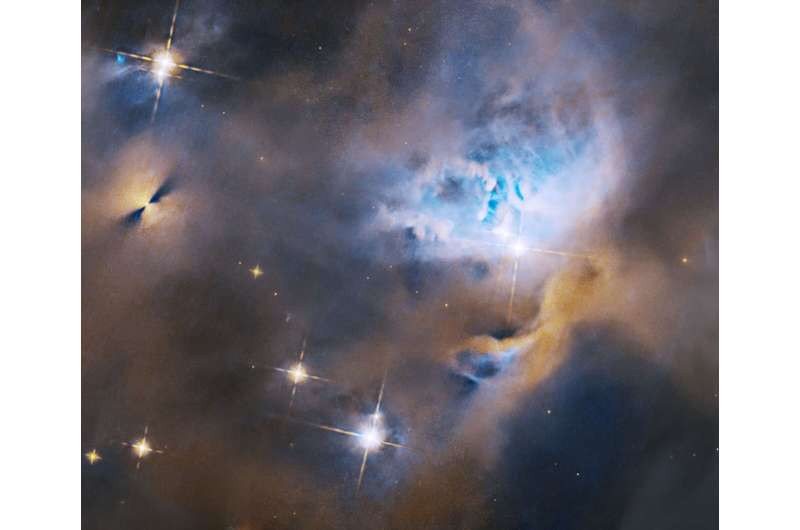
NASA’s Hubble Space Telescope has once again delivered a remarkably detailed look into the process of star formation, this time focusing on the lively stellar nursery known as NGC 1333. Located within the Perseus molecular cloud, this region sits about 950 light-years from Earth and is packed with stars in their earliest and most dynamic stages of life. The newly released image brings together a wide range of young stellar objects, revealing how chaotic, beautiful, and complex the birth of stars can be.
At first glance, the image looks like a richly textured cosmic painting. But every glow, shadow, and streak of light tells a precise scientific story about how stars and planetary systems take shape from clouds of gas and dust.
A Protostar and Its Planet-Forming Disk
On the left side of the image, Hubble captures an actively forming star known as a protostar. This object has not yet reached the stage where it can sustain hydrogen fusion in its core, but it is already influencing its surroundings in dramatic ways. The protostar illuminates nearby gas and dust, producing a glowing reflection nebula that acts like a cosmic spotlight on the star’s immediate environment.
One of the most striking features here is the presence of two dark stripes flanking the bright central point. These are not gaps or empty space. Instead, they mark a protoplanetary disk and its shadow. This disk is made of rotating gas and dust that slowly feeds material onto the growing star. Over time, this same disk may give rise to planets, moons, and other small bodies.
The disk’s shadow stretches across the surrounding envelope of material, offering astronomers a rare opportunity to study how light interacts with dense circumstellar matter. Interestingly, scientists still do not know exactly where the disk ends and the shadow begins, highlighting how much there is still to learn even from such detailed observations.
Outflow Cavities and a Fan-Shaped Nebula
Moving toward the center-right of the image, another dramatic structure comes into view: an outflow cavity carved into the surrounding molecular cloud. This cavity reveals a fan-shaped reflection nebula, created when starlight scatters off dust particles inside the hollowed-out region.
At the base of this structure are two young stars, HBC 340 and HBC 341. These stars are actively shaping their environment through stellar winds, which are steady flows of particles streaming away from their surfaces. Over time, these winds have pushed aside surrounding gas and dust, clearing out the cavity and allowing light to escape and illuminate the nebula.
Reflection nebulae like this one do not generate their own light. Instead, they shine because nearby stars scatter and reflect light off interstellar dust. This makes them valuable tools for tracing the structure and composition of star-forming regions.
Stars That Refuse to Stay the Same
One especially fascinating aspect of this nebula is that it does not shine at a constant brightness. Astronomers have observed that the reflection nebula near HBC 340 and HBC 341 fluctuates in brightness over time. These changes are linked to variations in the stars themselves, with HBC 340 identified as the main driver of the observed variability.
Both HBC 340 and HBC 341 belong to a class known as Orion variable stars. These are young stars that change brightness in irregular and unpredictable ways. The variability is thought to be caused by processes such as stellar flares, changes in accretion rates, or episodic ejections of material from the stellar surface.
The name “Orion variable” comes from the fact that these stars are often found in diffuse nebulae like the Orion Nebula, although they appear in other star-forming regions as well. Over time, as these stars mature and stabilize, they eventually evolve into non-variable stars.
In this Hubble image, Orion variables are not limited to just the central pair. Four beaming stars near the bottom of the image and another in the top right corner also belong to this energetic and unpredictable category, adding to the overall sense of motion and activity within NGC 1333.
A Crowded Nursery of Young Stars
Beyond the highlighted features, the rest of the image is filled with numerous other young stellar objects embedded throughout the cloudscape. Some are deeply shrouded in dust, while others are beginning to break free from their natal material. Together, they form a snapshot of stellar evolution at multiple stages, all coexisting within the same region.
NGC 1333 is particularly valuable to astronomers because it hosts stars that are very young on cosmic timescales, often just a few million years old or less. This makes it an ideal laboratory for studying how stars interact with their surroundings during their formative years.
Why NGC 1333 Matters to Astronomy
Star-forming regions like NGC 1333 help scientists answer fundamental questions about how stars and planetary systems form. By observing protostars, disks, and outflows in a single environment, researchers can compare different evolutionary stages under similar conditions.
Hubble’s sharp vision allows astronomers to examine circumstellar disks, track stellar winds, and study how young stars sculpt their surroundings. These processes play a critical role in determining whether a star ends up with planets, how massive those planets might be, and where they form within the disk.
NGC 1333 has also been observed by other telescopes, including infrared observatories, which can peer through dust that blocks visible light. When combined with Hubble’s data, these observations provide a more complete picture of star formation across multiple wavelengths.
The Role of Hubble in Modern Astronomy
Even decades after its launch, the Hubble Space Telescope continues to be a cornerstone of astrophysical research. Images like this one are not just visually stunning; they are packed with data that astronomers use to test models of stellar evolution and refine our understanding of the universe.
Hubble’s ability to resolve fine details in distant nebulae makes it especially powerful for studying regions like NGC 1333, where small-scale structures hold clues to large-scale cosmic processes.
Looking Ahead
As newer observatories continue to explore star-forming regions in different wavelengths, Hubble’s observations remain a critical reference point. Together, these instruments are helping astronomers piece together the full life cycle of stars, from collapsing clouds of gas to fully formed planetary systems.
This latest image of NGC 1333 serves as a reminder that star formation is not a quiet or orderly process. It is dynamic, messy, and constantly changing, shaped by gravity, radiation, and powerful stellar winds. And thanks to Hubble, we get to witness these early chapters of stellar life in extraordinary detail.
Research reference:
https://iopscience.iop.org/article/10.1088/0004-637X/808/1/50