Hubble Observes a Ghostly Cloud That Is Surprisingly Alive With Star Formation
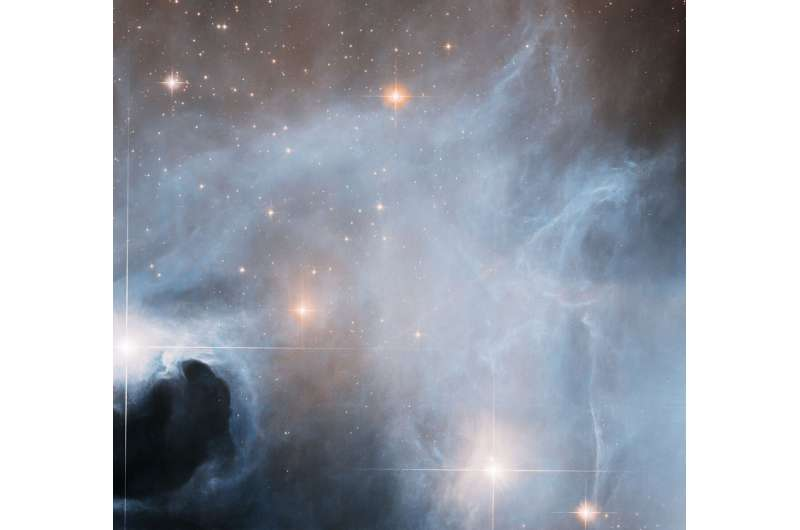
The NASA Hubble Space Telescope has once again delivered an image that looks more like cosmic art than hard science. At first glance, this newly released image appears calm, pale, and almost ghost-like. But look closer, and the scene tells a very different story. This is Lupus 3, a dense star-forming cloud where new stars are actively being born, hidden behind layers of gas and dust.
Lupus 3 lies about 500 light-years away from Earth in the constellation Scorpius. Although it appears serene and misty, astronomers know this region is anything but quiet. Behind the softly glowing gas and dark dust lanes is a busy stellar nursery filled with young stars, turbulent material, and powerful stellar winds shaping the environment.
A Closer Look at the Ghostly Landscape
The Hubble image reveals white, wispy gas structures drifting through the cloud, giving the scene its eerie, almost supernatural appearance. In sharp contrast, a dark dust cloud dominates the lower-left portion of the image, blocking visible light and obscuring what lies behind it.
Scattered throughout this cloudy landscape are bright points of light, which astronomers have identified as young stellar objects. Among them are several T Tauri stars, clearly visible at the left edge, the bottom right, and near the upper center of the image. These stars are key to understanding why Lupus 3 is such an important region for astronomers.
What Makes T Tauri Stars So Important
T Tauri stars represent a very early stage of stellar evolution. They are stars that have recently formed but have not yet entered the stable phase of their lives known as the main sequence. Typically, these stars are less than 10 million years old, making them cosmic infants by astronomical standards.
At this stage, a T Tauri star is still surrounded by leftover gas and dust from the cloud that formed it. Over time, this material begins to disperse due to radiation, stellar winds, and energetic outflows from the young star. These processes help clear the surrounding environment, eventually allowing the star to shine more clearly.
One of the defining features of T Tauri stars is their unpredictable brightness. Astronomers observe both random and periodic variations in their light output. The causes of these changes are well understood and reveal a lot about what is happening around and within these young stars.
Why Young Stars Flicker and Vary in Brightness
The random brightness variations seen in T Tauri stars are often linked to instabilities in their accretion disks. These disks are made of gas and dust that slowly spiral inward, feeding material onto the growing star. When clumps of material fall onto the star’s surface, they release energy, causing sudden changes in brightness.
In addition, stellar flares—powerful bursts of energy on the star’s surface—can temporarily increase brightness. These flares are far more intense than those seen on our Sun today.
The periodic changes, on the other hand, are usually caused by giant sunspots. These enormous dark regions rotate in and out of view as the star spins, creating a regular pattern in the star’s brightness. Observing these cycles helps astronomers measure rotation speeds and magnetic activity in young stars.
From Protostar to Main Sequence Star
T Tauri stars are still contracting under the force of gravity. As they shrink, their cores slowly heat up. Eventually, once the core becomes hot and dense enough, hydrogen fusion begins, marking the star’s arrival on the main sequence—the long, stable phase where stars spend most of their lives.
By studying regions like Lupus 3, astronomers gain direct insight into how stars form, grow, and stabilize. These observations also help scientists understand how planetary systems may form around young stars, since planets emerge from the same disks of gas and dust.
The Lupus Molecular Cloud Complex
Lupus 3 is part of the larger Lupus molecular cloud complex, a nearby collection of dark clouds known for active star formation. Molecular clouds like these are composed mainly of cold hydrogen molecules, along with heavier elements and dust grains.
These clouds appear dark in visible light because their dense dust blocks background stars. However, instruments like Hubble can still capture stunning details by observing how light interacts with the edges of the clouds and the stars embedded within them.
Because Lupus is relatively close to Earth, it offers astronomers an excellent opportunity to study star formation up close, compared to more distant regions of the galaxy.
How Hubble Captured This Image
The image was captured by the NASA/ESA Hubble Space Telescope, using instruments designed to observe fine details in cosmic structures. The observation highlights how young stars sculpt their surroundings, carving cavities in the gas and dust through radiation and stellar winds.
The image credits include NASA, ESA, and Karl Stapelfeldt of the Jet Propulsion Laboratory, with image processing by Gladys Kober of NASA and the Catholic University of America. Image processing plays a crucial role in bringing out subtle details while remaining faithful to the scientific data.
Why Observations Like This Matter
Images like this are more than visually striking—they are scientific tools. They allow astronomers to test theories of star formation, study how stellar environments evolve, and compare different star-forming regions across the galaxy.
Understanding how stars like our Sun formed helps answer broader questions about the origins of planetary systems, including our own. Regions such as Lupus 3 provide snapshots of processes that shaped the solar system billions of years ago.
Hubble’s Continuing Legacy
Decades after its launch, Hubble continues to deliver groundbreaking science and breathtaking imagery. Observations like this remind us that even the most peaceful-looking regions of space can hide extraordinary activity.
What appears to be a ghostly cloud is, in reality, a place where new stars are emerging, shaping the future of the galaxy one stellar birth at a time.
Research reference:
NASA Hubble Space Telescope observation of the Lupus 3 star-forming region
https://science.nasa.gov/missions/hubble/hubble-observes-ghostly-cloud-alive-with-star-formation/