Hubble Reveals the Largest and Most Chaotic Planet-Birthing Disk Ever Observed
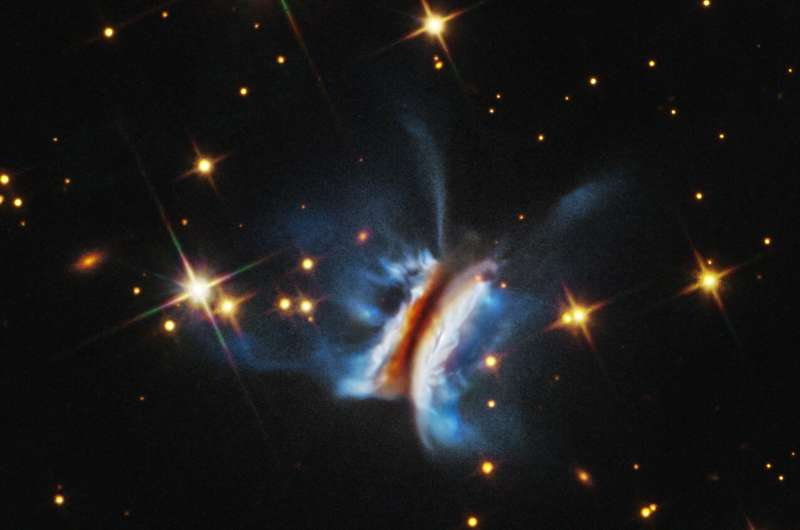
NASA’s Hubble Space Telescope has once again pushed the boundaries of what we know about the universe by revealing the largest protoplanetary disk ever observed around a young star. Officially cataloged as IRAS 23077+6707 and informally nicknamed “Dracula’s Chivito,” this enormous structure is giving astronomers an unprecedented look at how planets may form in extreme and highly dynamic environments.
Located roughly 1,000 light-years from Earth, this planet-forming disk spans nearly 400 billion miles from end to end. To put that into perspective, it is about 40 times the diameter of our solar system, measured out to the Kuiper Belt. Not only does this make it the largest known disk of its kind, but it also places it in a category of its own when it comes to size, structure, and complexity.
What makes this discovery especially remarkable is that Hubble captured the disk in visible light, allowing scientists to observe details that are often hidden in infrared or radio observations. These new images reveal that the disk is not calm or neatly layered, but instead chaotic, turbulent, and highly asymmetric, challenging long-standing assumptions about how planet-forming disks behave.
A Disk That Blocks Its Own Star
IRAS 23077+6707 is observed nearly edge-on, meaning the disk is tilted in such a way that it blocks direct light from the central object. As a result, the young star itself is completely obscured from view. Astronomers believe that the hidden object could be a single hot, massive star or possibly a pair of stars, still deeply embedded within the surrounding gas and dust.
The edge-on orientation gives the disk a striking appearance. A thick, dark band of dust runs through the center, flanked above and below by glowing layers of gas and fine particles that reflect starlight. This visual structure has often been compared to a hamburger, with the dark dust lane acting as the patty and the glowing layers resembling the bun.
Unprecedented Chaos and Asymmetry
What truly sets this disk apart from others is the level of disorder and vertical complexity revealed by Hubble. Bright wisps and filament-like structures extend far above and below the main plane of the disk, reaching heights never before seen in similar systems.
Even more puzzling is the disk’s extreme asymmetry. These towering filaments appear only on one side of the disk, while the opposite side looks comparatively smooth, sharply edged, and almost devoid of similar features. This lopsided appearance has surprised astronomers and suggests that powerful and uneven processes are shaping the disk.
Possible explanations include recent infall of gas and dust, interactions with nearby material in the surrounding interstellar environment, or internal instabilities driven by gravity, radiation, or magnetic fields. Whatever the cause, it is clear that this disk is far from static.
A Massive Reservoir for Planet Formation
Beyond its size and structure, IRAS 23077+6707 stands out for its immense mass. Scientists estimate that the disk contains material equivalent to 10 to 30 times the mass of Jupiter. This makes it one of the most massive planet-forming disks ever identified.
Such a large reservoir of gas and dust means the system has the potential to form multiple giant planets, possibly even more massive or numerous than those found in our own solar system. While planet formation in such an extreme environment may differ in scale, astronomers believe the core physical processes remain fundamentally similar to those that shaped Earth and its planetary neighbors billions of years ago.
Why This Discovery Matters
All planetary systems begin their lives in disks like this one. Over time, gas spirals inward and accretes onto the central star, while dust grains collide, stick together, and gradually grow into planetesimals and, eventually, full-fledged planets. Observing a disk at this scale and level of detail allows scientists to test and refine models of how planets form, migrate, and evolve.
IRAS 23077+6707 may represent a scaled-up version of the early solar system, offering a rare opportunity to study planet formation under conditions that push theoretical limits. The disk’s size, mass, and chaotic structure make it an ideal natural laboratory for understanding how planetary systems emerge in diverse environments across the galaxy.
The Meaning Behind “Dracula’s Chivito”
The disk’s unusual nickname adds a lighthearted cultural touch to a serious scientific discovery. The name “Dracula’s Chivito” reflects the backgrounds of the researchers involved. One of the scientists has roots in Transylvania, famously associated with Dracula, while another comes from Uruguay, where a popular national dish is the chivito, a hearty sandwich. Combined with the disk’s hamburger-like appearance, the nickname stuck.
How Hubble Made This Possible
Hubble’s ability to capture this disk in visible light is key to the discovery. While telescopes like the James Webb Space Telescope have observed similar structures in infrared wavelengths, Hubble’s sharp optical vision allows astronomers to trace fine details in the disk’s surface layers, especially the vertical filaments and asymmetries.
By observing how light scatters off dust grains, scientists can infer information about particle size, density, and motion, offering clues about the physical processes at work within the disk.
What This Tells Us About Planet Formation
The discovery of such a massive and chaotic disk reinforces the idea that planet formation is not always a gentle, orderly process. Instead, it can involve turbulence, uneven accretion, and dramatic structural changes over time. Studying systems like IRAS 23077+6707 helps astronomers understand the full range of conditions under which planets can form, including those far more extreme than our own cosmic neighborhood.
As Hubble continues to observe the universe alongside newer missions, discoveries like this remind us that planetary systems come in many shapes and sizes—and that our solar system may be just one example among countless variations.
Research Paper:
https://doi.org/10.3847/1538-4357/ae247f