Hubble Zooms In on the “Lost Galaxy” and Reveals Thousands of Young Star Clusters
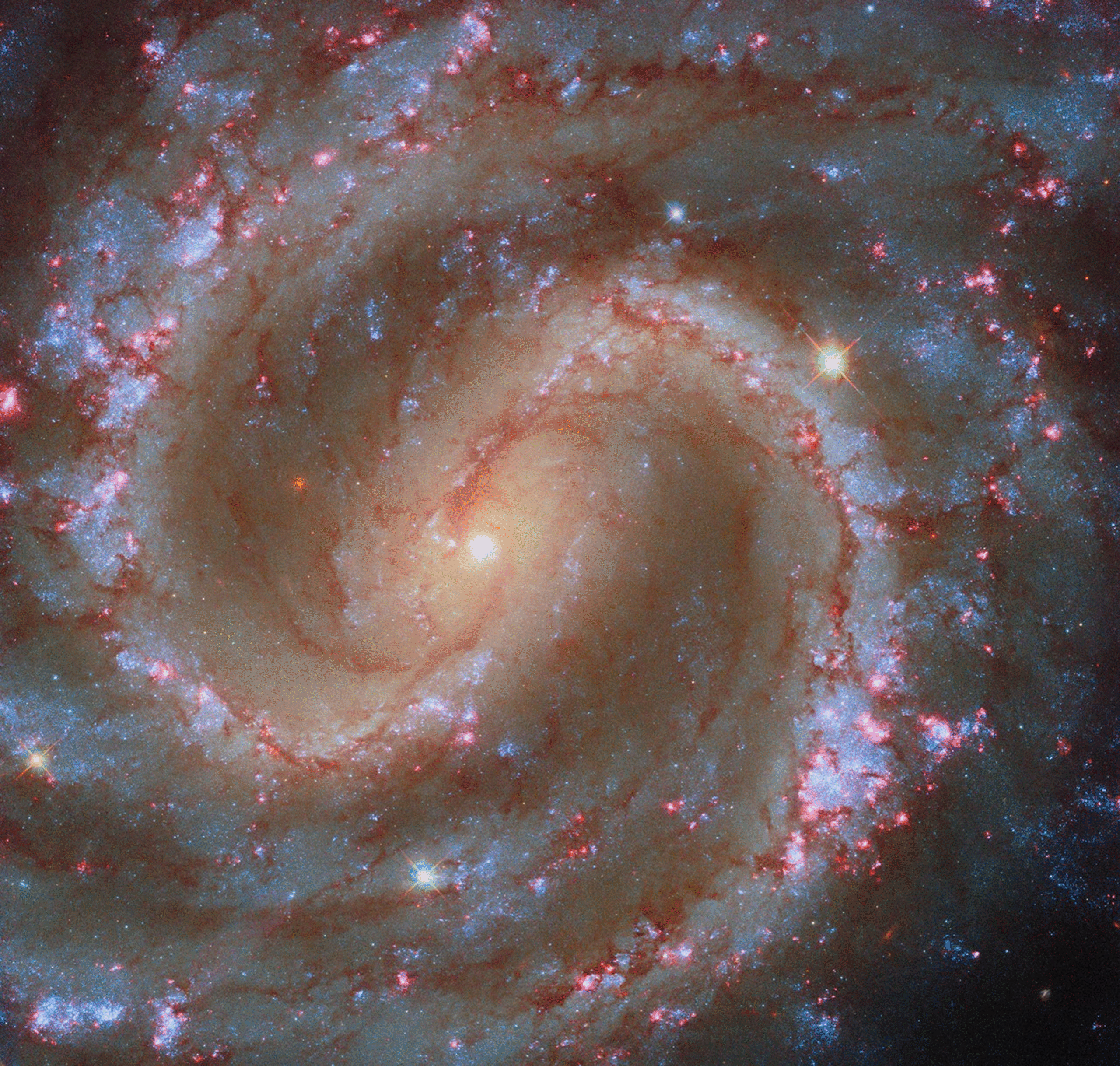
The NASA/ESA Hubble Space Telescope has once again delivered a stunning and scientifically rich image, this time focusing on a faint spiral galaxy known as NGC 4535, often nicknamed the “Lost Galaxy.” Located roughly 50 million light-years away in the constellation Virgo, this galaxy has long been difficult to observe from Earth using small telescopes. But Hubble’s powerful vision has transformed it from a barely noticeable smudge into a detailed cosmic landscape filled with young stars, glowing gas clouds, and clues about how galaxies grow and evolve.
NGC 4535 earned its “Lost Galaxy” nickname because of its low surface brightness. While it is actually a large barred spiral galaxy, its light is spread thinly across space, making it appear faint and elusive to amateur astronomers. Hubble, with its 2.4-meter (nearly eight-foot) mirror and its position above Earth’s atmosphere, has no such trouble observing galaxies like this. Free from atmospheric distortion and light pollution, the telescope can easily pick out subtle details that ground-based instruments miss.
The newly released image highlights young star clusters scattered along NGC 4535’s sweeping spiral arms. These clusters appear as bright blue groupings of stars, standing out sharply against the darker background of the galaxy. Surrounding many of these clusters are pink and red glowing clouds of gas, which immediately catch the eye and signal something important is happening there.
These glowing clouds are known as H II regions. Despite the name, there is no “H two” molecule involved. Instead, the term refers to ionized hydrogen, gas that has been energized by intense radiation from newly formed stars. These regions are clear markers of ongoing or very recent star formation. When massive, hot stars are born, they emit enormous amounts of ultraviolet radiation, which strips electrons from nearby hydrogen atoms. The result is gas that glows brightly in characteristic red and pink wavelengths.
The stars responsible for lighting up these H II regions are young, massive, and short-lived. They burn through their nuclear fuel quickly, produce strong stellar winds, and dramatically shape their surroundings. Over time, many of these stars will end their lives in supernova explosions, scattering heavy elements across the galaxy and influencing future generations of star formation. By observing these regions, astronomers can study not just where stars are forming, but how they interact with and transform their environment.
This Hubble image is part of a much larger scientific effort known as PHANGS, short for Physics at High Angular Resolution in Nearby GalaxieS. PHANGS is an ambitious international observing program that combines data from multiple telescopes, including Hubble, the Atacama Large Millimeter/submillimeter Array (ALMA), and other ground-based observatories. The goal is to understand the connection between cold gas, star formation, and galaxy structure in unprecedented detail.
One of the key objectives of the PHANGS-HST project is to catalog roughly 50,000 H II regions across dozens of nearby star-forming galaxies. NGC 4535 is one of those galaxies, making it an important piece of a much larger cosmic puzzle. By studying many galaxies in a uniform way, scientists can compare how star formation behaves in different environments, from tightly wound spirals to more diffuse, low-brightness systems like the “Lost Galaxy.”
Hubble had already observed NGC 4535 before. A previous image released in 2021 showed the galaxy in impressive detail, revealing its spiral structure and central bar. However, the newly released image adds an important new dimension. By incorporating specific filters sensitive to the light emitted by ionized hydrogen, this version captures the brilliant red glow of nebulae surrounding massive stars during their first few million years of life. This allows astronomers to more precisely pinpoint active star-forming regions and study their properties.
NGC 4535 itself is a fascinating galaxy beyond its faint appearance. It is classified as a barred spiral galaxy, meaning it has a linear bar of stars running through its center, from which its spiral arms extend. It is also a member of the Virgo Cluster, a massive collection of galaxies that dominates our local region of the universe. Studying galaxies within clusters like Virgo helps astronomers understand how interactions with neighboring galaxies and the cluster environment influence star formation and galactic evolution.
Hubble’s view of NGC 4535 clearly shows how organized and structured star formation can be, even in a galaxy that appears ghostly and hard to find from Earth. The spiral arms act as stellar nurseries, compressing gas and triggering the birth of new stars as they rotate around the galaxy’s center. The presence of numerous bright H II regions indicates that NGC 4535 is still actively forming stars and is far from being a quiet or dormant system.
Why Hubble Is Still So Important
Even decades after its launch, the Hubble Space Telescope remains one of the most valuable tools in astronomy. Its ability to observe in visible, ultraviolet, and near-infrared light makes it uniquely suited for studying star formation. In images like this one, Hubble bridges the gap between observations of cold gas, seen by radio telescopes, and the mature stellar populations observed in other wavelengths.
Hubble’s sharp resolution allows astronomers to resolve individual star clusters in galaxies millions of light-years away. This is essential for understanding how stars form in groups, how long these clusters survive, and how they contribute to the overall structure of a galaxy. Without Hubble, many of these details would be blurred together, hiding critical information about galactic life cycles.
A Closer Look at H II Regions
H II regions are more than just visually striking features. They are fundamental laboratories for astrophysics. By studying their size, brightness, and chemical composition, astronomers can estimate the ages of star clusters, measure the rate of star formation, and track how elements like oxygen and nitrogen are distributed throughout a galaxy. Over time, these measurements help build a clearer picture of how galaxies enrich themselves with heavy elements and evolve across cosmic time.
In NGC 4535, the sheer number of visible H II regions suggests a galaxy that is quietly but steadily producing new stars. It may be faint to our eyes, but it is far from inactive.
Putting the “Lost Galaxy” Back on the Map
Images like this do more than look beautiful. They restore attention to galaxies that might otherwise be overlooked. NGC 4535 is not rare or exotic, but it represents a class of galaxies that are underrepresented in detailed studies because of observational challenges. By bringing these systems into sharp focus, Hubble and the PHANGS program are helping astronomers build a more complete and unbiased understanding of the nearby universe.
The latest image of the “Lost Galaxy” is a reminder that even the faintest objects can hold rich scientific rewards when viewed with the right tools. What once seemed lost is now revealing its secrets, cluster by cluster, nebula by nebula.
Research reference:
PHANGS-HST Survey Overview and Data Analysis Paper – https://arxiv.org/abs/2101.02855