Inside the Massive Radio Search That Confirmed Our Newest Interstellar Visitor 3I/ATLAS Is Natural
The discovery of an interstellar object passing through our solar system is rare enough to spark excitement on its own. When that object is the third confirmed interstellar visitor ever detected, curiosity naturally runs high. That curiosity quickly turns into speculation, especially in the age of social media and rapid headlines. This is exactly what happened with 3I/ATLAS, an interstellar object discovered in mid-2025. While most astronomers identified it as a natural comet early on, the scientific community still took the idea of artificial origin seriously enough to investigate it thoroughly.
At the center of that investigation was a large-scale radio search designed to answer a simple but fascinating question: was 3I/ATLAS emitting any artificial radio signals that might suggest a technological origin?
What Is 3I/ATLAS and Why It Matters
3I/ATLAS was discovered in July 2025 by the ATLAS survey, which is designed to spot near-Earth objects. Follow-up observations quickly showed that the object was traveling on a hyperbolic trajectory, meaning it did not originate in our solar system. This placed it in the same category as 1I/‘Oumuamua (2017) and 2I/Borisov (2019), the only other known interstellar visitors observed so far.
Optical and infrared telescopes soon revealed familiar comet-like behavior. Astronomers detected a coma, signs of water outgassing, and measured a rotational period of about 16.8 hours. All of these features strongly pointed toward a natural origin. Still, given the unusual history of speculation surrounding ‘Oumuamua, researchers decided to be extra cautious with 3I/ATLAS.
That caution led to one of the most detailed radio technosignature searches ever conducted on an interstellar object.
The Allen Telescope Array and Its Recent Upgrade
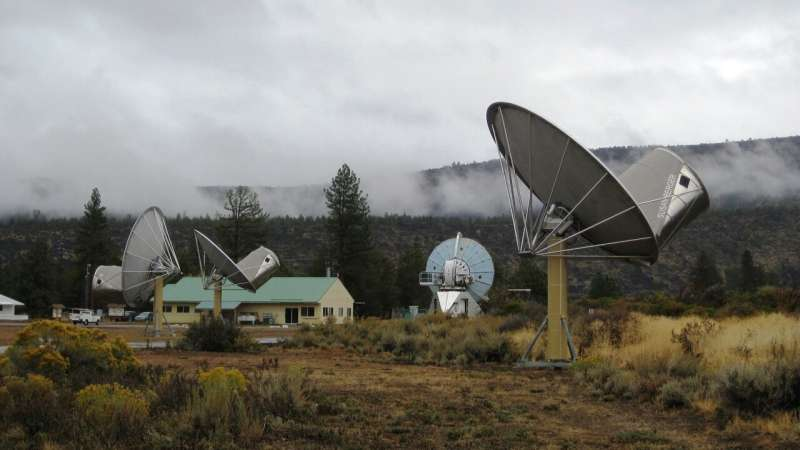
The primary instrument used for this search was the Allen Telescope Array (ATA) in California. The ATA is one of the world’s most capable radio observatories when it comes to searching for narrowband radio signals that could indicate technology.
Importantly, the ATA had recently undergone a major upgrade before observing 3I/ATLAS. The telescope was fitted with new Antonio feeds, named after Franklin Antonio, the founder of Qualcomm and a key donor to the upgrade project. These feeds are cryogenically cooled receivers that significantly improve the telescope’s signal-to-noise ratio across a wide range of frequencies.
This upgrade allowed the ATA to monitor radio signals across a massive 1–12 GHz frequency range, which includes many bands commonly used by human technology, such as the 2.4 GHz Wi-Fi and phone band.
How the Radio Search Was Conducted
The ATA observed 3I/ATLAS for a total of 7.25 hours, spread across five separate sessions in July 2025, shortly after the object’s discovery. The goal was not to listen for loud, obvious broadcasts, but to search for narrowband radio signals, the kind most likely to stand out against natural cosmic noise if they were artificial.
Thanks to the improved sensitivity of the new receivers, the telescope detected an overwhelming number of potential signals—more than 70 million. Most of these, however, were expected to be interference from Earth-based technology.
To handle this enormous dataset, the research team used a sophisticated filtering system known as the Breakthrough Listen Interesting Signal Search (bliss) algorithm.
Filtering Out the Noise
The filtering process happened in several stages. First, signals in frequency bands heavily polluted by human activity—such as GPS, satellites, and other known communication systems—were removed. This alone eliminated the majority of candidates.
Next, the team applied a more advanced filter that looked for signals matching the expected acceleration and Doppler shift of 3I/ATLAS as it moved through space. This was a new capability of the bliss pipeline and helped ensure that any remaining signals were consistent with the object’s motion, not stationary transmitters on or near Earth.
Finally, researchers checked whether the signals were actually coming from the exact region of the sky where 3I/ATLAS was located at the time of observation.
After all of this filtering, the original pool of over 70 million signals was reduced to just 211 candidates.
The Final Verdict: A Clear Null Result
Each of the remaining 211 signals was manually inspected by human researchers. In every case, the signals were traced back to Earth-based radio frequency interference that had slipped through the automated filters.
The result was a clear and definitive null detection. No artificial radio technosignatures were found coming from 3I/ATLAS.
That null result, however, came with carefully calculated limits. The researchers estimated the minimum transmitter power that would have been detectable at different frequencies. At 1 GHz, a signal would need to be around 10 watts to be detected. At 9 GHz, that threshold rose to about 110 watts.
To put that in perspective, 10 watts is only about five times the power of a typical mobile phone. Any civilization capable of deliberately sending an object between star systems would almost certainly be able to transmit at far higher power levels.
Independent Confirmation from Other Observatories
The Allen Telescope Array was not alone in observing 3I/ATLAS. Other major facilities around the world were also tracking the object.
Most notably, the Green Bank Telescope (GBT) in West Virginia conducted its own radio observations with even higher sensitivity. The GBT team reported that their data ruled out transmitters with power levels as low as 10 percent of a modern cell phone.
Additional observations from facilities such as MeerKAT in South Africa and the Vera C. Rubin Observatory in Chile reinforced the same conclusion. Across radio, optical, and infrared wavelengths, 3I/ATLAS consistently behaved like a normal, naturally formed interstellar comet.
Why These Searches Still Matter
Even though no technosignatures were found, studies like this are far from wasted effort. Interstellar objects offer a rare opportunity to study material formed around other stars, giving scientists direct insight into planetary systems beyond our own.
These searches also help refine the methods and tools used in SETI research. Each null result improves filtering algorithms, data pipelines, and observational strategies, making future searches more effective.
As astronomical surveys become more powerful, especially with next-generation facilities coming online, astronomers expect to detect interstellar visitors more frequently. When that happens, the techniques tested on 3I/ATLAS will be ready.
A Natural Object, Still Scientifically Valuable
While 3I/ATLAS has now been firmly established as a natural interstellar comet, it remains an object of intense scientific interest. As it continues its journey out of the solar system and back into interstellar space, astronomers will keep observing it whenever possible.
The takeaway is clear: no alien technology was found, but the investigation itself represents one of the most thorough and careful examinations of an interstellar object to date. In science, ruling out extraordinary claims with solid evidence is just as important as confirming them.
Research paper: https://arxiv.org/abs/2512.18142