James Webb Space Telescope Finds Bizarre Early Galaxies That Defy Classification
Astronomers using the James Webb Space Telescope (JWST) have stumbled upon something genuinely strange in the early universe: a small group of galaxies that refuse to fit neatly into any existing category. These objects are so unusual that researchers have nicknamed them “Astronomy’s Platypus”—a reference to the famously odd animal that blends traits from different branches of evolution.
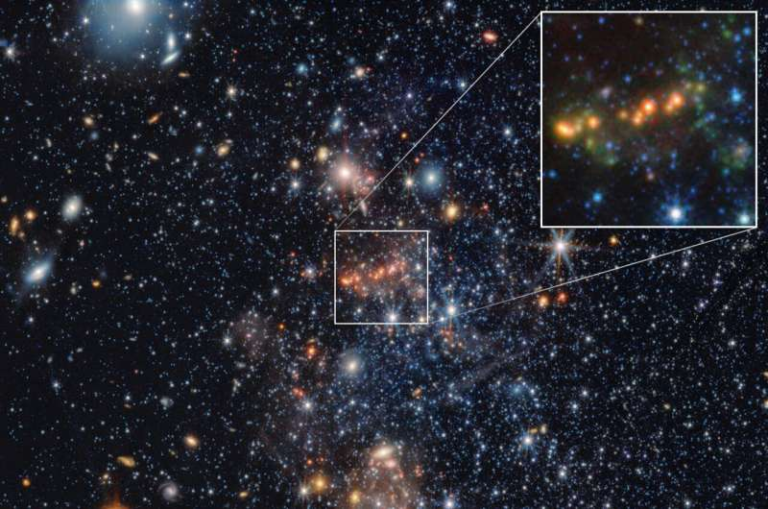
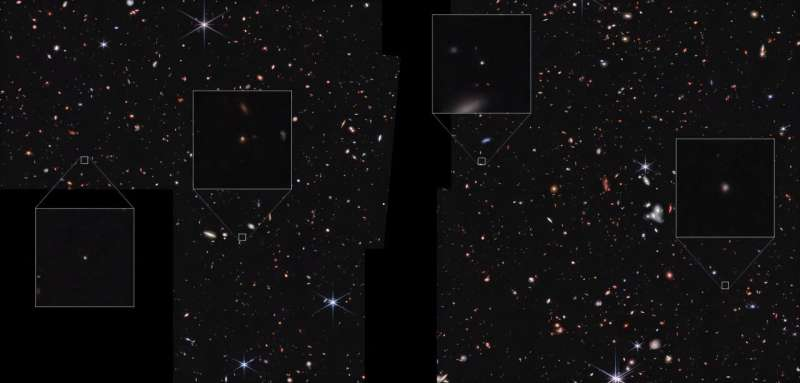
The discovery includes nine distant objects that look like simple points of light but behave nothing like the point-like objects astronomers are used to studying. Found deep in JWST survey data, these galaxies challenge long-standing ideas about how galaxies form, evolve, and light up the early universe.
A Discovery Hidden in Plain Sight
The objects were identified while researchers were analyzing data from three major JWST observing programs: the Cosmic Evolution Early Release Science Survey (CEERS), the Ultra Deep Survey (UDS), and the Cosmic Evolution Survey (COSMOS). These surveys were not specifically designed to find oddball galaxies. Instead, they were broad, deep looks at the universe intended to capture everything from stars to galaxies to quasars.
From an initial pool of about 2,000 point-like sources, the research team isolated nine objects that stood out. These sources date back to a time 12 to 12.6 billion years ago, meaning we are seeing them as they existed when the universe was still very young.
What immediately caught attention was their appearance. In JWST images, they look like unresolved points of light—similar to distant stars or quasars. But when astronomers examined their spectra, the light they emit at different wavelengths, things stopped making sense.
Why These Objects Are So Confusing
Normally, distant point-like sources fall into familiar categories. They are often quasars, powered by supermassive black holes, or occasionally compact stars within our own galaxy. These newly identified objects are clearly not stars, as they are far too distant.
At first glance, quasars might seem like the obvious explanation. However, quasar spectra have a defining feature: broad emission lines, caused by gas moving at extreme speeds around a supermassive black hole. The spectra from these nine objects are the opposite. They show narrow emission lines, indicating much slower gas motion.
This combination—point-like shape with narrow spectral lines—is almost unheard of.
They are also too dim to be typical quasars, which are among the brightest objects in the universe. Their brightness levels simply do not match what astronomers expect from actively feeding black holes at such distances.
Not Quite Quasars, Not Quite Galaxies
The researchers explored whether these objects could be a known type of active galactic nucleus (AGN). There are narrow-line AGN, but these usually appear as extended galaxies, not compact point sources. If these objects belong to the AGN family, they would represent an entirely new subclass, possibly low-luminosity, nearly hostless AGN embedded in extremely faint galaxies.
Another possibility is that these objects are star-forming galaxies. Their spectral signatures can be consistent with active star formation, and similar narrow emission lines are seen in some compact galaxies. However, there is a major issue here as well: their size.
Even with JWST’s extraordinary resolution, these galaxies appear extremely tiny and compact. If they are star-forming galaxies, they must be very young, likely less than 200 million years old. That raises an intriguing but troubling question: how can such small galaxies form stars actively while remaining so compact and orderly?
If this interpretation is correct, these objects may represent an early and quiet phase of galaxy formation, occurring before violent mergers and chaotic growth take over. This is a process astronomers have not clearly observed before.
A New Population Emerges
Because none of the existing explanations fully work, the researchers believe they are likely seeing a new population of galaxies altogether. These “platypus” objects combine features that normally do not coexist, forcing scientists to rethink some assumptions about the early universe.
Their discovery was presented at the 247th meeting of the American Astronomical Society in Phoenix, and the findings are detailed in a research paper titled “A New Population of Point-like, Narrow-line Objects Revealed by the James Webb Space Telescope.”
At this stage, the scientists are careful not to overcommit to a single explanation. Instead, they emphasize uncertainty—and curiosity. What is clear is that these objects do not comfortably belong to any known category.
Why JWST Is Uniquely Suited for This Discovery
This finding highlights exactly why JWST was built. Previous telescopes simply did not have the sensitivity or resolution to detect such faint, compact objects at these distances. JWST’s ability to capture both high-quality images and detailed spectra allows astronomers to identify subtle mismatches between appearance and physical behavior.
Without JWST, these objects would likely have been dismissed as unremarkable points of light or missed entirely.
What Comes Next
To understand these objects properly, astronomers need two things: more data and better data. The current sample includes only nine confirmed objects, which is far too small to draw firm conclusions.
Future work will focus on:
- Finding more examples of these point-like, narrow-line objects in JWST surveys
- Obtaining higher-resolution spectra to measure gas motions and chemical composition more precisely
- Determining whether black holes are present and how much they contribute to the observed light
Medium-resolution spectroscopy will be especially important for distinguishing between AGN activity and star formation.
What This Means for Galaxy Formation
If these objects turn out to be extremely young star-forming galaxies, they could represent building blocks of larger galaxies, forming in a surprisingly calm and compact way. If they are AGN, they may reveal a previously unseen phase of black hole growth in the early universe.
Either way, they remind astronomers that the early universe was more diverse and creative than many models predict.
Just as the platypus once confused biologists by blending traits from different animals, these galaxies are blending characteristics that should not exist together—yet clearly do.
The Bigger Picture
JWST continues to reveal that our cosmic classifications are far from complete. Each strange discovery forces scientists to refine theories, run new simulations, and ask better questions. These “Astronomy’s Platypus” objects may eventually become a well-understood class, or they may open the door to entirely new physics.
For now, they serve as a powerful reminder that the universe still holds surprises, even in data that was never meant to look for them.
Research paper:
https://arxiv.org/abs/2509.12177