James Webb Space Telescope Reveals a Star-Forming Embrace Between Two Interacting Dwarf Galaxies
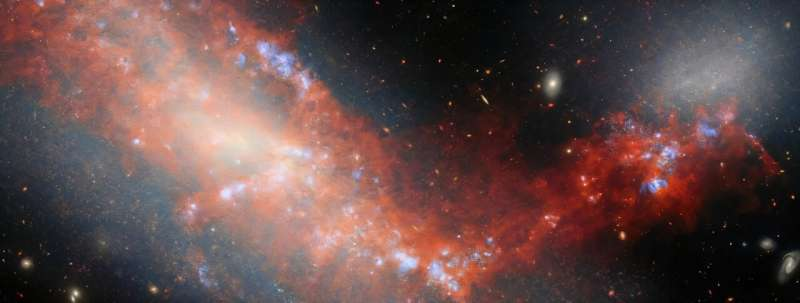
The James Webb Space Telescope has delivered another striking and scientifically rich observation, this time focusing on a close pair of dwarf galaxies known as NGC 4490 and NGC 4485. Together called Arp 269, these two galaxies are caught in the act of interacting, exchanging gas, and forming new stars. Located about 24–26 million light-years away, this system offers astronomers one of the clearest nearby examples of how small galaxies influence each other during early stages of a merger.
The image, selected as the ESA/JWST Picture of the Month, is more than just visually impressive. It is part of a detailed scientific investigation that uses Webb’s powerful infrared instruments to uncover the galaxies’ structure, stellar populations, and interaction history in unprecedented detail.
A Close and Unusual Pair of Dwarf Galaxies
NGC 4490 and NGC 4485 are classified as late-type dwarf galaxies, meaning they are relatively small, rich in gas, and actively forming stars. Excluding the Magellanic Clouds near the Milky Way, this pair is considered the closest known interacting dwarf–dwarf galaxy system, at a distance of roughly 7.4 megaparsecs.
Although astronomers identified these galaxies decades ago, many of their finer details remained hidden. Around 30 years ago, radio observations revealed a faint bridge of gas connecting them, suggesting a past gravitational encounter. However, even powerful telescopes like Hubble could not resolve enough individual stars to reconstruct what had actually happened between the two galaxies.
That limitation changed dramatically with the launch of the James Webb Space Telescope.
Why Webb Makes Such a Difference
JWST’s strength lies in its ability to observe the universe in infrared light, allowing it to see through thick clouds of dust and gas that block visible wavelengths. In the case of Arp 269, Webb’s NIRCam instrument resolved individual stars across both galaxies and along the gas bridge connecting them.
Using a combination of filters—F115W (blue), F200W (green), and F444W (red)—astronomers produced a composite image that highlights different physical components. In these images, red regions trace warm dust, often associated with star formation, while blue and green areas reveal stellar populations of different ages.
The result is a clear view of a tidal bridge of gas and stars stretching from NGC 4485 into the disk of NGC 4490, filled with young star clusters and dust-rich regions actively forming new stars.
Mapping the Stellar Populations in Detail
A key goal of the study was to identify and analyze the stellar populations within the system. By constructing near-infrared color–magnitude diagrams, researchers were able to classify stars by age and evolutionary stage.
The data revealed a remarkably diverse mix of stars:
- Young main-sequence stars less than 200 million years old
- Intermediate-age stars, including asymptotic giant branch (AGB) stars
- Old red giant stars, representing populations more than a billion years old
This wide age range shows that both galaxies have been forming stars over long periods, not just during their recent interaction.
Two Major Bursts of Star Formation
One of the most important findings is the identification of two distinct bursts of star formation. The first began around 200 million years ago, a timeframe that matches predictions from N-body simulations for the galaxies’ most recent close encounter, known as a pericenter passage.
The second burst started about 30 million years ago and is especially prominent along the gas bridge and within parts of NGC 4490. This later episode appears to be directly linked to gas that was stripped from the smaller galaxy and then compressed during the interaction.
These bursts provide strong evidence that gravitational encounters between dwarf galaxies can actively trigger star formation, even without the presence of a massive galaxy nearby.
Gas Stripping, Mixing, and Metallicity
Another crucial piece of the puzzle comes from studying metallicity, which measures the abundance of elements heavier than hydrogen and helium. Younger stars forming in the bridge show a clear metallicity gradient, meaning their chemical composition changes depending on location.
This pattern strongly supports a scenario where metal-poor gas was stripped from NGC 4485 during the encounter and then mixed with the more metal-rich gas of NGC 4490. The combined gas later collapsed to form new stars, particularly along the connecting bridge and in the main body of NGC 4490.
This kind of gas mixing is a fundamental process in galaxy evolution and is now being observed in exceptional detail thanks to Webb.
Understanding Galaxy Growth Through Dwarfs
Dwarf galaxies play a central role in modern theories of galaxy formation. Large galaxies like the Milky Way are thought to have grown through hierarchical mergers, beginning with small, gas-rich systems billions of years ago.
Because ancient galaxies were also low-mass and metal-poor, interacting dwarf galaxies in the nearby universe serve as living analogues of those early cosmic building blocks. Systems like NGC 4490 and NGC 4485 allow astronomers to study these processes close to home, rather than relying solely on distant and faint early-universe observations.
A Unique Laboratory for Future Research
The researchers emphasize that this study represents only the first step in fully analyzing the JWST data. Other teams are already examining the system using different approaches, including simulations and studies of the interstellar medium.
Together with other recent JWST observations of nearby galaxies, this work demonstrates how Webb’s capabilities far exceed those of previous infrared telescopes. For the first time, astronomers can connect detailed stellar histories, gas dynamics, and chemical evolution within dwarf galaxy interactions.
NGC 4490 and NGC 4485 now stand out as a benchmark system for understanding how tidal interactions shape star formation and chemical enrichment in small galaxies.
Why This Discovery Matters
Beyond its scientific importance, this observation highlights JWST’s ability to deliver images that are both visually stunning and deeply informative. The glowing bridge of gas, dotted with young stars, is a clear reminder that galaxy evolution is an ongoing and dynamic process—even in the nearby universe.
As astronomers continue to mine this dataset, Arp 269 will likely remain a key reference point for studies of dwarf galaxy mergers and the fundamental processes that build galaxies over cosmic time.
Research Reference:
Giacomo Bortolini et al., FEAST: JWST/NIRCam View of the Resolved Stellar Populations of the Interacting Dwarf Galaxies NGC 4485 and NGC 4490, The Astrophysical Journal (2025).
https://doi.org/10.3847/1538-4357/adfccc