James Webb Space Telescope Reveals Dwarf Stars and Hidden Worlds Inside the Glittering Westerlund 2 Cluster
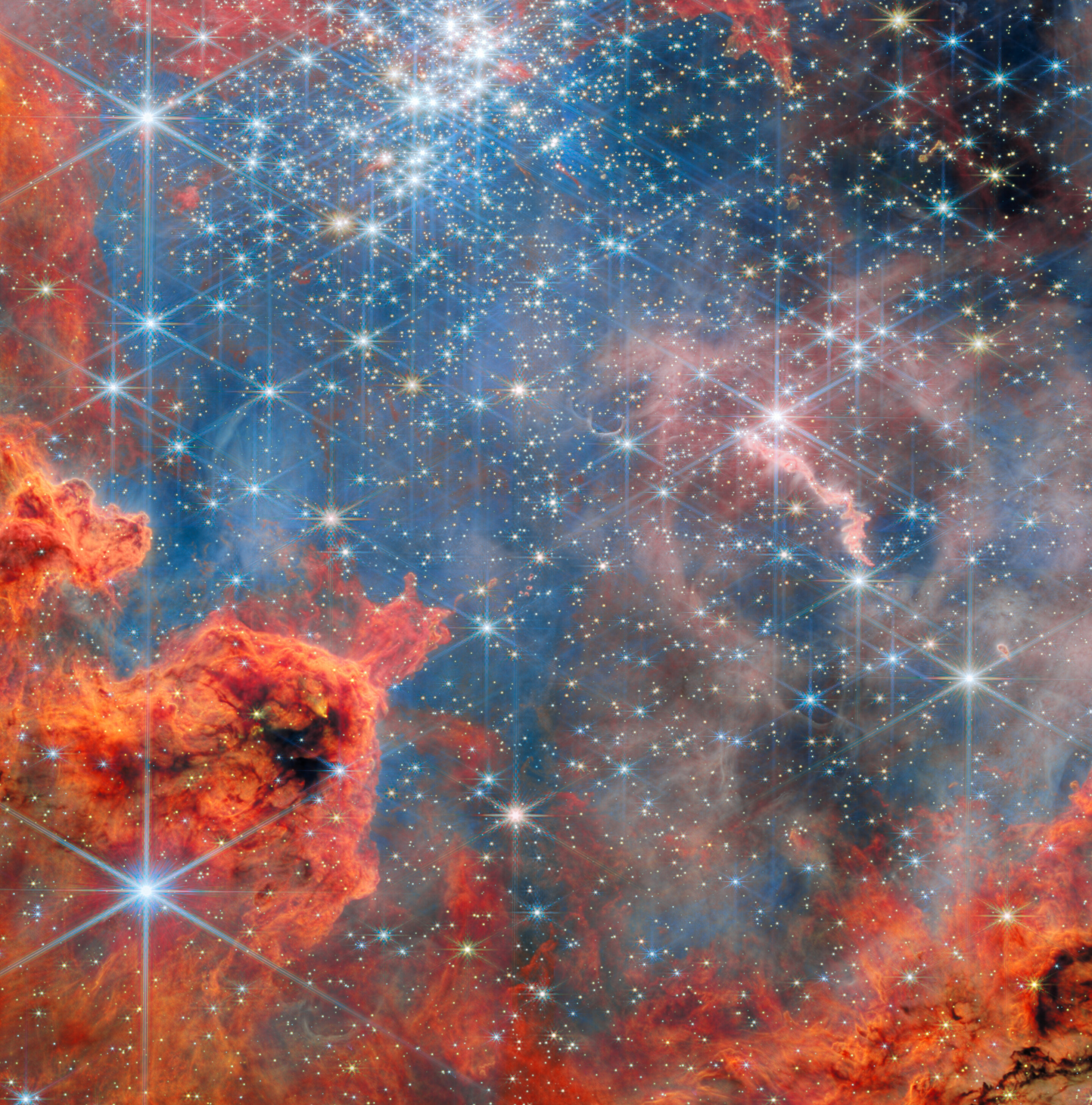
The James Webb Space Telescope (JWST) has closed out 2025 with a spectacular cosmic reveal: a richly detailed view of the Westerlund 2 star cluster, uncovering not only massive, blazing stars but also an unexpectedly large population of brown dwarfs—some of the smallest and faintest objects ever detected in such a hostile stellar environment. Released as the final ESA/Webb Picture of the Month for 2025, this image is both visually striking and scientifically important, offering astronomers a deeper understanding of how stars and planets form in extreme conditions.
A Stellar Nursery 20,000 Light-Years Away
Westerlund 2 is located roughly 20,000 light-years from Earth in the constellation Carina, also known as the Keel. It sits inside a glowing cloud of gas and dust called Gum 29, a well-known stellar breeding ground within our Milky Way galaxy. This region is a textbook example of a young, massive star cluster, with an estimated age of just 1 to 2 million years—remarkably young in cosmic terms.
The cluster spans between 6 and 13 light-years across and is packed with some of the hottest, brightest, and most massive stars known in our galaxy. These stars emit enormous amounts of ultraviolet radiation, which actively reshapes the surrounding nebula, carving out cavities, walls, and filaments in the gas and dust around them.
Westerlund 2 is not new to fame. It was previously chosen as the Hubble Space Telescope’s 25th anniversary image in 2015, but Webb’s infrared vision now reveals layers of detail that Hubble simply could not see.
How Webb Captured This Image
This new image combines data from two of Webb’s most powerful instruments: the Near-Infrared Camera (NIRCam) and the Mid-Infrared Instrument (MIRI). Together, these instruments allow Webb to peer through thick veils of dust that block visible light, exposing stars and structures that were previously hidden.
At the top of the image lies the dense core of Westerlund 2, glowing intensely with young, massive stars. Their radiation dominates the scene, shaping everything around them. Below and around this core, swirling clouds of orange and red gas form sculpted walls and tangled structures, pushed and eroded by stellar winds and radiation. Softer blue and pink wisps trace thinner material drifting between denser clouds, adding depth and complexity to the image.
Scattered throughout the field are also numerous foreground stars, much closer to Earth. These stars are easy to spot thanks to their sharp, star-shaped diffraction spikes—an optical signature produced by Webb’s telescope design rather than the stars themselves.
A Hidden Population of Brown Dwarfs
The most important scientific breakthrough from these observations is the first-ever complete census of brown dwarfs in a massive young cluster like Westerlund 2. Brown dwarfs are often described as “failed stars.” They form like stars but never gather enough mass to sustain hydrogen fusion in their cores.
Using Webb’s extreme sensitivity, astronomers identified brown dwarfs with masses as low as 10 times the mass of Jupiter. Detecting such small objects at a distance of 20,000 light-years is an extraordinary technical achievement and highlights why Webb is such a game-changer for astronomy.
This discovery is particularly surprising because Westerlund 2 is an intense and violent environment, dominated by massive stars whose radiation was thought to suppress the formation of low-mass objects. Webb’s findings show that even in these extreme regions, nature still finds a way to form tiny, faint bodies.
Hundreds of Stars With Planet-Forming Disks
Beyond brown dwarfs, the data also reveal several hundred young stars surrounded by disks of gas and dust. These disks are the raw material from which planets eventually form. Importantly, the disks are seen in various evolutionary stages, giving astronomers a rare opportunity to study how disks change over time in a high-radiation environment.
Understanding disk evolution in clusters like Westerlund 2 is crucial. Most stars in the Milky Way, including the Sun, are believed to form in clusters. By studying extreme clusters, scientists can test how radiation, stellar winds, and crowding affect the chances of planet formation.
Why Westerlund 2 Is So Scientifically Valuable
Massive clusters like Westerlund 2 serve as natural laboratories for studying star formation under pressure. The presence of enormous stars means strong ultraviolet radiation, powerful winds, and shock fronts—all factors that can both trigger and disrupt the birth of new stars.
The new Webb image captures this balance beautifully. You can see dense gas being compressed into new stars in some areas, while in others, radiation has cleared out cavities, effectively shutting down further star formation. This ongoing interaction drives what astronomers call the cycle of star birth and destruction within galaxies.
Webb’s Broader Role in Star Formation Studies
Webb’s ability to detect faint infrared signals allows it to study objects that were once invisible, including brown dwarfs, protostars, and deeply embedded disks. Compared to earlier telescopes, Webb can measure these populations more completely, helping astronomers refine models of how stars form across a wide range of masses.
In the case of Westerlund 2, Webb’s observations challenge long-standing assumptions that low-mass objects struggle to form near massive stars. Instead, the cluster shows a surprisingly rich and diverse population, from enormous stellar giants to Jupiter-sized substellar bodies.
The Survey Behind the Image
These observations were conducted as part of Webb program #3523, led by M. Guarcello, under the Extended Westerlund 1 and 2 Open Clusters Survey (EWOCS). This large survey aims to systematically study young, massive clusters to better understand how stellar populations develop in extreme environments.
By combining detailed imaging with population analysis, EWOCS is helping astronomers connect the dots between star formation, disk evolution, and planet formation on a cluster-wide scale.
Why This Image Matters Beyond Astronomy
Beyond its scientific impact, the image is a reminder of Webb’s role as both a research instrument and a cultural icon. Its ability to turn raw data into visually stunning portraits helps bring complex astrophysical processes to the public in a way that is both accessible and inspiring.
As the final ESA/Webb Picture of the Month for 2025, this image of Westerlund 2 feels like a fitting conclusion to another year of discovery—one that underscores how much remains hidden in our galaxy, waiting for the right tools to reveal it.
Research Reference:
https://arxiv.org/search/?query=Guarcello+EWOCS+Westerlund+2&searchtype=all